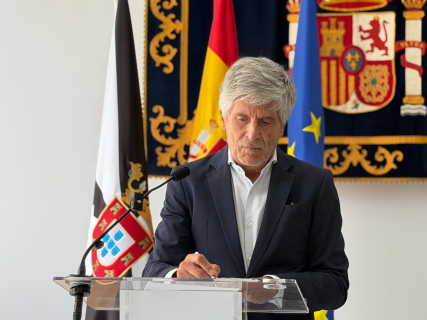
The PP intensifies its offensive against the Government over the migration crisis and again summons Marlaska to the Senate on August 20.

The popular ones request again to enable August so that the Minister of the Interior appears in the Interior Commission after he did not attend the call of this week.

3 minutes

fotonoticia 20260813153236 1920

fotonoticia 20260813153236 1920

Add DEMÓCRATA to Google

Ask FREN

Published

Last updated

3 minutes

Most read

The Popular Party in the Senate will again summon the Minister of the Interior, Fernando Grande-Marlaska, to appear regarding the migratory crisis in Ceuta next Thursday, August 20, according to sources from Genoa to DEMÓCRATA.

The Populars will again request to enable the month of August to convene and hold the appearance of the Interior Minister in the Interior Commission of the Upper House, after Marlaska did not attend the meeting held this week.

The PP maintains that the minister must provide explanations in the Senate and rejects that the Executive can decide in which Chamber its members appear. Marlaska had already indicated that he planned to provide explanations about the situation in Ceuta in Congress at the end of August.

The PP summons Marlaska again after his absence

The new summons comes after Marlaska did not appear this Wednesday before the Interior Commission of the Senate, an absence that provoked criticism from the groups that participated in the session. The PP, which has an absolute majority in the Upper House, even staged the minister's absence with a photograph around his empty chair.

Now, popular sources inform DEMÓCRATA that they will summon the minister again for Thursday, August 20. The PP describes his previous absence as a sign of the "cowardice and incompetence of the entire Government" and reproaches the president, Pedro Sánchez, for remaining on vacation during the crisis.

The Populars also criticize the plans of Marlaska, the Minister of Foreign Affairs, José Manuel Albares, and the Minister of Defense, Margarita Robles, to provide explanations in Congress. "From the PP we will not allow them to choose where to provide explanations because the emergency in Ceuta cannot wait," the consulted sources maintain.

Robles communicated this week to the president of the Senate that she would also not appear on the initially scheduled date in the Upper House and expressed her willingness to do so during the next ordinary session period.

The PP defends the obligation to appear in the Senate

The Popular Group maintains that the Senate must continue to exercise its function of parliamentary control and defends that Marlaska is obliged to attend when required by the Chamber.

The controversy over the appearances arises after the PP promoted a modification of the Senate Regulations aimed at strengthening the obligation of government members to attend the Upper House when summoned. The Executive, for its part, has defended that its ministers can provide the corresponding explanations in Congress and has questioned the need to duplicate appearances in both chambers.

However, the PP considers that the situation in Ceuta justifies that Marlaska appears specifically before the Senate Interior Commission and will reactivate the procedure to hold the session during the non-working period of August.

The popular party attacks the management of the Ceuta crisis

The PP again holds the Government responsible for the management of the irregular entry recorded at the end of July and claims that the Executive ignored prior warnings.

The popular party speaks of "an avalanche of nearly 80,000 people" and asserts that thousands of migrants still remain in Ceuta. These statements are part of the political assessment conveyed by the PP. The figures regarding the magnitude of the entry and how many people currently remain in the city have varied over the past two weeks.

The border situation continues to be monitored in light of the calls spread on social media to attempt new crossings coinciding with August 15. Morocco has reinforced its deployment in the area of Fnideq, while Spain maintains a large police presence in Ceuta.

The PP also maintains that Ceuta and Melilla constitute the southern border of Europe and demands a response from the Executive in line with the national and European dimension of the crisis.

More key points, information and questions with FREN

AI-GENERATED CONTENT

What is the exact parliamentary process for the appearance of ministers in the Senate and what procedures remain for Marlaska to appear on August 20?

The appearances of Government members in the Senate are structured based on the Constitution (art. 66.2 and 110 CE) and the Senate Rules of Procedure. In summary, any Chamber or committee can request the presence of ministers, but the specific procedure and the development of the debate differ depending on whether the appearance is before the Plenary or before a committee. Regarding the case of Fernando Grande-Marlaska, as of August 14, 2026, there is no closed institutional call for August 20: the PP has politically announced that date, but the official Senate agendas do not yet show a session scheduled for that day.

1. General procedure for appearances in the Senate

1.1. Who can request the appearance
  • Before the committees (for example, Interior):
    • Usually at the initiative of one or more parliamentary groups or a minimum number of senators, who register a written request.
    • In investigative committees, the Rules (art. 60) and Organic Law 5/1984 allow requiring the presence of “any person,” including ministers.
  • Before the Plenary:
    • The Rules (art. 182) establish that the President of the Government will appear at his own request or by agreement of the Board of Spokespersons, at the initiative of two groups or a relevant fraction of senators.
    • For other members of the Government, the same article provides that, at their own request or by agreement of the Board of Spokespersons, they may appear before the Plenary.
1.2. Qualification and agreements of the Board / Board of Spokespersons
  • The registered request is sent to the Senate Board, which qualifies it (checks that it complies with the Constitution and the Rules).
  • If admitted, it is sent to the competent committee or the Plenary and, when appropriate, the Board of Spokespersons is consulted to fit it into the calendar.
  • In periods like August, the Board may agree to enable the month to hold extraordinary committee sessions, as has been done with Interior, Defense, and Foreign Affairs.
1.3. Setting the date, agenda, and possible accumulations
  • The Senate Board or the committee Board set:
    • The date and time of the session.
    • The inclusion of the appearance in the official agenda.
  • Several appearances can be accumulated in the same session (for example, several ministers on the same issue) or rescheduled through new Board agreements.
  • The call and agenda are published on the Senate website and, if applicable, in the Official Bulletin of the General Courts (Senate Section).
1.4. Development of the debate on the day of the session
  • In ordinary committee:
    • Initial intervention by the minister, usually without a strict time limit, explaining the subject of the appearance.
    • Turns of the group spokespeople or designated senators, in order set by the Presidency.
    • Reply by the Government member and, if authorized by the Presidency, second rounds of reply and counter-reply.
  • In the Plenary (art. 182):
    • Initial oral presentation (President of the Government or minister).
    • Intervention of the spokespeople of each group: the Rules provide, for the President of the Government, 20 minutes per group in the first turn and a possible shorter second turn; for other members of the Government, shorter times but with a similar scheme.
    • The Presidency of the Senate, after hearing the Board of Spokespersons, may open a second round of replies (for example, 10 or 5 minutes).

2. Situation of Marlaska's appearance on August 20

According to the newspaper Demócrata, the PP has announced that, using its absolute majority, it has set for Thursday, August 20 a new session of the Interior Committee of the Senate “in which it again demands the presence of Minister Fernando Grande-Marlaska” due to the Ceuta crisis, along with José Manuel Albares and Margarita Robles. This information is based on a planned agenda to which Europa Press would have had access.

However, with the parliamentary data specifically consulted for 08/20/2026, the Senate agenda returns the status “no events scheduled” for that date: neither Plenary nor committee is convened that day, nor is there an agreement of the Board or the Board of Spokespersons that has formally set that session or its agenda.

From this it follows that, as of August 14:

  • The appearance on August 20 is politically announced by the PP, but it does not yet appear as a convened session in the official Senate sources.
  • The following are not published:
    • A Board agreement specifying session and date for that appearance.
    • The formal call of the Interior Committee for the 20th with Marlaska's presence on the agenda.
2.1. Procedures remaining, if it is desired that he appear on the 20th
  • That the Senate Board or, if applicable, the Interior Committee Board adopt the agreement to convene a session on August 20.
  • That the official agenda including the appearance of the Minister of the Interior (and, if applicable, other ministers) be approved and published.
  • That the Presidency of the Senate or the committee issue the formal summons to the Government.

Until these steps are reflected on the website and in the Chamber's bulletins, the appearance on August 20 must be considered, legally, not yet convened, although the PP has set it as a political objective and publicly announced the date.

What are the specific powers and functions of the Minister of the Interior in managing migratory crises according to Spanish legislation?

In the Spanish legal system, there is no “migratory crisis law” that concentrates all the functions of the Minister of the Interior, but several norms articulate a set of powers that, combined, make him a central figure in managing mass entries or migratory tension situations. The main ones are Organic Law 4/2000 (immigration), Organic Law 4/2015 (citizen security), Law 17/2015 (National Civil Protection System), Law 36/2015 (National Security), Law 50/1997 (Government), and the organic structure regulations of the Ministry of the Interior.

1. Political direction and general coordination of the Interior scope

Law 50/1997, of the Government, establishes generally that ministers direct the department, promote and execute Government policy in their scope, and exercise regulatory and management powers over dependent services. Applied to the Interior, this means that, in a migratory crisis, the minister:

  • Sets guidelines for the National Police and Civil Guard on border control, identification, and custody of persons arriving irregularly.
  • Coordinates the actions of government delegations and sub-delegations in affected territories (Ceuta, Melilla, Canary Islands, Andalusia, etc.).
  • Proposes to the Government specific norms and plans (royal decrees, Council of Ministers agreements) to respond to the crisis.
2. Border control, entries, and exits

Organic Law 4/2000, on the rights and freedoms of foreigners, assigns Interior a key role in controlling entries and exits:

  • It can, in an exceptional and motivated manner, impose individual measures for public security reasons, such as periodic presentation requirements or border distancing (the minister of the Interior's competence to agree on these in sanctioning procedures is expressly provided).
  • It is recognized that exits can be recorded for control of stay and that, exceptionally, the minister can prohibit leaving Spanish territory for national security or public health reasons.
  • Interior directs the procedures of return, repatriation, and expulsion, in close connection with border police and foreigner internment centers.

The same law also provides that the Minister of the Interior recognizes stateless status and documents foreigners who cannot be documented by any country, when humanitarian reasons, public interest, or international commitments concur, which is relevant when the migratory crisis involves groups without clear national protection.

3. Public order, citizen security, and border rejection

Organic Law 4/2015, on citizen security protection, configures the framework for the action of Security Forces and Corps in public spaces and in managing gatherings, disturbances, or risk situations. In a migratory crisis, this translates into the minister:

  • Directs the security police acting in port areas, border crossings, provisional stay centers, and CIE (Foreigner Internment Centers).
  • Orders measures such as controls, passage restrictions, evictions, or evacuations when there are serious security risks.
  • Is part of the “border rejection” regime specific to Ceuta and Melilla, interpreted by the Constitutional Court, which applies precisely in mass entry scenarios and requires safeguards of fundamental rights.
4. Civil protection emergencies linked to the massive arrival of people

Law 17/2015, of the National Civil Protection System, dedicates a title to the powers of the General State Administration and reinforces the powers of the Minister of the Interior as “senior authority” in civil protection:

  • The law contemplates national interest emergencies in which the Minister of the Interior assumes operational direction from the National Emergency Monitoring and Coordination Center of Civil Protection, integrating regional centers.
  • It is foreseen that the Ministry of the Interior manages the National Information Network and the National Civil Protection Alert Network, decisive when a migratory crisis overwhelms local capacity (for example, the need to transfer people to other territories or activate emergency health and accommodation resources).
  • The Ministry of the Interior administers the Emergency Prevention Fund and can sign collaboration instruments with other departments and administrations to anticipate and finance preventive and response actions.
5. Fit within the National Security System and European cooperation

Law 36/2015, on National Security, integrates migratory risks into the broad security concept. On that basis:

  • The National Security Council, chaired by the President of the Government, approves strategies (such as maritime security or against organized crime) in which Interior is a main actor in fighting networks that instrumentalize migratory flows.
  • A Specialized Immigration Committee is regulated, whose development order has been published in the BOE, in which Interior and other departments participate to coordinate policies and responses to migratory pressure scenarios, also in relation to the EU and Frontex.

Finally, the royal decrees of organic structure of the Ministry of the Interior specify these functions by distributing tasks among state secretariats, general directorates of Police, Civil Guard, Immigration and Foreigners, and the General Directorate of Civil Protection and Emergencies. The minister exercises the political leadership of this entire framework, which gives him a central position — although always collegial and coordinated with other ministries and the Presidency of the Government — in managing any relevant migratory crisis.

What legal requirements does the Senate Rules of Procedure establish for Government members to be obliged to appear before the Upper Chamber?

The Senate Rules establish a network of obligations and powers for the Government to appear before the Upper Chamber. The obligation is stronger before the Committees (where there is an explicit duty to appear) and somewhat more flexible in the Plenary, where it regulates who can request the appearance and how the debate is ordered. Additionally, appearances are framed within the mechanisms of questions and interpellations, which set material limits and grounds for inadmissibility.

1. Appearances before the Plenary (art. 182 RSenate)

1.1. Who can request the appearance
  • The President of the Government can appear at his own request.
  • He can also appear by agreement of the Board of Spokespersons.
  • These appearances before the Plenary can be requested by:
    • Two parliamentary groups, or
    • One fifth of the members of the Chamber (1/5 of the senators).
  • The rest of the Government members can also appear at their own request or by agreement of the Board of Spokespersons, and must meet “the same requirements” above.
1.2. Nature of the obligation and purpose
  • Article 182 indicates that the President of the Government “shall appear before the Plenary … to inform on a specific matter.” It is an informative appearance, linked to a specific subject.
  • For the rest of the Government members, the provision replicates this scheme (“may appear before the Plenary”) with the same requirement to inform on a specific matter.
  • The Rules do not expressly formulate here a clause of “legal obligation to attend” the Plenary, but they do articulate the right of groups and a qualified minority of senators to trigger the appearance, which is then integrated into the power of the President and the Board of Spokespersons to set the agenda.
1.3. Development and modulations
  • After the initial presentation, the group spokespeople intervene for set times (20 minutes in the case of the President of the Government, 10 for other Government members), with the possibility of a second round of replies at the discretion of the Presidency, after hearing the Board of Spokespersons.
  • The Government can also send communications and reports for debate, which give rise to a turn limited to two interventions in favor and two against, plus the spokespeople.
  • The President of the Senate and the Board of Spokespersons therefore have leeway to modulate times and fit into the agenda, although no specific grounds are foreseen to deny an appearance that meets the formal requirements.

2. Appearances before Committees

2.1. Who can request them and obligatory nature
  • The Rules provide that Committees or their Boards, by delegation, may agree to hold appearances of Government members and other authorities and officials of the state public sector, on their own initiative or at the request of a parliamentary group.
  • This presence is requested “through the President of the Senate.”
  • It is expressly established that Government members and other authorities and officials of Public Administrations “are obliged to appear before Committees and their bodies, including Investigative Committees,” according to articles 76 and 110 of the Constitution.
  • Additionally, the Government itself can request the appearance of its members before Committees, indicating the points to be addressed.
2.2. Purpose, limits, and development
  • The purpose is “to be informed about some matter within their competence,” which refers to the material scope of the corresponding Committee.
  • The typical development: initial intervention by the minister (up to 40 minutes), turn of spokespeople (up to 15 minutes each), new intervention by the minister (up to 30 minutes) and, if applicable, a new short turn and closing by the minister. The Committee President can adjust these times.
  • For other persons (not Government members), appearances of judges and magistrates on facts related to their jurisdictional activity cannot be agreed, which marks a clear material limit. The Committee President also sets times and can modulate the development.

3. Questions and interpellations as control channels

  • Title Six allows senators to formulate questions to the Government; the Board may reject them, among other reasons, if:
    • they are of exclusive personal interest,
    • they are pure legal consultations,
    • they concern matters not within the Government's competence,
    • they affect other State powers not subject to parliamentary control, or
    • they offend the decorum of the Chamber or parliamentary courtesy.
  • Interpellations must refer to the Executive's policy on matters of general interest and the Government can request, with reasons, their postponement up to one month, which acts as a mechanism of temporal modulation of the obligation to respond.

Overall, the Rules combine a reinforced duty to appear before Committees (including investigative ones) with a system of plenary appearances and questions/interpellations in which the Board, the President, and the Board of Spokespersons organize the exercise of that political control within constitutional and regulatory limits.

Play

Test your knowledge with FREN!

How much do you know about this topic? Answer the following 3 questions.

On what date has the PP summoned Marlaska to appear in the Senate regarding the Ceuta migration crisis?

Question 1 of 3

What reason did the PP give for demanding that Marlaska appear in the Senate and not just in the Congress?

Question 2 of 3

What has Morocco done in response to the migration situation in Ceuta according to the news?

Question 3 of 3

Hola, soy Fren. ¿Cómo te ayudo?