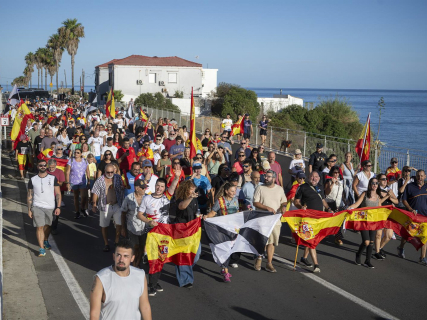
Thousands of people are demonstrating in Ceuta to demand an "exceptional solution" to the migration crisis.

The protest has started from the Royal Walls between flags of Spain and Ceuta and shouts against the Government and also demands the resignation of the Government delegate.

2 minutes

fotonoticia 20260902145342 1920

fotonoticia 20260902145342 1920

Add DEMÓCRATA to Google

Ask FREN

Published

Last updated

2 minutes

Most read

The streets of downtown Ceuta have filled with demonstrators of all ages, from young people and adults to seniors and families with children. Many of the attendees have come with flags of Spain and Ceuta, some of large dimensions.

Before the start of the march, participants gathered in the vicinity of the Royal Walls. On Valentín Cabillas street, near the Assembly headquarters, a stage has been set up from which Manolo Escobar's pasodoble "Que viva España" has been played.

The mobilization takes place after a night marked by the taró, the characteristic dense fog of the Strait, and with a sultry day that did not prevent numerous Ceutans from taking to the streets.

Among the t-shirts and banners, messages could be read such as "Ceuta is Spain", "Ceutian pride" or "Ceuta is not for sale, it is defended".

The organizers have asked attendees to position themselves on the sidewalks before starting the route to allow the front of the demonstration to exit and keep the passage clear for emergency vehicles.

"Where are the reports?"

The march began with shouts of "Where are the reports?" and "Ceuta united will never be defeated". Before moving, attendees had also chanted "I am Spanish", "a caballa never surrenders" and "Invaders, expulsion".

The reference to the reports occurs amid a political controversy over the police documentation prepared regarding the massive entry of migrants on the past 30th and 31st of July and the existing warnings before those events.

During the route, banners addressed to European institutions were also displayed. One of them demanded "SOS Europe Save Us", while another posed the question "Today Ceuta and tomorrow?".

They demand an "exceptional legal solution"

One of the main demands of the protest is the adoption of an "exceptional legal solution" to facilitate the departure of migrants who remain in the city after the crisis.

The demonstrators aim to make visible the consequences that, they claim, the migratory situation is having on the daily life of Ceuta and demand an urgent response from the administrations.

The protest has also included politically charged messages. Attendees have demanded the resignation of the Government delegate in Ceuta and insults directed at the President of the Government, Pedro Sánchez, have been heard.

The mobilization continues to traverse the streets of the autonomous city with a strong presence of Spanish and Ceutí symbols and with the demands regarding the management of the migration crisis as the central axis.

More key points, information and questions with FREN

AI-GENERATED CONTENT

What is the parliamentary status of the processing of a possible exceptional legal solution for the migration crisis in Ceuta?

As of September 2, 2026, there is no single and finalized “Ceuta law” that can be identified as the already approved exceptional legal solution for the migration crisis in the city. What exists is a package of regulations and projects at different stages — some already in parliamentary processing, others still in the governmental draft phase — which, together, constitute the extraordinary legal response to the scenario opened after the massive entry at the end of July.

1. The central axis: Royal Decree-Law 2/2025 and its processing as a law

The most advanced legal pillar is the Royal Decree-Law 2/2025, of March 18, “which approves urgent measures to guarantee the best interests of children and adolescents in extraordinary migratory contingency situations.” This decree-law:

  • Was approved by the Council of Ministers on March 18, 2025, and published in the BOE on March 19, 2025.
  • Was ratified by the Congress, where it was also agreed to process it as a bill by urgent procedure (file 121/000055).

From a strictly parliamentary point of view, this bill is under processing in the Congress: according to the information gathered, the amendment period has been extended until September 9, 2026. That is:

  • The regulation already has the status of an in-force decree-law, applicable to situations of “extraordinary migratory contingency” in territories such as the Canary Islands, Ceuta, and Melilla.
  • But its final text as a law can still be modified through amendments and subsequent parliamentary debate (committee, commission, Plenary, and later passage through the Senate).

This framework regulates, among other aspects, the mandatory model for the distribution of unaccompanied foreign minors when certain saturation thresholds are exceeded, a key issue to relieve pressure in border territories like Ceuta.

2. Structural reforms in preparation: Immigration and Asylum

The Ceuta crisis has also accelerated two fundamental reforms which, although not limited to the city, are politically presented as part of the “exceptional response”:

  • Draft Organic Law amending Organic Law 4/2000 on Immigration, approved in first reading by the Council of Ministers on August 25, 2026 (official reference). Among other elements, it incorporates the border return procedure provided for in the European Pact on Migration and Asylum (PEMA), with very short deadlines to return those who arrive irregularly and have no right to international protection.
  • Draft new Asylum Law, also approved on August 25, 2026 (government text), aimed at adapting Spanish regulations to Directive (EU) 2024/1346 on the reception of international protection applicants.

Both texts are still in the draft phase: they must gather reports and return to the Council of Ministers to then be sent to the Cortes as bills. Therefore, they have not yet entered the parliamentary phase, but they form the basis of the future broader “legal solution” on migration and borders that will directly affect Ceuta.

3. Specific exceptional measures on Ceuta

Alongside these reforms, specific instruments focused on the city have been approved:

  • The declaration of a situation of interest for national security in the city of Ceuta through the Royal Decree 681/2026, of August 25, published in the BOE on August 26, 2026 (BOE), and its subsequent modification by the Royal Decree 706/2026, of September 1, published on September 2, 2026 (BOE).
  • The Royal Decree-Law 22/2026, of September 1, “which approves urgent social and economic support measures for the city of Ceuta,” published today in the BOE (full text).

This last decree-law is in force, but its parliamentary status is pending ratification by the Congress of Deputies and, if applicable, a decision on whether it will subsequently be processed as a bill. That vote and possible processing will determine its final integration into the legal system.

4. Parliamentary initiatives for promotion and control

In addition to regulations with the status of law, there has been intense political oversight activity:

  • Motions and non-legislative proposals in the Senate on migratory pressure and reinforcement of resources in Ceuta, already approved and concluded (for example, initiative (15)661/001931).
  • Parliamentary non-legislative motions and debates in the Congress on strengthening humanitarian and health actions in Ceuta, currently on the agenda but without direct normative effects.

These initiatives serve to guide and politically pressure, but do not themselves constitute the “exceptional legal solution,” as they do not create binding rights.

In summary, the “exceptional legal solution” for the Ceuta crisis is currently structured around: a decree-law already in force and in bill phase in the Congress (Royal Decree-Law 2/2025 / 121/000055), a new socio-economic support decree-law pending ratification (Royal Decree-Law 22/2026), and two draft reforms of Immigration and Asylum that have not yet reached the Cortes, along with declarations of situations of interest for national security. There is no single closed law for Ceuta, but a regulatory framework at different stages of processing.

What are the powers and functions of the Government Delegate in Ceuta according to Spanish legislation?

The Government Delegate in Ceuta is the highest representative of the National Government in the autonomous city and the body that directs and coordinates the General State Administration (AGE) in its territory. Its basic statute is found in Law 40/2015, on the Legal Regime of the Public Sector, which regulates the territorial bodies of the AGE (articles on Government Delegates) and expressly mentions the Government Delegates in the cities of Ceuta and Melilla in its additional provisions, equating them to those of the autonomous communities. Additionally, regulations such as Royal Decree 1330/1997 (on the structure of Government Delegations) and Organic Law 2/1986, on Security Forces and Corps, complete its competence framework, especially in matters of security and public order.

1. Representation of the National Government

According to Law 40/2015 (window 165000-172500 of the text), Government Delegates, and by extension the one in Ceuta, exercise the representation of the National Government in the corresponding territorial scope. This implies:

  • Being the institutional face of the Government in Ceuta before local authorities, other administrations, and the public.
  • Acting as the ordinary channel of political and institutional relations between the central Government and the Autonomous City, alongside the cooperation mechanisms that Law 40/2015 provides for Ceuta and Melilla in its additional provisions (referred to in the Law’s preamble).
  • Assuming the status of executive body of the AGE, with the rank of undersecretary, appointed and removed by Royal Decree of the Council of Ministers, at the proposal of the President of the Government.
2. Direction and coordination of the General State Administration in Ceuta

Law 40/2015 establishes that Government Delegates direct and supervise the General State Administration in the territory, coordinating it internally and, when appropriate, with the autonomous and local administration. In Ceuta, this translates into:

  • Promoting, coordinating, and supervising the actions of all state services and bodies present in the city (Treasury, Education, Health, Social Security, etc.).
  • In the services integrated into the Delegation, directly managing their activity, according to the objectives and technical criteria set by the competent ministries.
  • Appointing, when appropriate, territorial managers (figures analogous to subdelegates or island directors in other territories) and coordinating the use of buildings and material resources of the AGE, a function that Law 40/2015 links to Government Delegates also by reference to Law 33/2003 on Public Administration Assets.
  • Informing proposals for the appointment of heads of territorial bodies of the AGE and of local or provincial public bodies based in Ceuta.
3. Information to the Government and the public

Among the competences catalogued by Law 40/2015 is a specific block of information on Government action and information to citizens:

  • Coordinating information about Government and AGE programs and activities in Ceuta, ensuring a coherent message.
  • Receiving information from ministries about plans and programs to be executed in the city, to guarantee their proper territorial coordination.
  • Preparing and sending reports to the Government (at least annually) on the functioning of state public services in Ceuta and on the general situation of the territory from the AGE perspective.
4. Coordination and collaboration with the Autonomous City and other administrations

Law 40/2015 positions Government Delegates as a key piece in inter-administrative coordination. In Ceuta, this means:

  • Maintaining cooperation relations between the AGE and the Autonomous City of Ceuta, as well as with local entities (when they exist), participating in mixed commissions and other cooperation bodies.
  • Promoting and monitoring state financing agreements and programs affecting the city, ensuring their correct execution.
  • Fostering integrated systems of information exchange between the AGE and the Autonomous City, a matter expressly highlighted in the explanatory memorandum of Law 40/2015 regarding relations with Ceuta and Melilla.
5. Legality control and rights protection

Law 40/2015 also assigns Government Delegates competences of legality control regarding acts of the Delegation itself and integrated services:

  • Resolving administrative appeals against resolutions issued by Delegation bodies, after intervention of the competent ministry by subject matter.
  • Suspending the execution of challenged acts when responsible for resolving the appeal, or proposing such suspension in other cases, according to general administrative procedure legislation.
  • Channeling claims for patrimonial liability related to AGE activity in Ceuta to the competent ministerial departments.
6. Citizen security, civil protection, and immigration

Although Organic Law 2/1986 and Organic Law 4/2015 generally regulate public security and Security Forces and Corps, Law 40/2015 and Royal Decree 1330/1997 specify that, within the Delegation’s territorial scope, integrated services are those exercising competences over civil protection, immigration, and asylum, among other matters, functionally dependent on the Ministry of the Interior.

Consequently, the Government Delegate in Ceuta:

  • Coordinates territorially the actions of AGE bodies with competences in citizen security, civil protection, immigration, and asylum present in the city.
  • Acts as the main interlocutor of the Ministry of the Interior before the Autonomous City on issues of public order, borders, and migration flow management, within the framework of citizen security and immigration laws.
  • Participates in coordination bodies (security boards or others) to harmonize the actions of the Civil Guard, National Police, and, if applicable, local police forces.
7. Differences and similarities with other Government Delegates

Law 40/2015 establishes a common regime for all Government Delegates in autonomous communities and, by specific mention in its additional provisions, extends that model to the Government Delegates in Ceuta and Melilla. Therefore:

  • The basic competences are substantially the same (Government representation, AGE direction, information, coordination, and legality control).
  • The singularity of Ceuta comes more from its status as a border city and a single-province autonomous city than from a radically different legal statute of the Government Delegate, which reinforces its role in matters such as borders, immigration, and citizen security.

Which political parties currently compose the Assembly of Ceuta and how many seats does each have?

With the information available from the sources consulted this session, it is not possible to reconstruct completely and reliably the seat distribution by party in the Assembly of Ceuta at present. Some partial data can be extracted, but official and updated figures for all groups are lacking, so any attempt to provide a closed picture of the composition would be speculative.

What can be stated with explicit support in the sources is the following:

  • In a political analysis piece published on August 15, 2026, the newspaper Demócrata reports statements from the Vox leader in Ceuta, Juan Sergio Redondo, in which he speaks of an “alternative absolute majority” formed by the People's Party (PP) and Vox in the Ceuta Assembly. In that context, the leader himself details that this possible majority would be formed by nine PP deputies and four Vox deputies in the Assembly of Ceuta (9 + 4). That figure, therefore, is confirmed in the source as the number of seats of each of those two parties at that time.
  • In another Demócrata report, dated August 28, 2026, it is indicated that “the spokespersons of all political groups with representation in the Assembly of Ceuta, along with two non-affiliated deputies,” sign an institutional declaration on the situation of violence in the city. The text does not detail the number of seats of each group, but it does allow knowing that, besides PP and Vox, there are other political groups represented and, additionally, at least two non-affiliated deputies in the Assembly.

From there, what can be safely deduced is:

  • PP: 9 seats (figure explicitly mentioned in the Demócrata information, quoted from the Vox leader).
  • Vox: 4 seats (also explicitly mentioned in the same information).
  • There are other groups with representation (the text speaks of “all political groups with representation in the Assembly of Ceuta”), but in the located pieces their names or how many seats each has are not specified.
  • There are at least two non-affiliated deputies, without specifying from which lists they come or how exactly this affects the internal distribution by parties.

On the other hand, not appearing in the sources consulted this session are:

  • An official and complete table of the seat distribution by party in the Assembly of Ceuta after the 2023 elections or with any subsequent changes.
  • The precise breakdown of seats of other forces that, according to general press, are known to have competed in Ceuta (such as PSOE or local formations), but whose specific seats are not documented in the retrieved texts.

Since your question requires an exact numerical answer – “which parties currently compose the Assembly of Ceuta and how many seats each has” – and the tools consulted this session do not provide that complete breakdown, it would be methodologically incorrect to invent or complete from memory the missing data. I can only guarantee, with textual support, that:

  • The PP has 9 deputies in the Assembly of Ceuta.
  • Vox has 4 deputies in the Assembly of Ceuta.
  • There are other groups represented and at least two non-affiliated deputies, but without concrete figures by party in the sources handled.

If you need the complete and updated detail (all parties and the seats of each), the safest route is to go directly to the official sources of the Autonomous City of Ceuta (for example, the institutional page of the Assembly of Ceuta or the electoral results portal of the General State Administration), where both the definitive election results and the current composition of the Chamber and its possible changes throughout the legislature are usually published.

Can you tell me which parties, besides PP and Vox, have representation in the Assembly of Ceuta even if their exact number of seats is unknown? How has the political composition of the Assembly of Ceuta evolved over the last two legislatures? What role do PP and Vox play in the governance of Ceuta with the 9 and 4 deputies you mention?

Play

Test your knowledge with FREN!

How much do you know about this topic? Answer the following 3 questions.

What solution do the protesters mainly demand in the Ceuta protest?

Question 1 of 3

What slogan could be read on some of the banners during the demonstration in Ceuta?

Question 2 of 3

Who was asked to resign during the protest in Ceuta?

Question 3 of 3

Hola, soy Fren. ¿Cómo te ayudo?