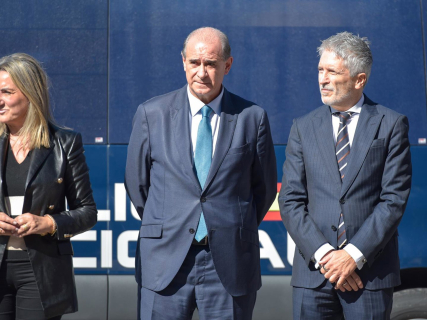
The director of the Police denies Marlaska that his report holds Morocco responsible for the massive entry into Ceuta

Francisco Pardo assures that Judge Tardón had ordered the investigative team to keep the information confidential and that the document does not conclude that the Moroccan forces organized the massive entry.

3 minutes

fotonoticia 20260606120543 1920

fotonoticia 20260606120543 1920

Add DEMÓCRATA to Google

Ask FREN

Published

Last updated

3 minutes

Most read

The General Director of the Police, Francisco Pardo Piqueras, has explained to the Minister of the Interior, Fernando Grande-Marlaska, the circumstances surrounding the police report on the massive entry of migrants in Ceuta and has denied that the document directly attributes to Morocco the planning or execution of the events.

According to sources from the Interior, Pardo has conveyed to the minister that he had no prior knowledge of the content of the report because the judge of the National Court María Tardón would have given express instructions to the investigative team not to inform their superiors while conducting their inquiries.

The explanations come after various reports published this Tuesday indicated that the document prepared by the National Center for Immigration and Borders (CENIF) pointed to Moroccan agents, both uniformed and plainclothes, as responsible for guiding and coordinating part of the migrants during the massive entry on the days 30 and 31 of July.

Interior now maintains that the report does not reach that conclusion.

The judge allowed this Wednesday to inform the superiors

Sources from the Ministry explain that the magistrate Tardón authorized this Wednesday the investigative team to give access to the content of the report to their superiors.

This circumstance would explain, according to Interior, why the General Director of the Police had not previously received the document despite it having already been sent to the National Court.

Pardo has conveyed to the minister that the judge's instructions prevented the investigative team from providing information about their inquiries to the police chain of command.

In this way, Interior dissociates Pardo's lack of prior knowledge from any possible internal concealment and places the origin of the reservation in the instructions given during the judicial investigation.

The report does not directly attribute authorship to Morocco

The main clarification conveyed by the Police Director affects the content of the document.

According to sources from the Interior, Pardo has communicated to Marlaska that the report "does not attribute to the Moroccan Security Forces the planning or execution" of what occurred in Ceuta on the days 30 and 31 of July.

The precision is particularly relevant after information was disseminated that presented the document as a police investigation that pointed directly to an operation organized by Morocco to provoke the collapse of the Spanish border.

Interior holds that this interpretation does not correspond with the conclusions of the report.

The document does analyze the circumstances surrounding the mass entry, the prior alerts, and the behavior of the people who arrived in Spanish territory, but sources from the Ministry deny that it directly establishes the responsibility of the Moroccan security forces.

Marlaska had requested explanations

Pardo's clarification comes hours after Marlaska requested explanations about the report and about the information that had leaked regarding its content.

The minister wanted to know, among other issues, what exactly the CENIF team had concluded and why the document had reached the National Court without, according to Interior, the director general of the Police having prior knowledge of its conclusions.

The controversy had also opened the possibility that responsibilities within the police chain of command could arise, an option that sources from Interior had not ruled out while clarifying what happened with the document.

Pardo's new explanations modify the scenario: if it is confirmed that the judge had ordered to keep the investigation confidential and that the report does not attribute to Morocco the planning or execution of the mass entry, the hypothesis of a deliberate concealment of information from the minister loses strength.

The controversy arrives amid a political crisis over Ceuta

The controversy occurs at a particularly delicate moment for the Government, after the Executive has maintained that it does not have information from its security and intelligence services linking Morocco to the mass entry.

Pedro Sánchez himself defended this position in his interview this Monday and assured that there were no reports from Spanish services or from countries with which Spain cooperates that pointed to Moroccan participation.

The publication of information about the police report had, however, opened a new front regarding the actions of the Moroccan authorities during the crisis and about the knowledge that the Government had of the investigations.

Now, the explanations offered by the director general of the Police to the minister indicate that the document does not establish a direct attribution of responsibility to Morocco and that the absence of prior knowledge on Pardo's part was due to the instructions of the judge leading the investigation.

More key points, information and questions with FREN

AI-GENERATED CONTENT

What is the current status of the judicial investigation into the Ceuta migration crisis and what are the next steps planned in the procedure?

The Ceuta migration crisis has given rise to several distinct judicial fronts. As of today (September 2026), the most relevant procedure is before the National Court, in the preliminary proceedings phase, with no decision yet on whether there will be specific charges or the opening of a trial. Meanwhile, there are already sentenced cases related to the management of the 2021 crisis and other investigations open in Ceuta courts.

1. Main investigation at the National Court

The central axis of the current criminal investigation is being followed at the National Court following a complaint filed on July 30 by the party Iustitia Europa. The complaint refers to the massive entry of people from Morocco to Ceuta on July 30 and 31 and raises possible crimes against the peace and independence of the State, as well as others linked to state security, facilitation of illegal immigration, human trafficking, membership in a criminal organization, and omission of the duty to prosecute crimes.

The Instruction Section of the Central Court of the National Court agreed to open preliminary proceedings (Preliminary Proceedings 64/2026). According to Demócrata, Judge María Tardón has already ordered several actions:

  • Request a detailed report from the General Immigration and Borders Police Station (UCRIF) of the National Police on the "massive irregular entry" in Ceuta, including whether it was due to a concerted or organized action.
  • Ask the Civil Guard Intelligence Headquarters to clarify if any of its units received alerts or prior warnings about the possible massive entry, what devices were activated, and with what result.
  • Request data on the border operation, rescue operations, number of fatalities, and identification of survivors.

A report from the National Immigration and Borders Center (CENIF), submitted to this case and cited by Demócrata, points out that the entry of tens of thousands of people would have responded to a planned process involving members of the Moroccan security forces, ruling out that it was a purely spontaneous phenomenon.

Procedural status

With the available information, the case at the National Court is still in an early investigation phase:

  • The preliminary proceedings are open and investigative actions (official requests, reports, data collection) are ongoing.
  • There is no record, in the sources consulted, of any indictment or dismissal orders having been issued yet; that is, the judge is gathering elements to decide if there is sufficient evidence of a crime and who might be responsible.
Expected next steps

In procedural terms, the logical next steps in this investigation would be:

  • Reception and analysis by the judge and the Public Prosecutor's Office of the reports requested from the National Police and Civil Guard, as well as any supplementary documentation provided by the parties.
  • Depending on the results of those reports, possible new proceedings: statements from police commanders, potential testimonies from authorities or political leaders, requests for more documentation, or even international rogatory commissions if it is intended to delve into the possible coordinated action from Morocco.
  • Once the investigation phase is concluded, the judge must decide between:
    • Dismissing the case if there is no sufficient criminal evidence, or
    • Transforming the proceedings into an abbreviated or summary procedure and, if applicable, proposing the opening of a trial against the persons to whom criminal responsibilities are attributed.

2. Other cases linked to Ceuta

Alongside this macro-case, there are other relevant procedures related to the management of migration crises in Ceuta:

  • Sentence for illegal return of minors in 2021. The Provincial Court of Cádiz (Ceuta seat) has sentenced the former vice president of Ceuta, Mabel Deu, and the former Government delegate, Salvadora Mateos, to nine years of disqualification for the irregular return of 55 Moroccan minors in August 2021, linked to the May 2021 crisis, according to Demócrata. The sentence can be appealed, so a possible review by higher courts is possible.
  • Contentious-administrative procedures. The Andalusian High Court of Justice confirmed in 2025 the illegality of certain "hot returns" of people entering Ceuta by swimming, requiring compliance with the procedures of the Immigration Law (ElDiario.es). These rulings are not criminal but condition administrative action and judicial assessment of border management.
  • Investigations in Ceuta courts. Additionally, the Court of First Instance and Instruction No. 6 of Ceuta has initiated preliminary proceedings following a complaint by Manos Limpias against the Government delegate Miguel Ángel Pérez Triano, focused on whether he received prior warnings and did not act, according to Demócrata. This case is also in an initial phase.

Overall, therefore, the "judicial investigation into the Ceuta migration crisis" is not a single procedure but a set of cases: some already sentenced for actions in 2021 and others, such as the National Court case and the Ceuta Court No. 6 case, open and still in an investigation phase where facts, responsibilities, and possible criminal scope are being defined.

What are the powers and functions of the Minister of the Interior regarding border management and police coordination in Spain?

The Minister of the Interior in Spain is the political authority responsible for the internal security of the State. Within this framework, they hold key competencies both in border management and in the direction and coordination of the State Security Forces and Corps (FCSE), as well as in the articulation with regional and local police forces. Their functions combine a normative and strategic level, an operational command and coordination level, and one of internal and international representation.

1. Border management and control

Regarding borders, the Minister of the Interior exercises political direction over the Spanish external border control device, mainly executed by the National Police (entry and exit controls of people) and the Civil Guard (maritime surveillance, land borders, and coasts).

Normative and strategic functions:

  • Define the border control policy and the fight against irregular immigration, in coordination with the Government as a whole and other ministries (Foreign Affairs, Defense, Inclusion and Migration, etc.).
  • Promote and propose regulations and plans regarding entry and exit from the territory, visas, border surveillance, and migration flow control, as well as protocols of action at border crossings, ports, and airports.
  • Establish criteria and priorities for the management of information systems such as the Schengen Information System (SIS), the Visa Information System (VIS), or entry and exit registers, within the European framework.

Operational functions (through the hierarchical chain):

  • Order, through instructions to the Directorate General of Police and the Directorate General of the Civil Guard, the reinforcement devices at certain borders or times (for example, during arrival peaks or specific threats).
  • Supervise the coordination between National Police and Civil Guard at sensitive points (Ceuta, Melilla, Canary Islands, Strait of Gibraltar, international airports, etc.).
  • Politically direct the response to border crises, defining priorities (protection of lives, public order control, cooperation with neighboring countries) and authorizing the extraordinary deployment of human and material resources.

Representation and international/European relations functions:

  • Represent Spain in the EU Interior Ministers Council and in international forums where border, migration, and internal security policies are decided.
  • Liaise with FRONTEX and other European agencies, approving Spanish participation in joint operations, deployment of resources, and interoperability projects of databases.
  • Lead political relations with origin and transit countries regarding police cooperation and border control (readmission agreements, joint patrols, coordination centers, etc.).
2. Internal police coordination

Domestically, the Minister of the Interior is the highest political authority responsible for citizen security and the direction of the state-level FCSE (National Police and Civil Guard), and plays an essential role in coordination with Mossos d’Esquadra, Ertzaintza, Policía Foral, and local police.

Normative and strategic functions:

  • Define the internal security strategy, plans against terrorism, organized crime, cybercrime, gender violence, or violent radicalization, among other areas.
  • Promote legal and regulatory reforms regarding Security Forces and Corps, disciplinary regime, technological means, police data protection, and inter-administrative coordination.
  • Set the planning of resources and personnel (staffing, territorial deployment, investments in equipment and police infrastructure).

Operational and coordination functions:

  • Exercise political command over the National Police and Civil Guard, conveying priorities, objectives, and guidelines to their operational commanders.
  • Promote and preside over, directly or through dependent bodies, the national police coordination mechanisms: intelligence and coordination bodies such as CITCO, territorial coordination centers, etc.
  • Ensure coordination with regional and local police through security boards, mixed bodies, and cooperation agreements, including shared use of databases and police information systems.

Representation and institutional relations functions:

  • Be the visible face of the Government on internal security matters, appearing before Parliament and the public to explain plans, relevant incidents, or operations of special significance.
  • Maintain relations with other administrations (autonomous communities, local entities) and with international security and police organizations (INTERPOL, Europol, etc.), promoting cooperation and information exchange.

In sum, the Minister of the Interior does not directly execute controls nor act operationally on the ground, but sets the normative and strategic framework, exercises political command, and coordinates the various national and international actors involved in border security and police coordination in Spain.

Which political party does Fernando Grande-Marlaska belong to and what has been his professional trajectory before becoming minister?

The sources consulted clearly place Fernando Grande-Marlaska as Minister of the Interior in Pedro Sánchez's governments since June 2018, but do not explicitly detail which political party he is affiliated with nor provide a complete biographical profile of his trajectory prior to the ministry. Based on the available information, it is only possible to accurately describe his role as Interior Minister and the type of political responsibilities he has exercised since then.

Political party and institutional framework

Various news and official agendas repeatedly present him as Minister of the Interior within the Government led by Pedro Sánchez. For example, a Demócrata report on the crises that have questioned his continuity highlights that he has held the Interior portfolio since June 2018, and notes that he is one of the longest-serving ministers in Sánchez's cabinets, placing him at the political core of the current Government.

In La Moncloa's official agendas, he also appears as “Fernando Grande-Marlaska (of the Government)” in various events: control sessions in the Congress and Senate, meetings of the EU Interior Ministers Council, inaugurations at the General Council of the Judiciary, or appearances before parliamentary committees. All this reflects his affiliation to the central Government and his role as a member of the Council of Ministers, but these sources do not specify his formal membership in any particular party.

Since the documentation recovered focuses on his governmental function and not on his internal affiliation record, and even the consulted political office database does not provide a "grouping" or party data in his record, with this information it is not possible to state in a documented way which political party he formally belongs to.

Trajectory as Minister of the Interior

However, there is abundant information about his time at the head of the Ministry of the Interior. Demócrata articles describe that his mandate began in June 2018 and has been marked by especially sensitive episodes for the State Security Forces and Corps, migration policy, and the direction of the National Police and Civil Guard.

Among the milestones mentioned are:

  • The crisis originated in 2020 by the dismissal of Colonel Diego Pérez de los Cobos as head of the Civil Guard Command in Madrid, which led to a strong political controversy and, subsequently, to the annulment of the dismissal by the Supreme Court.
  • The tragedy at the Melilla fence in June 2022, with dozens of migrants dead according to official Moroccan figures, which generated intense parliamentary and social pressure on the Ministry of the Interior.
  • The events in Barbate in 2024, with the death of two civil guards when their boat was rammed by a drug trafficking speedboat, which reopened the debate on material resources in the fight against drug trafficking.
  • The 2026 crisis around the so-called Leire Díez case, which led to the indictment of high-ranking Civil Guard officers and placed Interior's decisions regarding the Armed Institute's leadership under scrutiny.
  • The most recent migration crisis in Ceuta, with a massive entry of migrants at the end of July 2026, which has led to new tensions between the Government and the opposition and demands for explanations in Congress and the Senate.

Despite having been reprimanded on several occasions by different chambers and repeated calls for resignation by the opposition and some professional associations, chronicles indicate that Pedro Sánchez has consistently kept him at the head of the Ministry, reinforcing the idea that he is one of the stable pieces of the current ministerial lineup.

Available information on prior trajectory

Regarding the specific question about his professional trajectory before becoming minister, the sources consulted in this investigation focus mainly on his activity as a Government member and his participation in recent political agendas (control sessions, appearances, European meetings, press conferences, etc.). They do not provide, however, a structured biography detailing his previous positions, professional career, or experience before June 2018.

Thus, with the data available here, it can only be stated with certainty that:

  • He has been Minister of the Interior of the Government of Spain since June 2018 and continues to hold that position currently.
  • He has managed some of the main security, migration, and police crises of recent years, which have shaped his public profile.
  • No explicit mention of his formal party affiliation nor a complete account of his professional posts prior to the ministry has been identified in these sources.

If you need detailed information about his previous career (judicial assignments, responsibilities in judicial governing bodies, etc.), you would need to consult specific biographies or his updated official profile, which are not part of the specific set of documents analyzed in this response.

Play

Test your knowledge with FREN!

How much do you know about this topic? Answer the following 3 questions.

Who authorized the investigative team to allow police commanders access to the report on the Ceuta crisis?

Question 1 of 3

What did the Ministry of the Interior state about the alert issued by CENIF on July 29?

Question 2 of 3

What was the main clarification from the Police director regarding the content of the report related to the entry of migrants in Ceuta?

Question 3 of 3

Hola, soy Fren. ¿Cómo te ayudo?