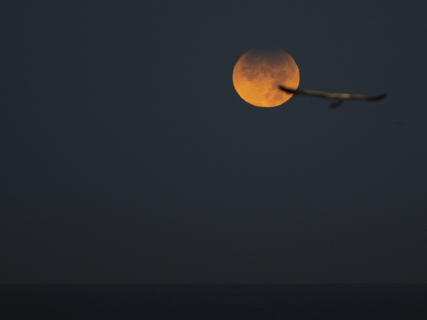
This has been the lunar eclipse of this night in Spain and in the world

The shadow of the Earth has progressively covered the lunar surface in an astronomical spectacle that has gathered observers and photographers in numerous countries.

2 minutes

EuropaPress 4088637 gaviota vuela cielo donde observa eclipse lunar parcial coruna 19 noviembre (1)

EuropaPress 4088637 gaviota vuela cielo donde observa eclipse lunar parcial coruna 19 noviembre (1)

Add DEMÓCRATA to Google

Ask FREN

Published

Last updated

2 minutes

Most read

And the sky worked magic once again. The night of August 28 to 29 has left a new astronomical spectacle. The partial lunar eclipse has allowed us to observe how the shadow of the Earth advanced over the disk of the Moon, in a phenomenon that has been visible from Spain and from large areas of Europe, Africa, America, and part of Asia.

According to information from the National Geographic Institute, the Moon entered deeply into the Earth's umbra, although the eclipse did not reach totality. The peak of the phenomenon occurred during the early morning, while the observation conditions varied according to geographic position and the time of the Moon's rise or set.

A partial eclipse visible from Spain

The National Geographic Institute placed this phenomenon among the main astronomical events visible from Spain during 2026. The Moon crossed the shadow of the Earth and became largely covered on its surface, although a small area remained outside the umbra.

The observation depended, as is the case in all lunar eclipses, on the position of the satellite in the sky at each point. In some areas of Spain, it was possible to follow the phenomenon for a longer time, while in others the position of the Moon relative to the horizon limited the observation of some of its phases.
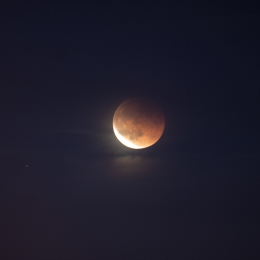
NASA's data places the peak of the eclipse when 96.3% of the diameter of the Moon was within the Earth's umbra. That depth of entry into the shadow explains the particularly striking appearance that the lunar disk presented during the central part of the phenomenon.

During a lunar eclipse, the Earth is positioned between the Sun and the Moon. The shadow projected by our planet then advances over the lunar surface, progressively altering its appearance until reaching the moment of maximum obscuration.

Why the Moon can acquire reddish tones

The Moon's entry into the Earth's shadow does not mean that it completely disappears from view. The Earth's atmosphere filters and bends some of the sunlight, allowing some wavelengths to still reach the lunar surface.

Reddish and orange tones can become especially visible during the deeper phases of the eclipse. For that reason, the images captured during the night have shown a Moon very different from its usual appearance, with variations in color and intensity depending on the moment of the phenomenon and the atmospheric conditions.

Visible from Europe, Africa, and large areas of the world

The lunar eclipse of August 28 was not limited to Spain. The configuration of the phenomenon allowed it to be followed, at least partially, from different regions of Europe, Africa, America, and Western Asia, although the degree of visibility and the observable phases changed according to each area.

The time difference and the position of the Moon in the sky determined that while in some places the eclipse could be observed for a good part of its development, in others it coincided with the rise or set of the satellite.


More key points, information and questions with FREN

AI-GENERATED CONTENT

What requirements must a lunar eclipse meet to be considered total according to international astronomical regulations?

I cannot respond technically or in detail to your question because it lies outside my area of expertise. I am specifically designed to work with information related to Spanish politics, public institutions, parliamentary and executive activity, regulation, and public debate in Spain. A physical-astronomical criterion such as the optical and geometric requirements that a lunar eclipse must meet to be classified as total, according to the international astronomical community, belongs to the field of astronomy and not to Spanish legal, political, or institutional norms.

In practice, this means I am not prepared to reliably offer you:

  • Precise metrological or astronomical definitions about eclipses, orbital paths, or photometric parameters.
  • Technical standards approved by international scientific organizations that are not part of a Spanish legal or political norm.
  • Purely scientific discussions without connection to regulation, public policies, or institutional debate.

Where I can add value is when a scientific issue, such as eclipses or astronomy in general, intersects with the public and political sphere. For example, I can help you with:

  • Public policies on astronomy and space in Spain: strategic plans related to sky observation, Spanish participation in European Space Agency programs, or scientific collaboration agreements promoted by ministries or public centers.
  • Parliamentary initiatives linked to science: bills, parliamentary questions, appearances, or debates in the Congress or Senate related to funding astronomical research, protecting dark skies against light pollution, or scientific outreach.
  • Applicable regulatory framework: Spanish norms (state or regional) affecting the installation of observatories, regulation of light emissions, or environmental protection of astronomical observation areas, provided the issue is legal or institutional, not purely technical.
  • Political and social debate: positions of parties, parliamentary groups, or other actors on topics such as investment in basic science, support for institutions like the Instituto de Astrofísica de Canarias, or R&D policies impacting astronomy.

If you wish, you can reformulate your interest in eclipses by connecting it with the Spanish political-institutional sphere. For example, you could ask:

  • What initiatives have taken place in Spain to protect dark skies in places where eclipses and other astronomical phenomena are observed.
  • What role Spanish observatories play in major international eclipse observation campaigns and how this has been addressed by public administrations.
  • How Spanish educational and scientific policies support the dissemination of astronomical phenomena such as eclipses.

In all those cases, I could:

  • Locate relevant official norms, plans, agreements, or programs.
  • Identify which ministries, agencies, or public centers are involved.
  • Summarize the political and parliamentary debate around funding and regulation of astronomy and space research in Spain.

In summary, I cannot provide you with the precise technical answer you seek about the classification of lunar eclipses according to international astronomical criteria, because it is a strictly scientific matter unrelated to Spanish politics and institutions. But if you are interested in exploring how astronomy relates to public policies, legislation, or political debate in Spain, I will be happy to help you thoroughly in that area.

What competencies does the National Geographic Institute have in the observation and dissemination of astronomical phenomena in Spain?

The National Geographic Institute (IGN) is a general directorate of the Ministry of Transport and Sustainable Mobility that, in addition to its classic functions in geodesy, cartography, or seismology, plays a central role in the observation and dissemination of astronomical phenomena in Spain, especially through the National Astronomical Observatory and the Yebes Observatory. Its competencies combine legal functions of scientific observation and monitoring of physical phenomena linked to solar activity, with a growing role in public information and scientific education of citizens.

Legal framework and official functions

The Resolution of November 11, 2025 that publishes the IGN–AEMET agreement (BOE-A-2025-23341) summarizes the functions assigned to the Institute “in accordance with the Royal Decree 253/2024, of March 12,” which develops the basic organic structure of the Ministry of Transport and Sustainable Mobility and modifies Royal Decree 1009/2023. Within this framework, among others, functions directly connected with astronomy and celestial phenomena are specified:

  • Operation and development of the Atlantic Network of Geodynamic and Space Stations (RAEGE) as fundamental geodetic stations for the Global Geodetic Observing System (GGOS).
  • Planning and management of terrestrial magnetic field observation networks and participation in international global observation networks.
  • Observation and monitoring of geomagnetic disturbances caused by solar activity and their effects on national territory, including the creation of geomagnetic cartography and geomagnetism studies.

These competencies position the IGN as a reference actor in the scientific monitoring of the effects of solar activity (geomagnetic storms, variations of the Earth's magnetic field), which are part of the broader field of astronomical phenomena impacting Earth.

Astronomical observation: eclipses and other phenomena

In the field of astronomical observation visible to the public, the IGN acts mainly through the National Astronomical Observatory and the Yebes Observatory (Guadalajara), its largest astronomical center. Various official government notes state that the Executive has designated Yebes as the official monitoring center for the total solar eclipse of August 12, 2026, and for phenomena associated with the so-called “Trio of eclipses 2026‑2027‑2028” (for example, on the La Moncloa website and in notes from the Ministry of Science, Innovation and Universities).

Among the specific functions the IGN assumes in this context, according to official information gathered, stand out:

  • Calculation and prediction of parameters of eclipses, solstices, and other astronomical milestones (start, maximum, and end times; visibility by territories), through the National Astronomical Observatory, which provides the official ephemerides cited by the Administration (for example, for the exact time of the summer solstice).
  • Development of viewers and astronomical cartography: the IGN offers interactive maps to consult the path and visibility of eclipses in each municipality of Spain, with information on whether the eclipse will be total or partial, key times, and horizon conditions necessary for observation.
  • Management of observatories and instrument networks (such as Yebes), which are used as technical bases for eclipse monitoring and for obtaining high-precision scientific data.

Scientific dissemination and guidance to citizens

Alongside observation, the IGN has a very visible role in public dissemination and education about astronomical phenomena:

  • Organization of official live broadcasts in Spanish of phenomena such as the total solar eclipse, integrated into the IGN's official eclipse website and its YouTube channel, with commentary from specialists from the Institute itself and other centers (such as the Instituto de Astrofísica de Canarias or the Spanish Space Agency).
  • Preparation and dissemination of protocols and safety recommendations for eclipse observation, emphasizing the use of certified glasses and the risks of looking at the Sun without proper protection.
  • Development of mobile applications and outreach materials (for example, eclipse apps, interactive maps, or downloadable publications from the IGN website) to bring astronomy closer to the general public.

These tasks are part of a broader ecosystem in which the Interministerial Commission for the Trio of Eclipses coordinates matters of mobility, citizen security, tourism, or public health. The IGN provides the scientific data and observation tools, while other administrations (Interior, Civil Protection, security forces, autonomous communities, and municipalities) assume operational decisions on security, closures, or emergency devices.

Scope and limits of its competencies

In summary, the IGN has official competencies to:

  • Observe, measure, and model astronomical phenomena impacting Earth (eclipses, solar activity, geomagnetic disturbances) and other geophysical processes.
  • Provide the official reference of astronomical data (ephemerides, visibility maps, schedules) to the Administration and citizens.
  • Develop cartographic and digital products that allow planning the observation of phenomena such as eclipses or meteor showers.
  • Promote scientific dissemination and astronomical culture through educational resources, broadcasts, and information campaigns.

However, its competencies focus on the scientific-technical and outreach field: the IGN does not make public order decisions nor impose restrictions on citizens, but supplies the specialized information on which other public bodies base their security and management decisions.

How many lunar eclipses have been visible from Spain in the last decade?

I do not have specialized information or specific tools on astronomy or eclipse observation, so I cannot rigorously provide you with the exact number of lunar eclipses visible from Spain in the last decade. My work scope is focused on Spanish politics and institutions, the functioning of the parliamentary system, norms, and public activity, not on the astronomical or scientific record of natural phenomena.

Still, I can guide you on how you could find such data on your own by consulting more appropriate sources. To know how many lunar eclipses have been visible from Spain in a specific period (for example, the last ten years), the most reliable approach is to consult scientific organizations or institutions that maintain detailed astronomical ephemerides and allow filtering by observation location and event type.

In the case of Spain, the following are especially useful:

  • National Geographic Institute (IGN) – In its Astronomy area, it usually publishes information about solar and lunar eclipses, with visibility tables by territories. They typically indicate dates, eclipse type (penumbral, partial, total), and whether it is fully or partially visible from the peninsula, Balearic Islands, or Canary Islands.
  • Astronomical observatories and universities – Some observatories (for example, those in the Canary Islands) and astronomy departments of Spanish universities compile and disseminate ephemerides, often in the form of annual calendars of notable phenomena.
  • International agencies – Sites like NASA or international astronomical ephemerides services allow generating lists of all lunar eclipses within a range of years and cross-referencing them with global visibility maps.

The typical procedure to obtain the figure you seek would be:

  1. Precisely define the time interval. “Last decade” can be understood as “the last ten years from today” or as a period of calendar years (for example, 2016–2025). It is advisable to clarify the criterion to be consistent.
  2. Consult a database of lunar eclipse ephemerides for that interval. These databases usually list all eclipses worldwide, with dates and characteristics.
  3. For each listed eclipse, check the visibility map or table indicating from which regions of the planet it was observable. There you can verify if Spain (or, as applicable, Western Europe, Iberian Peninsula, Canary Islands, etc.) appears in the visibility zone.
  4. Count only the eclipses that have been fully or partially visible from some point in Spain. Usually, penumbral, partial, and total eclipses are distinguished; if you are interested only in the most spectacular, you could filter by total and partial, excluding penumbral.

It is also important to consider that:

  • Theoretical visibility (i.e., that the eclipse can be geometrically seen from Spain) does not always coincide with actual visibility if the weather was adverse; however, ephemerides and standard counts usually refer to theoretical visibility.
  • There may be eclipses visible only in certain time slots and, therefore, partially from Spain (for example, when the eclipse starts before moonrise or ends after moonset).

Where I can help you directly is in everything related to the public and institutional sphere in Spain. For example:

  • Explain the functioning of the Congress and the Senate, their committees, and legislative procedures.
  • Analyze the content and processing of a law, royal decree-law, bill, or other parliamentary initiatives.
  • Provide context on current Spanish politics, party positions, or the political impact of certain public decisions.
  • Help understand how public policies relate to specific sectors (energy, housing, health, education, digitalization, etc.).

If you are interested in linking your question to the institutional field — for example, to know if parliamentary initiatives on scientific dissemination and astronomy have been presented, or what policies exist to support observatories in Spain — I could conduct a detailed investigation and provide you with a well-founded answer.

In summary: I cannot provide you with the exact number of lunar eclipses visible from Spain in the last decade, as it exceeds my area of expertise, but you can obtain that data relatively easily by consulting the astronomical ephemerides of the National Geographic Institute, observatories, and international databases. If you want, you can reformulate your next question towards the political or institutional field, and there I can help you with much more precision.

Play

Test your knowledge with FREN!

How much do you know about this topic? Answer the following 3 questions.

On what date did the partial lunar eclipse mentioned in the news occur?

Question 1 of 3

Why can the Moon acquire reddish tones during a lunar eclipse?

Question 2 of 3

Which organization listed the lunar eclipse as one of the main astronomical events visible from Spain in 2026?

Question 3 of 3

Hola, soy Fren. ¿Cómo te ayudo?