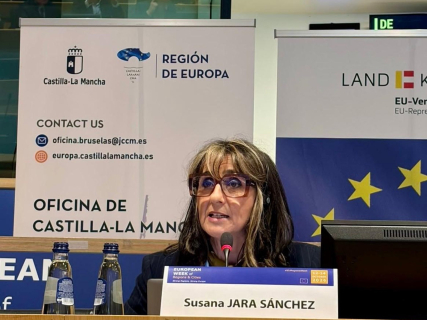

The general director of Natural Environment and Diversity of the Junta de Castilla-La Mancha, Susana Jara, intervened this Monday in one of the first debate forums of the Regions Week, which is being held in Brussels until Tuesday. In this meeting, she demanded the continuity of the cohesion funds that support forest management policies and highlighted the UFIL strategy in Cuenca, active since 2018, as a notable example of success.
Her participation was framed in a working session with representatives from different European regions under the slogan "Stronger together: territorial innovation as a tool for cohesion," a space for exchange in which each territory presented its most relevant initiatives.
In a round table shared with representatives from Umbria (Italy), Carinthia (Austria), Bouches-du-Rhône (France), and Thuringia (Germany), the speakers emphasized the role of European Union funding not only as a temporary support network but as a long-term strategic investment that drives innovation in the regions.
In statements to Europa Press prior to the session, Jara stressed that for Castilla-La Mancha, the arrival of structural and cohesion funds to rural areas is essential, as they allow attracting productive fabric to the most depopulated territories and sustaining economic activity linked to the natural environment.
In this context, she claimed that "we also need a boost for forest biomass, using this energy source to detach ourselves from fossil fuels and eliminate fossil biofuels from our fields."
Jara recalled that one of the main challenges of the region is that the forestry sector "has not yet acquired the importance it deserves, considering that its area is 48% at the regional level." In her view, this potential holds "economic opportunities," but it is wasted because "there are no people in the territory and there is no structured dimension or people specialized in the management" of these forests.
She added that, according to available studies, "there is a gap regarding the profitability of the operations," which causes the necessary forest management in private estates "not to be executed."
In the same line, he has pointed out that "two-thirds of the forest territory is in private hands," whose owners cannot assume the management of such large areas "if it is not profitable." For this reason, he has asked that "that is why it is important to take into account the vision of Mediterranean countries," without forgetting "the effects of climate change" on forest spaces and the increase in the risk of fires.
UFIL Cuenca as a reference for forest bioeconomy
During the session, Castilla-La Mancha has presented several successful experiences in forestry, among them the Urban Forest Innovation Lab (UFIL), which has been developed for years in Cuenca, "a bioeconomy project associated with forest management" promoted by young entrepreneurs in a province that he has described as "forestry with excellence."
Jara has recalled that the capital of Cuenca is "the municipality with the largest forest area in Europe," and that around UFIL different lines of aid financed with Feder cohesion funds have been articulated since 2018.
According to the data provided, this innovation laboratory has already allowed "the launch of 45 companies" that have generated more than 150 jobs "related to forest management" or linked to the wood sector, consolidating a business ecosystem tied to the sustainable use of the forest.
In her speech, the general director has also warned of the risks associated with the rise of "climate denialism and extremism" in part of public opinion. In response, she has argued that "a well-managed forest provides you with raw materials, resources, and ecosystem services that prevent the effects of climate change, water infiltration, or erosion."
For this reason, she has insisted on the need to "promote" through European aid and cohesion funds the creation, consolidation, and rooting of companies dedicated to forest management in rural areas.
European cohesion, an essential piece for the future of the forest
In the exchange with representatives from other regions, Jara has emphasized that the cohesion policy for Castilla-La Mancha is "key" for the present and future of the community, especially to develop policies for the management of natural and forest resources.
He explained that an added difficulty is that the forests of the region "are located precisely in the territories most affected by depopulation," which translates to "an almost total shortage of labor and companies, a lack of demand for forest raw materials, and a structural deficit in the provision of basic services."
In this sense, he emphasized that "the daily management of forests and natural resources in Castilla-La Mancha requires the continuity of cohesion funds, especially those from the Feader, managed through the Strategic Plan of the CAP (Pepac), but also those from the Feder. These funds are fundamental, as they allow covering part of the management costs while innovative solutions are sought," he concluded.