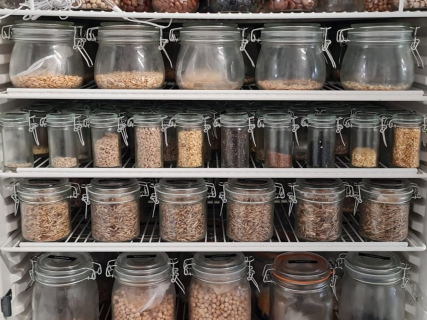

The Ministry of Agriculture, Fisheries and Natural Environment, through the Institute of Agricultural and Fisheries Research and Training (Irfap), continues to expand the seed bank and advance in the recovery, conservation, and valorization of the local varieties of the Balearic Islands.
Specimens such as the Valldemossa tomato, the red onion of Andratx, or the black bean are considered an essential part of the agricultural and gastronomic heritage of the archipelago, according to the Ministry in a statement.
The work of Irfap allows for the maintenance of this plant material, its research, and detailed description, but also promotes that these varieties are not limited to the germplasm bank, but return to the farms and become available again for the professionals in the field.
The minister in charge, Joan Simonet, has emphasized that protecting local varieties means safeguarding a part of the agricultural heritage, although the purpose is more ambitious. "We want this heritage to remain alive, to return to the field, and for our farmers to continue cultivating it," he stated.
In the same vein, Simonet has highlighted the role of research and the work carried out by Irfap to maintain the agricultural biodiversity of the archipelago.
"Behind each seed are years of selection and knowledge from generations of farmers. We have the responsibility to conserve that legacy, study it, and put it back at the service of the sector," he pointed out.
The minister has stressed that research also involves recovering what already exists, deepening its knowledge, and ensuring that it continues to be useful for agricultural production. "Local varieties are part of our identity, but they are also a resource that we must preserve for the future," the minister added.
From seed to field
The seed bank of Irfap brings together hundreds of native varieties of vegetables and cereals. The seeds are preserved under controlled conditions and are periodically regenerated to maintain their viability. At the same time, they are analyzed and documented to better understand their properties and ensure the preservation of this agricultural heritage.
However, conserving a traditional variety is not limited to storing its seeds. For it to be cultivated again, it is essential to advance in the procedures that allow for its legal production and marketing, so that they can be made available again to farmers.
For this reason, one of the lines of action of the Irfap is the registration of local varieties as conservation varieties in the Register of Commercial Varieties. This figure allows seed-producing companies to multiply them and put them on the market with all legal guarantees.
During this year, the Irfap has processed the registration of the Valldemossa tomato, the Cor de Bou tomato, the boiling pea, and the shelling pea. At the same time, the registration of the red onion of Andratx, the Mallorcan lentil, and the black bean has already been authorized, so their seeds can be produced and marketed officially.
"This is precisely the meaning of all this work: that a variety we have managed to recover and conserve can take the next step and be sown again in our farms. Conservation has all its value when we manage to return that heritage to the hands of farmers," emphasized the councilor.
A seed bank in expansion
The seed bank of the Irfap continues to add new incorporations. This year, among others, the Mallorcan garlic, the Ciutadella eggplant, the white onion of Menorca, and the long purple eggplant have been added. From now on, these varieties will begin the process of conservation, characterization, and regeneration.
This task is carried out with the involvement of entities, associations, and farmers who collaborate in the recovery and maintenance of agricultural diversity in the Islands.
Among the collaborators are the Associació de Varietats Locals, the Jardí Botànic de Sóller, the Xarxa de Llavors d'Eivissa i Formentera, the Leader groups, and other producers and entities that participate in the recovery, study, and multiplication of these varieties.
With this strategy, the Ministry of Agriculture, Fisheries, and Natural Environment reinforces applied research for the conservation of the phytogenetic resources of the Balearic Islands and helps maintain agricultural biodiversity closely linked to the history and landscape of the archipelago.
"We want research connected with the field and with our agricultural reality. Conserving our seeds means conserving biodiversity, knowledge, and heritage, but above all guaranteeing that all of this can remain alive in the farms of the Illes Balears," concluded Simonet.