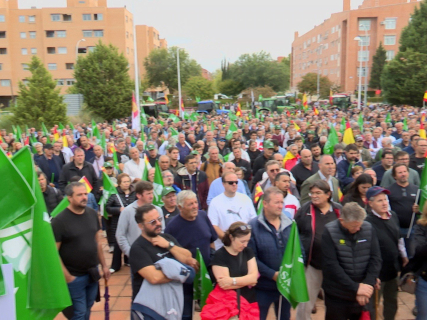

An important deployment of farmers, with a thousand people and several dozen tractors called by Asaja Castilla-La Mancha, has concentrated in front of the headquarters of the Ministry of Sustainable Development to convey their "fed-up" feeling about the situation facing the countryside in the region.
According to the organizers, more than 90 tractors have attended the protest —mostly from different municipalities in the province of Toledo— and around 2,000 attendees.
In contrast, sources from the Government Delegation consulted by Europa Press have lowered these figures and pointed out that 51 tractors and 1,500 people have been counted.
The president of Asaja, José María Fresneda, has thanked the support of Cooperativas Agro-alimentarias Castilla-La Mancha for this call, and has warned that the mobilizations "are not going to stop," also emphasizing that the proximity of the general and regional elections may help their demands gain more impact.
"The important thing is that farmers take the floor, take the squares, take the streets, take the administrations starting today," Fresneda stated, calling on professionals in the field to maintain pressure.
The agricultural leader has lashed out at the political class that thinks "the agricultural sector is encapsulated in an ideology." "We are here because we want freedom. What they are doing is sheltering an ideology that we no longer want, nor need, nor is necessary, nor will guarantee that tomorrow there will be food sovereignty in this country."
In front of the doors of the Ministry of Sustainable Development, Fresneda has denounced that "there are people sitting at their tables watching how hate is injected into the productive model of a farmer." In his opinion, "they are only thinking about releasing pests, releasing animals, decreeing with the Special Protection Areas for Birds (ZEPA), decreeing anything to harm the productive model."
He explained that, with these protests, they also aim to stop "the proposal that the Ministry of Agriculture wants to make by diverting money from direct payments to farmers to take it to rural development programs." Regarding this issue, he stated: "Let them pay for the parties."
In relation to water, he has warned that the fourth cycle of hydrological planning "nullifies any possibility of increasing irrigation and even of maintaining it," which in his opinion seriously compromises the future of many farms.
Fresneda has emphasized that "we are open to negotiating whatever is necessary. We want to have an agreement on fire issues, we want people to harvest, we want people not to lose their hectares to rabbits, we want people to be able to irrigate peacefully, we want to maintain our production costs and for the food chain law to be respected."
Likewise, he has warned of the "risk" that, in his view, society assumes "by consuming products from third countries" that do not meet the same requirements in food safety, animal welfare, and environmental protection that are demanded of producers in Castilla-La Mancha.