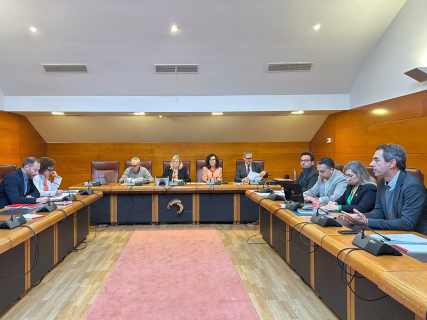

The Bill of Authority of the Teaching Staff and School Coexistence in the educational centers of Cantabria will reach the Plenary of the Parliament next Monday, October 26, for its debate and final approval, after this Wednesday 19 partial amendments promoted by PP and Vox have been incorporated, five of them registered jointly.
The modifications have been approved in the Education Commission, where, on the contrary, the amendments presented by the PRC, the PSOE, and the non-attached deputy Cristóbal Palacio have been rejected. The 'popular' spokesperson in the commission, Álvaro Aguirre, has defended that the text of the regional government, articulated in 20 articles, is "good," although with "small things" that it was advisable to "improve and clarify," which has justified the presentation and approval of the amendments from the PP.
Among the accepted changes are proposals to recognize the right of teachers to digital disconnection, limit the suspension of the right to attendance to a maximum of five days when applied as a provisional measure, and specify which behaviors hinder or prevent the right to learn or the duty to study, so that they are classified as harmful to coexistence.
As a result of the agreement between PP and Vox, which will allow the 'popular' party, in parliamentary minority, to push the law forward, both groups have presented five additional joint amendments. One of them specifies, within the harmful behaviors for coexistence, the capture and dissemination of images or audios.
The rest of the agreed amendments aim to detail that, in cases of bullying, the separation of the group from the person or persons attributed with such behaviors will be prioritized; to specify the treatment of damages caused through digital means; and to recognize specific mediation programs as part of educational measures when conflicts occur.
The PP deputy has emphasized that the teaching staff requires legal support in the exercise of their functions, such as that which this law will provide, and has stressed that this authority "is not a privilege," but "the guarantee that they can carry out their work with the respect they deserve, because without authority there is no possible learning."
In his opinion, the teaching and pedagogical authority "is the best guarantee of coexistence" and both concepts, Aguirre has added, are integrated into the norm because "in practice they are inseparable." "This law builds a very important triple approach for the classrooms of Cantabria: the preventive, the disciplinary, and the resolutive. It seeks to anticipate conflicts, organize them when they arise, and resolve them effectively," the parliamentarian has pointed out.
Regarding the position of the PP, Aguirre has defended support for the amendments from Vox because, in his view, they "enrich" the text in "highly positive" aspects, such as the protection of teachers' rights and the exercise of the teaching function, the reinforcement of coexistence protocols, or the recognition of all forms of harassment and violence. He has admitted that some proposals from Palacio seem "frankly interesting" to them, but he has argued that they "do not fit" in the text submitted by the Government.
On the other hand, the PP has voted against the PSOE amendments considering them "very poorly worked," distant from the model of law they defend, "antagonistic," or overlapping with other proposals from the PP and PRC. They have also rejected those from the PRC because, as he has said, they represent "a dumping" of the total amendment that the regionalists, like the socialists, already presented and which was rejected in the Plenary.
For his part, the Vox deputy Armando Blanco has justified the vote against the amendments from Palacio, PSOE, and PRC for "not contributing anything to the text, being repetitive, not meeting the minimum technical quality" or being "contrary to the objective of the norm."
PSOE and PRC defend their proposals against the PP-Vox agreement
From the PSOE, the parliamentarian Jorge Gutiérrez has insisted that the amendments from his group do not represent "an obstacle" to the approval of the law, but "an opportunity to improve it" and turn it into a "truly useful tool."
He has detailed that their proposals seek a law "clearer, more protective, and effective," that protects teachers without undermining the rights of students and that combines the correction of behaviors with prevention, reparation, and education.
The regionalist deputy Teresa Noceda has rejected that the 34 amendments of the PRC are a simple reproduction of the alternative text that her group already defended and that was rejected, and has maintained that they aim to "correct the real shortcomings" detected in the project. Her objective, she has said, is for Cantabria to have a law that "does not limit itself to recognizing the authority of the teaching staff, but guarantees their protection and provides centers with tools to improve coexistence," a task she has described as "a shared responsibility."
In this line, the PRC has voted against the amendments agreed upon by PP and Vox, understanding that the resulting norm "should give much more space to prevention, effective protection, and the obligations of the Administration."