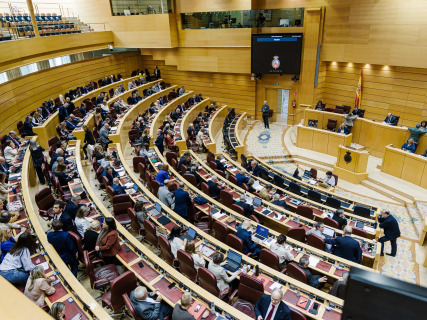

The struggle to secure an absolute majority in the Senate in the next legislature has pushed the left and right blocs to negotiate agreements, aware of the strategic weight that the Upper House has acquired. Its control can be decisive in the renewal of several magistrates of the Constitutional Court and other bodies, in the eventual application of article 155 and in the pace of processing laws.
PSOE, Frente Amplio, and other leftist forces have reached an agreement to run jointly in 47 Senate constituencies. For their part, PP and Vox continue to analyze formulas to articulate coordinated lists to the Upper House for the elections on November 29.
In the recently concluded legislature, the PP enjoyed an absolute majority in the Senate, while in the Congress the majority lay with the PSOE and its allies. This distribution of forces has translated into a reinforcement of parliamentary control, the initiation of several investigative commissions, the veto and slowing down of certain legislative initiatives from the Government, and even various institutional clashes between both Chambers.
In light of this scenario, the two blocs have internalized the strategic value of the Senate and have initiated alliances with the aim of dominating the Upper House for the next four years.
A politically secondary role until now
Traditionally, the political impact of the result in the Senate was considered limited. It does not participate in the election of the president of the Government and its role in the drafting of laws is not definitive, as the amendments or modifications it approves can be reversed by the Congress, which retains the final word.
However, the absolute majority of the PP has turned the Senate into a "counterweight" to the Government in this legislature, highlighting its capacity to veto laws, prolong the processing of sensitive regulations such as the amnesty, or condition the renewal of the magistrates of the Constitutional Court that it is responsible for designating.
The Senate is also key to activating article 155 of the Constitution, as seen in the case of Catalonia in 2017. The Executive must send a project to the Upper House, which must debate and approve it by absolute majority; without that endorsement, the Government cannot adopt measures under that constitutional provision.
In previous legislatures, the Senate also had a decisive role in the approval of the so-called spending ceiling, as it could veto it and force the Executive to present it again. However, in this mandate, the Ministry of Finance has eliminated the High Chamber's power to block that spending limit.
Keys in the constitutional bodies and other competencies
One of the main reasons why control of the Senate is disputed is its participation in the appointment of the four magistrates of the Constitutional Court that correspond to it, whose renewal is still pending in the current legislature.
To elect or renew the magistrates of the Constitutional Court that depend on the Senate, a three-fifths (3/5) majority of the members of the Chamber is required. Thus, if one of the blocks were to reach 160 seats, it could carry out those appointments autonomously.
The Court of Auditors is another body in which the Senate has a decisive role, by electing six of its twelve counselors, also with a three-fifths majority. In addition, the High Chamber intervenes in the approval of treaties or international agreements and in the reforms of the statutes of autonomy.
Among the competencies of the Senate is also the possibility of creating investigative commissions. The PP has taken advantage of its absolute majority in this legislature to promote up to seven parliamentary investigations.
Likewise, the Senate has the capacity to modify its internal Regulations, set criteria on the use of co-official languages within the institution, politically guide the debate on the use of Artificial Intelligence (AI), and exert greater influence in the management of the Chamber's own Budgets.