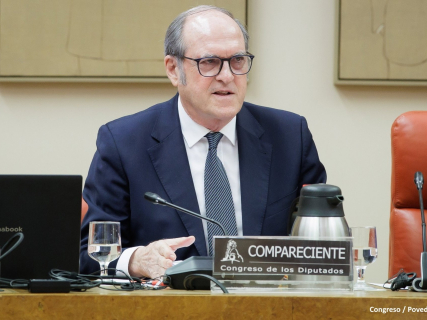

The political party Iustitia Europa has filed an urgent document with the Constitutional Court opposing the precautionary measure requested by the Ombudsman, Ángel Gabilondo, regarding the 'grandchildren's law', with the aim of keeping the Supreme Court's resolutions on the registrations in the Electoral Census of Absentee Residents (CERA) in force.
The Ombudsman filed an amparo appeal before the Constitutional Court against the Supreme Court's decision to suspend the voting rights of individuals who obtained nationality under the 'grandchildren's law' included in the Democratic Memory Law.
Gabilondo thus addressed the requests made by "individuals and entities," and has demanded the Constitutional Court to adopt precautionary measures, in addition to a ruling on the interpretation that the Supreme Court makes regarding "the suspension of the fundamental right to vote" of those affected, as detailed by the institution in a statement released this Friday.
In response, Iustitia Europa has warned that nullifying the Supreme Court's resolutions would alter the framework of the general elections on November 29 before the guarantees court resolves on the substance of the amparo appeal. Likewise, it has emphasized that agreeing to a measure of this scope without hearing the parties involved would cause accomplished and irreversible effects on the development of external voting, with no real possibility of prior contradiction.
The party has recalled that the origin of the judicial conflict lies in its complaint on June 28 before the Central Electoral Board, following the impact of the eighth additional provision of Law 20/2022 and the instruction of October 25, 2022.
As explained, on July 21 it went to the Supreme Court through an ordinary appeal, after which the Third Chamber agreed on precautionary measures on September 10 and confirmed them on October 12, rejecting the appeals for reconsideration filed by the General State Administration and the National Institute of Statistics.
The president of Iustitia Europa and responsible for its legal direction, Luis María Pardo, has stated that in this procedure the "ordinary legal route" has been strictly followed, with the prior intervention of the electoral body and the endorsement of the high court when the electoral process was already underway. For this reason, the legal representative has pointed out that "reversing" this situation without hearing the parties implies "de facto altering a legal situation built within the ordinary legality," as indicated in a statement released this Saturday.
Pardo has also warned that a possible suspension of the Supreme Court's orders would set a precedent of special institutional gravity in the relationship between ordinary jurisdiction and constitutional jurisdiction. In his view, resorting to an extremely precautionary measure to temporarily replace the legality criterion of the Third Chamber violates the principle of legal certainty and affects the stability of the electoral call.
"Sánchez is taking this issue to a dangerously institutional terrain. After the State appealed and lost before the Supreme Court, it is now intended that a constitutional precautionary decision without hearing us produces the practical effect that was not obtained in ordinary jurisdiction," Pardo stated in the document.
In this line, the document maintains that the action promoted by the Ombudsman seeks to neutralize the Supreme Court's resolutions and "materially coincides" with the position defended by the Executive.
For all these reasons, the formation has formally requested the Constitutional Court to reject the requested suspension and maintain the effectiveness of the orders from September and October, which establish an individualized system of consular certification. Subsidiarily, Iustitia Europa requests that any provisional decision be made after an urgent and mandatory hearing of the parties involved and the Public Prosecutor's Office.