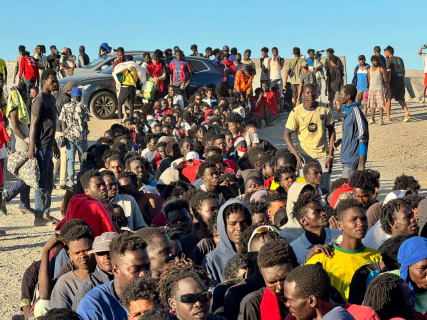

The National Court has opened a new line of investigation into the migration crisis in Ceuta by ordering the Information Headquarters of the Civil Guard to report specifically on whether any of its units received alerts or information prior to the massive entry of citizens from Morocco on July 30 and 31. The order, which has been accessed by DEMÓCRATA, represents a new impetus to the proceedings opened following the complaint filed by Iustitia Europa and focuses on one of the most controversial aspects of the management of the crisis.
The resolution, signed on August 4 by Judge María Tardón, head of the Instruction Section, Plaza No. 3, of the Central Court of the National Court, agrees to carry out new proceedings within the Preliminary Proceedings 64/2026, opened to investigate a possible crime against the peace and independence of the State.
Among them, it orders the Information Headquarters of the Civil Guard to send a detailed report on the operation deployed during the massive irregular entry from Moroccan territory.
The doubt of prior alerts
However, the aspect of greatest political and judicial significance of the order is that the National Court does not consider the issue of possible prior alerts closed.
The judge expressly requests that it be reported whether any unit of the Civil Guard in Ceuta received, in the days leading up to the events, communications or warnings that allowed for the anticipation of what happened. This is a line of investigation that is especially relevant, as the Government has publicly maintained that there were no alerts anticipating the crisis.
The order does not conclude that such alerts existed, but does indicate that the judicial body considers it necessary to verify this before dismissing that possibility. With this request, the National Court seeks to determine what information the State Security Forces and Corps had before the massive entry, what was the operational response deployed, and whether the actions taken corresponded to the information available at that time.
In addition to the possible alerts, the judge requests information about the device deployed by the Civil Guard to address the crisis, the rescue operations carried out in Spanish territorial waters, and the known circumstances regarding the individuals located during those days. She also requires data on the fatalities, including, where applicable, the cause and date of death, as well as the identification of the survivors for whom information has been gathered.
Was there a coordinated action with Morocco?
These proceedings respond to several of the questions raised by Iustitia Europa in the complaint that gave rise to the procedure. The political formation, which acts as the complainant in the case under the legal direction of lawyer Luis María Pardo, argues that it is necessary to clarify what information the authorities had prior to the mass entry, what measures were taken to respond to the situation, and whether the events could have been the result of a coordinated action from Moroccan territory.
After the resolution was made known, Pardo stated that the investigation "continues to advance in the direction we pointed out from the very first moment" and emphasized that now it will be the Civil Guard itself that must officially inform about the deployed device, the victims, and, especially, about the possible alerts received before the events.
Brussels gathers the Committee on Civil Liberties and Justice
The expansion of the proceedings coincides, moreover, with a moment of growing international attention on the Ceuta crisis. This Thursday, the Committee on Civil Liberties, Justice and Home Affairs of the European Parliament will debate the situation recorded in the autonomous city following the proposal promoted by the European People's Party, incorporating the episode into the community agenda due to its implications regarding border control, immigration, and security.
From Iustitia Europa, they believe that this judicial evolution reinforces the need to fully clarify what happened before political conclusions can be drawn. The organization argues that, while the National Court continues to investigate whether there was a coordinated action and whether there was sufficient prior information to anticipate the crisis, some member states of the European Union have chosen to adopt measures that, in their opinion, shift the consequences of the episode to the state that suffered the migratory pressure.
With the provision known as DEMÓCRATA, the investigation now enters a particularly sensitive phase. The information sent by the Civil Guard will allow the National Court to determine if there were intelligence elements or prior warnings about the massive entry from Morocco, how the response operation was organized, and if there are new facts that justify the continuation of an investigation that has already placed the Ceuta crisis at the center of judicial and political debate.