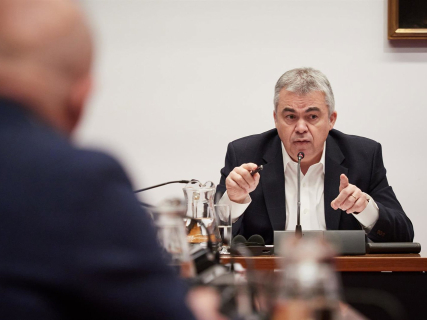

The magistrate of the National Court who is instructing the 'Leire Díez case', Santiago Pedraz, has decided not to attribute criminal responsibility to the PSOE for the moment and postpones any decision in that regard until completing more proceedings, including the statement of former socialist leader Santos Cerdán, after the PP formally requested the indictment of the party.
In an order to which Europa Press has had access, the judge states that, although the facts being investigated "could present in abstract a criminal appearance on the part of the PSOE, a piece of evidence or principle of proof that reasonably supports its reality has not yet been incorporated."
With this resolution, Pedraz aligns with the criterion of the Anti-Corruption Prosecutor's Office, which in a recent report considered it premature to indict the socialist formation. The Public Prosecutor admitted the existence of indications of possible criminal conduct of the alleged plot aimed at obstructing judicial proceedings affecting the PSOE and the Government, supposedly led by Cerdán and coordinated by former socialist member Leire Díez.
"The truth is that with what has been acted upon, what is being called a 'principle of proof' to attribute the condition of investigated is not accredited," emphasizes the instructor, who details that the principle of proof "is a data, element, or objective source that provides a minimum support to the reality of the stated fact," that is, that "it does not prove the fact, but gives it an objective basis."
The judge points out that "the eventual and indicative attribution of criminal responsibility to the PSOE for the crimes allegedly committed" by Cerdán and by the party manager, Ana María Fuentes, already investigated in this case, would have to be assessed.
Issues to clarify and analysis of documentation
Before being able to indict the party, Pedraz considers it essential to clarify "what real powers Santos Cerdán had within the structure of the party"; "who authorized and executed the payments investigated in the case" to Leire Díez and other supposed members of the network, allegedly in exchange for their services; "what internal controls existed"; "if there were relevant failures in the supervision mechanisms" and "if the party obtained any benefit from the investigated conduct." All these aspects, he emphasizes, remain unspecified.
To clear up these uncertainties, the magistrate plans to carry out various tests: take a statement from Cerdán, review the documentation seized at the party's headquarters and at the home of the former Secretary of Organization, as well as at the homes of other investigated individuals, including lawyers Jacobo Teijelo and Ismael Oliver, businessman Javier Pérez Dolset, and the former Vice President of the Junta de Andalucía Gaspar Zarrías.
Pedraz also wants to determine if the payments to Leire Díez and other supposed members of the plot "were ordered and satisfied" by Cerdán "from accounts owned by the entity for the commission of the illicit order, allowing to establish an objective connection between the actions of that one and the patrimonial structure" of the alleged criminal organization.
The judge also intends to specify "who materially ordered those payments; who was authorized to dispose of the accounts; how it was accounted for; what concept was recorded in the transfer or accounting; if there were invoices, contracts, or other documents intended to provide an apparent cover for the payment; who authorized or internally validated the expense; if the financial or accounting department intervened" and "if the administrative bodies were aware of the payments."
The unified popular accusation, led by the PP, demanded the indictment of the PSOE understanding that the proceedings already carried out "confirm" that the party "covered" the expenses of the alleged network "at the indication" of Santos Cerdán, and attributes possible crimes of bribery, influence peddling, money laundering, and illegal financing to it.
Relevance of the statements and scope of responsibility
In his resolution, Pedraz adopts the arguments of the Anti-Corruption Prosecutor's Office, which considers it necessary to "complete the proceedings that allow to specify the indications of the own criminal responsibility that weigh on the conduct of Cerdán."
The prosecutors highlight the significance of the statements of Cerdán, Díez, Zarrías, and Juan Manuel Serrano, former president of Correos and former chief of staff of Pedro Sánchez in the PSOE, according to a report that Europa Press has also accessed.
Likewise, the Prosecutor's Office emphasized that, based on the statements of Fuentes and the president of the PSOE, Cristina Narbona, as well as the party secretaries, Covadonga San Pedro and Celia Rodríguez, "it seems evident that there was no control mechanism over the management that Cerdán made of the party's accounts."
The Public Prosecutor's Office, which appreciates "multiple indications" about Cerdán's actions, insists on the importance of differentiating "the eventual personal criminal responsibility of those managers from the possible autonomous criminal responsibility of the organization."
"The responsibility of the legal entity cannot be affirmed by the simple accreditation of the crime committed by the natural person integrated into the organization; it will be necessary to analyze whether its commission was possible or facilitated by the inexistence or ineffectiveness of specific mechanisms of surveillance and control," the Prosecutor's Office specifies.
On the other hand, the Public Prosecutor's Office maintains that with "the proceedings carried out to date, there is no doubt that Cerdán was authorized to make decisions on behalf of the organization and held powers of organization and control within it."
However, it specifies that Cerdán "must be heard" to "clarify his powers, functions effectively performed, capacity to dispose of the bank accounts, autonomy in contracting, and dependence on the governing body, the CEF (Federal Executive Commission) and his determination and responsibility in contracting the services of Díez."