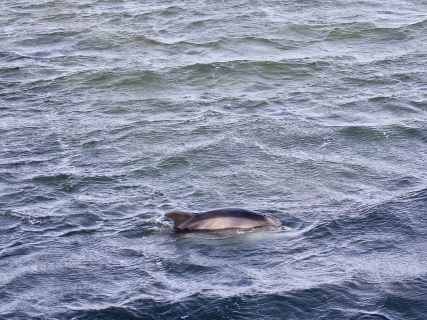
Controversy in Ceuta over images of a group of migrants with a baby dolphin on the beach

2 minutes

EuropaPress 4109746 tres delfines liberados permanecer varados puente 27 noviembre 2021 toxa

EuropaPress 4109746 tres delfines liberados permanecer varados puente 27 noviembre 2021 toxa

Add DEMÓCRATA to Google

Ask FREN

Published

2 minutes

Most read

An environmental association has reported to the Civil Guard the death of the animal and claims that it was taken alive from the water and beaten. The images circulated on social media do not allow for confirmation on their own of how the cetacean died, and the case is being investigated.

The images of a group of migrants carrying a baby dolphin on the Trampolín beach in Ceuta have caused outrage and numerous comments on social media in recent hours. The episode has also ended with a report to the Civil Guard to clarify the death of the animal.

The video, recorded this Wednesday on the Ceuta beach, shows several people around the cetacean and later moving it out of the water. The images are current and correspond to the Trampolín beach, according to what Newtral has been able to verify.

The recording does not allow for determining on its own whether the animal was alive when it was picked up or what the cause of its death was. In the video itself, when the person recording asks who killed the dolphin, some of the migrants respond in French that "it was dead."

An association reports the facts to the Civil Guard

The controversy has jumped from social media to the Civil Guard. The Association for the Defense of Urban Trees, Biodiversity, and the Environment (DAUBMA) has filed a formal complaint this Friday regarding what happened and has requested that proceedings be opened to determine how the cetacean died.

The version maintained by the organization is more serious than what can be verified solely in the viral video. DAUBMA claims to have gathered photographs, videos, and screenshots from social media that, according to their complaint, would show that the baby arrived alive and disoriented at the shore, was taken out of the water, and subsequently beaten on the head.

The association has submitted this material to the Civil Guard and demands the identification of possible responsible parties, a report from the competent authorities, and that the actions be forwarded to the Environmental Prosecutor's Office.

This version must be clarified by the investigators. The images that have gone viral and show the group carrying the animal do not by themselves prove that the migrants caused its death. Security sources consulted by Newtral have confirmed that the death of the cetacean is being investigated.

The images go viral

The video began circulating this Thursday on platforms such as X, Instagram, Facebook, TikTok, and Threads, accompanied in some cases by messages that directly attribute the animal's death to the people appearing in the images.

The dissemination has generated a wave of criticism and outrage on social media and has also prompted calls to identify those involved. The episode occurs while Ceuta continues to manage the consequences of the massive influx of migrants recorded at the end of July.

The case is now pending the investigation into what happened before the images were disseminated, what condition the calf was in when it reached the shore, and what the cause of its death was.

More key points, information and questions with FREN

AI-GENERATED CONTENT

What are the competences of the Guardia Civil in the protection of fauna and the environment?

The Guardia Civil plays a central role in the protection of fauna and the environment in Spain, both by general legal mandate and through specialized units, especially SEPRONA (Nature Protection Service). Its competences combine functions of administrative police, judicial police, and assistance to other environmental administrations.

General framework of competences

As a State Security Force and Body, the Guardia Civil:

  • Monitors compliance with state and regional regulations regarding the environment, natural spaces, waters, forests, waste, atmosphere, coasts, natural heritage, and biodiversity.
  • Performs judicial police functions when there are indications of a crime (for example, crimes against natural resources, intentional forest fires, illegal trafficking of species).
  • Collaborates with environmental administrations (ministries, autonomous communities, hydrographic confederations, municipalities) in inspection, control, and implementation of measures.

SEPRONA: specialized unit

The core of the Guardia Civil's action in this area is SEPRONA, present throughout the territory. Its specific competences include:

  • Preventive surveillance of the natural environment: patrols in rural areas, protected spaces, riverbeds, forests, and areas of high ecological value to detect illegal activities or environmental risks.
  • Inspection and investigation of administrative infractions and environmental crimes, preparing reports and submitting them to the judicial authority or the competent administration.
  • Technical support in complex investigations (fauna poisonings, pollutant spills, illegal species trade networks, etc.), in coordination with specialized prosecutors and judges.

Protection of wildlife

Regarding fauna, the competences of the Guardia Civil include:

  • Control of hunting and fishing: verification of licenses, quotas, open seasons, permitted methods, and respect for protected species, both in inland waters and terrestrial environments.
  • Persecution of poaching and prohibited methods (snares, poisons, illegal nets, traps, electronic calls…), including operations against organized networks of illegal hunting and capture.
  • Action against illegal trafficking of species of flora and fauna, both native and exotic, including interventions at airports, roads, and shops (pet stores, markets, online sales).
  • Investigation of fauna poisonings, especially of threatened species (birds of prey, scavengers, large predators), with sample collection, evidence custody, and coordination with laboratories.
  • Collaboration in the recovery of injured or disoriented animals, placing them at the disposal of wildlife recovery centers and competent veterinary services.

Protection of the environment and natural resources

Beyond fauna, the Guardia Civil acts on a wide range of environmental areas:

  • Waste and spills: control of illegal landfills, transport and management of hazardous waste, discharges into surface or underground waters or soil, pollutant emissions, and irregular industrial activities.
  • Forests and forest fires: monitoring forest uses, timber harvesting, and activities that may generate fire risk; in fires, investigation of causes and possible criminal liabilities.
  • Urban planning and land management: support to authorities against illegal constructions on rural land, improper occupation of public domain, alterations of riverbeds or coasts, and other damages to landscapes or protected spaces.
  • Protection of natural spaces: control of activities within national parks, natural parks, and other protection figures (vehicle circulation, illegal camping, unauthorized species collection, impactful sports or tourism activities).
  • Control of economic activities that affect the environment (farms, livestock operations, quarries, mining operations, fish farms, etc.), verifying permits and environmental conditions.

Institutional coordination and environmental education

The Guardia Civil also performs functions of cooperation and awareness:

  • Participation in joint operations with other security forces, regional forestry services, environmental agents, and water or coastal authorities.
  • Collaboration with environmental specialized prosecutors, providing technical reports, expert opinions, and investigation follow-up.
  • Development of informative and educational campaigns in schools, associations, and rural municipalities about fauna protection, fire prevention, responsible use of the natural environment, and reporting environmental crimes.

Overall, the Guardia Civil, and particularly SEPRONA, acts as a key piece of the environmental protection system in Spain, integrating daily territorial surveillance with criminal investigation and collaboration with other administrations and civil society.

What procedures does the Environmental Prosecutor's Office follow in similar cases?

The Environmental and Urban Planning Prosecutor's Office acts as a specialized prosecutor within the Public Prosecutor's Office, applying the general rules of the Criminal Procedure Law but with its own protocols and criteria for prosecuting environmental crimes. Although there may be nuances depending on the autonomous community, the basic operational scheme is quite homogeneous.

1. Start of the procedure: how the case arrives

The action usually begins through one of these channels:

  • Complaints from individuals (citizens, environmental associations, NGOs, unions, etc.).
  • Police reports or statements, especially from SEPRONA (Guardia Civil), regional or local police.
  • Communications from the Administration (hydrographic confederations, environmental departments, municipalities, coastal authorities, etc.).
  • Ex officio action, for example, based on press reports or alerts about fires, massive spills, or irregular urban works.

At this stage, the Prosecutor's Office performs an initial screening: it reviews whether, in abstract, the facts could fit a criminal type (crime against natural resources, land use planning, forest fire, animal abuse, etc.) or if they seem exclusively administrative matters.

2. Prosecutor's investigative proceedings

When minimal indications of a crime are perceived but the information is insufficient, the Prosecutor's Office opens investigative proceedings (pre-procedural proceedings), with several objectives:

  • Specify the facts (when, where, how, with what impact).
  • Identify the alleged responsible parties (natural and legal persons).
  • Quantify or describe the environmental damage and its relevance.
  • Assess whether the typical elements of the crime concur (severity, risk to health or ecosystems, intent or gross negligence, etc.).

To do this, the Prosecutor's Office may:

  • Request technical reports from administrative bodies (environment, waters, coasts, urban planning).
  • Order proceedings to SEPRONA, regional police, local police, or environmental agents.
  • Request documentation (licenses, sanction files, urban plans, discharge authorizations, etc.).
  • Hear statements from complainants, company officials, municipal technicians, etc.

3. Coordination with security forces and administrations

The Environmental Prosecutor's Office systematically relies on the specialized judicial police (mainly SEPRONA and regional police with environmental units) and on the technical services of the administrations. It is key to:

  • Coordinate on-site inspections, sample collection, and measurements.
  • Contrast the situation with applicable regulations (urban plans, water, atmosphere, waste, protected fauna regulations...).
  • Ensure that evidence is not destroyed (work stoppage, machinery immobilization, seals, etc., when appropriate and already in judicial venue).

In many territories, there are delegated prosecutors for Environment and Urban Planning, who maintain stable coordination channels with administrative services and police forces, facilitating a rapid response in fires, spills, or urgent demolitions.

4. Key decision: dismissal or prosecution

Once the investigative proceedings are carried out, the Prosecutor's Office adopts a resolution:

  • Dismissal of proceedings, when:
    • The facts do not constitute a crime (mere administrative infraction).
    • There is no known author nor reasonable possibilities to identify one.
    • The evidence is clearly insufficient to support even a minimal criminal accusation.
  • Referral to the administrative route, when the appropriate response is a sanction or environmental restoration measure by the Administration, but there is insufficient criminal relevance.
  • Filing of complaint or lawsuit before the competent Investigating Court, when reasonable indications of a crime are perceived and there are possibilities to sustain an accusation.

5. Judicial phase: relationship with the investigating court

Once the case is presented in court, the Prosecutor's Office acts as in any criminal procedure, but with thematic specialization:

  • Promotes investigative proceedings (expert reports, technical reports, statements of suspects and witnesses).
  • May request precautionary measures (stoppage of polluting activities, closure of facilities, obligation to provisionally restore, bonds, etc.).
  • Supervises that environmental damage and civil liabilities for restoration or compensation are proven.

At the end of the investigation, the prosecutor may:

  • Request dismissal (judicial archiving) if they understand there is no basis to accuse.
  • File an indictment, detailing facts, crimes, and requested penalties, as well as civil liability.
  • Promote a plea agreement with the defenses (guilt and penalty agreement) when the law allows and it is appropriate.

6. Substantive criteria in environmental cases

Transversally, the Environmental Prosecutor's Office usually applies some constant criteria:

  • Relevance of damage or risk: priority is given to cases with severe or massive impact, or risk to public health.
  • Repeated or professional conduct: more attention to business or institutional activities that systematically infringe regulations.
  • Principle of minimal intervention: reserving criminal law for the most serious cases, leaving minor ones to the administrative route.
  • Damage repair: seeking not only punishment but restoration of the environment and prevention of new infractions.

How many environmental complaints have been filed in Ceuta in recent years?

With the information available from open sources consulted right now, it is not possible to provide a single and precise figure of “how many environmental complaints have been filed in Ceuta in recent years” as a complete series broken down by year. Some partial data and references can be extracted that help approximate the context and order of magnitude, but they do not add up to a closed total for the city.

What specific data exists about Ceuta

From the official sources located, the most direct data specifically referring to Ceuta comes from the Maritime Captaincy of Ceuta, dependent on the Ministry of Transport and Sustainable Mobility.

  • In its 2024 activity report, the Maritime Captaincy of Ceuta initiated 74 sanctioning proceedings against vessels (mainly recreational boats and jet skis) for different infractions related to navigation (licenses, insurance, safety equipment, etc.).
  • Within that set, it expressly notes the opening of 4 sanctioning proceedings against merchant ships for causing marine pollution, highlighting the case of the chemical tanker K ONSET, which was imposed a guarantee of 600,000 euros for the spill of more than 27,000 liters of fuel in the port of Ceuta (source: official Transport note of 01/31/2025 and expanded in this statement).

Those 4 proceedings for marine pollution in 2024 are, therefore, a subset of complaints or procedures with environmental content in Ceuta, but they are limited to the port and maritime scope and to a single year. They do not include other possible cases of land spills, waste, fauna, inland waters, urban planning, etc.

General data on environmental complaints in Spain

To put Ceuta in context, general statistics for Spain show that sanctioning and criminal activity in environmental matters is relevant:

  • According to a note from the Ministry of the Interior about SEPRONA of the Guardia Civil (06/05/2024), more than 100,000 administrative infractions were reported in 2023 linked to its scope of action. Approximately 20 % of those infractions were related to waste and spills. ( Ministry of the Interior note ).
  • The same note indicates that SEPRONA has doubled its actions for crimes against natural resources and the environment in the last five years, reaching more than 6,500 criminal proceedings in 2023 nationwide and a clearance rate above 80 %.
  • Another example is the European LIFE program, which highlights the existence in Spain of a website to receive environmental complaints that generated 681 written complaints and more than 1,200 inquiries, leading to police operations against environmental crimes (illegal spills, waste, water, fauna, etc.). ( LIFE Awards 2024 ).

None of these sources, however, offer a specific breakdown for Ceuta that allows knowing how many of those infractions, crimes, or complaints have occurred exactly in the autonomous city year by year.

Why there is no single figure for Ceuta

Environmental complaints or infractions in a territory like Ceuta are usually recorded in multiple systems and administrations:

  • Guardia Civil (SEPRONA) and National Police, when there are indications of criminal offenses.
  • Maritime Captaincy and Port Authority, for spills and pollution in port waters.
  • Environmental services of the Autonomous City, for administrative files on waste, noise, soils, etc.
  • Environmental Prosecutor's Office, when complaints are channeled directly through criminal proceedings.

Each body keeps its own statistics and often the data are published aggregated by province or at the national level, without detailed breakdown for Ceuta or without clearly distinguishing which files are strictly “environmental” versus other types of infractions.

Conclusion and how to refine the information

With the sources accessible right now, it can be stated that:

  • There is evidence of at least several sanctioning proceedings for marine pollution in Ceuta in recent years (for example, the 4 proceedings against merchant ships in 2024 in the port of Ceuta).
  • The volume of environmental complaints in Spain as a whole is high (more than 100,000 administrative infractions per year in SEPRONA's scope), but a specific historical series for Ceuta that allows providing the total figure you request is not published directly.

To obtain a more precise figure, it would be necessary to request detailed statistical information from:

  • The Guardia Civil (SEPRONA) about criminal and administrative actions in the Ceuta area.
  • The Ceuta Prosecutor's Office about proceedings and investigations for environmental crimes.
  • The Autonomous City of Ceuta about environmental sanctioning files under its competence.

Only by combining those records could a robust series of “environmental complaints in Ceuta” by year be constructed. With the public information located now, that global figure cannot be established with rigor.

Play

Test your knowledge with FREN!

How much do you know about this topic? Answer the following 3 questions.

On which beach in Ceuta did the dolphin calf episode occur?

Question 1 of 3

Which organization filed the formal complaint with the Civil Guard?

Question 2 of 3

What does the DAUBMA association request in its complaint about the dolphin's death?

Question 3 of 3

Hola, soy Fren. ¿Cómo te ayudo?