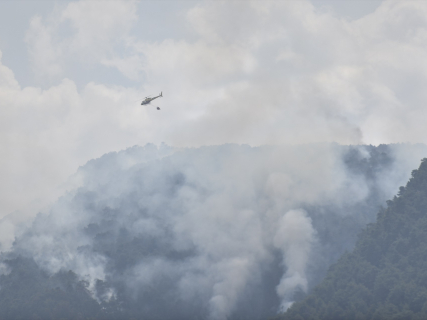
Fires in Spain today, August 19: Las Hurdes forces the evacuation of 700 people while Riglos improves

The fire in Pinofranqueado, in Cáceres, becomes the main focus of the day after activating level 2 and mobilizing the UME, while Las Peñas de Riglos moves towards stabilization.

3 minutes

incendios 19 agosto

incendios 19 agosto

Add DEMÓCRATA to Google

Ask FREN

Published

Last updated

3 minutes

Most read

The situation of the wildfires changes this Wednesday compared to the previous day. The main focus is now in Las Hurdes, in the province of Cáceres, where a fire declared in the area of Pinofranqueado has forced the evacuation of around 700 people from several hamlets and has led to the activation of operational situation 2 of the INFOCAEX Plan. The emergency has also required the mobilization of the Military Emergency Unit (UME).

Meanwhile, the fire in Las Peñas de Riglos, in Huesca, shows a much more favorable evolution than in recent days, after affecting about 17,500 hectares. The stabilization of a good part of the fronts has allowed progress in the return of the evacuees, although the operation continues deployed over the wide perimeter of the fire.

Las Hurdes becomes the main focus after evacuating about 700 people

The fire declared in Pinofranqueado, in the Cáceres region of Las Hurdes, concentrates this Tuesday the largest forest emergency in the country. The evolution of the fire forced the evacuation of different hamlets from the municipalities of Pinofranqueado and Nuñomoral, including El Gasco, Cerezal, Martinlandrán, La Fragosa, Avellanar, Horcajo, Erías, Castillo, and Robledo.

The Junta de Extremadura raised the response to level 2 of danger and activated operational situation 2 of the INFOCAEX Plan due to the risk to people and property. The device has land resources, heavy machinery, and a wide aerial deployment, to which the UME has joined. The evacuees have been transferred mainly to resources set up in Caminomorisco.

Las Peñas de Riglos improves and moves towards normalization

The fire of Las Peñas de Riglos leaves behind the most critical situation of last week. The rain and the improvement of weather conditions allowed the stabilization of most sectors after several days in which the fire kept more than a thousand people evacuated and forced the deployment of an extraordinary device.

Work is now focused on consolidating the perimeter, monitoring possible hot spots, and completing the return to the affected areas. The evolution represents a significant change compared to the days when the flames threatened the surroundings of San Juan de la Peña and forced the evacuation of numerous towns and camps.

Niebla remains stabilized after the great emergency in Andalusia

The fire in Niebla, between Huelva and Sevilla, remains stabilized after becoming one of the largest wildfires of the summer. The emergency affected a large area and forced the deployment of a broad autonomous and state device before favorable developments allowed for the lifting of evacuations.

The ongoing work is focused on perimeter surveillance and preventing reproductions. The fire no longer concentrates the emergency situation of previous days, although the device continues to monitor the affected areas while the assessment of damages continues.

Beniardà is under control amid extreme risk alert

In the Comunitat Valenciana, firefighters have declared the Beniardà forest fire controlled, in the Alicante region of Marina Baixa. The fire broke out on Tuesday in an area of difficult access and forced the mobilization of ground and aerial resources, although its evolution allowed for a gradual reduction of the operation.

The fire coincides with a situation of extreme risk of wildfires that has led the Generalitat to decree extraordinary measures and preventive restrictions in the Comunitat Valenciana. The evolution of Beniardà is favorable, but the weather conditions keep the concern high regarding the possibility of new outbreaks.

Ponteareas maintains an active fire affecting about 40 hectares

Another active focus is located in the parish of Nogueira, in Ponteareas, Pontevedra. The fire has affected around 40 hectares and strong gusts of wind have complicated the extinction efforts by favoring the appearance of secondary outbreaks.

Emergency teams have managed to prevent the flames from reaching homes, although work on the ground continues. The device maintains ground resources and aerial support mobilized during the emergency to completely control the affected perimeter.

More key points, information and questions with FREN

AI-GENERATED CONTENT

What are the legal requirements to activate operational situation 2 of the INFOCAEX Plan in Extremadura?

The “operational situation 2” of the INFOCAEX Plan in Extremadura legally corresponds to “Level 2” of operability regulated in the Forest Fire Fighting Plan of Extremadura (INFOEX Plan). Its activation is essentially linked to the incorporation of extraordinary state resources at the request of the Plan's Management and also to certain scenarios of simultaneous fires.

Applicable regional regulation

The reference legal framework is:

  • DECREE 132/2022, of October 26, approving the Forest Fire Fighting Plan of Extremadura (INFOEX Plan), published in the Official Gazette of Extremadura (DOE No. 210, November 2, 2022).
    Official text: DOE – Decree 132/2022.
  • As a general civil protection framework: Law 10/2019, of April 11, on civil protection and emergency management of the Autonomous Community of Extremadura (BOE-A-2019-7223), which establishes the organization and general principles of emergency response, although the specific operational level requirements are referred to the sectoral plan (INFOEX).

Literal quote about “Level 2” (operational situation 2)

Article 7 of Decree 132/2022 (“Fires according to their operability”) defines the operational levels. Regarding what concerns us here, the provision literally states:

«Article 7. Fires according to their operability.
[…]
− Level 2: referring to those fires in which, at the request of the INFOEX Plan Management, extraordinary state resources are incorporated.
Resources from the Ministry with competencies in forest fires deployed in support of the Autonomous Communities will not be considered extraordinary.
This level may also be declared when the simultaneity of forest fires requires the incorporation of extraordinary resources.»

The same article adds that «all forest fires will be level 0 except those expressly declared as level 1 or 2», and that the level may vary according to the fire's evolution.

Material requirements for activation

From this definition, the substantive requirements to activate operational situation 2 (Level 2) are:

  • It must be forest fires requiring the incorporation of extraordinary state resources (for example, resources from the General State Administration that are not part of the ordinary support provided under usual agreements and devices).
  • Such incorporation of extraordinary resources must occur “at the request of the INFOEX Plan Management”, that is, the mere presence of state resources is not enough: there must be an express decision by the plan management to request them.
  • Alternatively, level 2 may also be declared when there is a simultaneity of forest fires that requires resorting to those extraordinary resources to adequately address them.
  • In both cases, the fire ceases to be manageable with the ordinary resources of the INFOEX Plan in its basic or expanded configuration and requires an extraordinary reinforcement from the State.

Formal requirements and organizational effects

Formally, Decree 132/2022 does not detail the format of the act in the cited fragment, but it can be deduced from the entire plan that:

  • The INFOEX Plan Management is the body that proposes and requests the incorporation of extraordinary state resources, which entails the declaration of Level 2.
  • The classification of the operability level is an express act: «all forest fires will be level 0 except those expressly declared as level 1 or 2». Therefore, operational situation 2 requires a formal declaration of level change.
  • The declaration of Level 2 triggers effects on the technical direction of the extinction. The decree itself foresees that the Commanding Officer assumes the technical direction of fires “that have been declared Level 2 or those which, due to their characteristics, it is deemed appropriate,” reinforcing unified command and inter-administrative coordination.
  • Additionally, greater participation of coordination and support bodies (Steering Committee, etc.) is activated, which gain reinforced competencies in planning and resource allocation when there are Level 2 fires.

In summary, operational situation 2 within the INFOCAEX/INFOEX Plan in Extremadura is activated when the size or simultaneity of fires requires requesting extraordinary state resources, a decision that corresponds to the Plan Management and entails an increase in command level, coordination, and resources within the framework of regional civil protection regulations and Decree 132/2022 itself.

What competencies does the Military Emergency Unit (UME) have in forest fire management in Spain?

The Military Emergency Unit (UME) does not have the ordinary competence to extinguish forest fires in Spain, which belongs to the autonomous communities. Its role is that of a state intervention and extraordinary support force: it is activated when a fire exceeds the autonomous capacity or when a national interest emergency is declared, providing specialized resources, operational command, and coordination within the National Civil Protection System.

Its basic legal framework is based on Royal Decree 416/2006 (creation and initial organization), Royal Decree 1097/2011 (UME Intervention Protocol), Law 17/2015 of the National Civil Protection System, and recent state coordination regulations on forest fires, as well as the organic regulation of the Armed Forces.

General competence framework in forest fires

The consulted sources emphasize that:

  • Prevention, surveillance, and ordinary extinction of forest fires generally correspond to the autonomous communities, which organize their own devices, plans (Infoca, Infocam, etc.), personnel, and resources.
  • The central government has a role of support and coordination, mobilizing state resources (BRIF, MITECO aerial fleet, UME, Security Forces and Corps) when the emergency requires it.
  • The new state royal decree on coordination in forest fires, approved in 2026, strengthens this cooperation by establishing a common framework of action, homogeneous classification of extinction units, common protocols for aerial resources, and safety standards.

What is the UME and on which regulations is it based

According to the official note “UME: Military Emergency Unit”, the UME is a permanent joint force integrated into the Armed Forces, whose mission is to intervene throughout the national territory in cases of serious risk, catastrophe, or calamity.

  • Royal Decree 416/2006 established its creation and initial organization as an emergency intervention force.
  • Royal Decree 1097/2011 approves the UME Intervention Protocol and expressly includes forest fires among the situations justifying its activation.
  • Law 17/2015 of the National Civil Protection System grants it the status of “public emergency intervention and assistance service” and articulates its role in emergencies of national interest.
  • The current organic framework of the Armed Forces is set out in Royal Decree 521/2020, which integrates the UME into the Defense structure.

How and who activates the UME in forest fires

Regarding forest fires, the UME's competencies translate into its capacity to intervene, but not self-activation:

  • The UME does not act on its own initiative in forest fires. Usually, the affected autonomous community requests its support when the fire reaches a size that requires extraordinary resources, as explained in various analysis pieces by Demócrata on “who mobilizes the UME.”
  • This request is channeled through the National Civil Protection System and the Ministry of the Interior, which assesses the need to deploy the UME alongside other state resources.
  • When a national interest emergency is declared due to fires (articles 28‑30 of Law 17/2015), the Minister of the Interior assumes the general direction of the emergency and the operational direction on the ground is entrusted to the UME, which coordinates all mobilized resources (autonomous firefighters, Civil Guard, Civil Protection, etc.).

Operational functions of the UME in fires

In practice, the UME's functional competencies in forest fires are:

  • Direct attack on the fire: specialized ground intervention sections in forest fire fighting (LCIF), with trained personnel and specific extinction equipment.
  • Logistical and communications support: transmission battalions, support and intervention regiments, transport vehicles, ambulances, and advanced telecommunications systems to ensure command and control in complex scenarios.
  • Protection of people and property: deployment in the urban-forest interface, support for evacuations and confinements, defense of critical infrastructures and sensitive points, in coordination with Civil Protection and security forces.
  • Operational coordination: in large fires or national interest emergencies, creation of unified commands to order evacuations, road closures, and resource distribution among fronts, integrating autonomous, state, and local services.
  • Prevention and preparation: planning, training, drills, and, where appropriate, participation in preventive tasks (controlled burns, firebreak openings) within fire campaign plans.
  • International support: possibility of deploying outside Spain in firefighting missions under the European Civil Protection Mechanism or bilateral agreements.

Specific resources and deployment

In recent campaigns, Defense and Interior have detailed that the UME provides for forest fire fighting:

  • Intervention Battalions with dozens of LCIF modules distributed across the peninsula and Canary Islands, able to intervene within hours anywhere in the territory.
  • Hundreds of specialized vehicles (heavy and medium fire trucks, engineering machinery, contaminated area intervention vehicles, ambulances, minibuses), as well as transport and support means.
  • Growing technological capabilities: teleoperated ground drones for indirect attack, satellite communication systems, Tetrapol networks, and command management tools integrated with autonomous devices.

In summary, the UME acts as the State's specialized operational arm in extreme emergencies caused by forest fires, reinforcing autonomous services and, in the most serious cases, assuming operational coordination under the Ministry of the Interior's direction within the National Civil Protection System framework.

Which other autonomous communities have recently adopted preventive restrictions due to extreme forest fire risk?

In recent weeks, several autonomous communities, besides yours, have activated specific preventive measures in response to episodes of very high or extreme forest fire risk. These restrictions are based on their special civil protection plans and complement the minimum prohibitions required by the Forestry Law when AEMET places the danger at extreme levels.

Communities that have recently adopted restrictions

Castile and León

The Junta of Castile and León has been among the most active:

  • Resolution of August 7, 2026 (General Directorate of Fire Prevention and Extinction; published in the BOCyL on August 10) declares an alert for meteorological fire risk for August 11‑13, with:
    • Prohibition of lighting fires in forests and recreational areas.
    • Suspension of authorizations for festive-recreational use of fire and barbecues.
    • Limitations on activities that may generate sparks near forest land.
    Resolution 8/07/2026 (Castile and León)
Valencian Community

The Generalitat Valenciana has reinforced restrictions within the framework of the Special Plan against Forest Fire Risk (PEIF):

  • Joint Resolution of August 5, 2026 (Valencian Agency for Security and Emergency Response and Autonomous Secretariat of Environment and Territory):
    • Limitation of access to parks and natural spaces at pre-emergency level 3.
    • Suspension of recreational, sports, and leisure activities in forest areas.
    • General prohibition of fire use in forests and forest influence zones.
    Resolution 8/05/2026 (Valencian Community)
  • These decisions have resulted, for example, in the closure of access and cancellation of activities in the Devesa de El Saler and the Natural Park of l’Albufera, according to notes from the Valencia City Council.
Community of Madrid
  • Resolution of the Directorate General of Emergencies of July 7, 2026: temporary suspension of the use of machinery that may generate sparks (brush cutters, angle grinders, etc.) and the launching of fireworks in forest land and within a 400-meter strip around it, on July 7 and 8, due to an extreme risk episode.
    Community of Madrid Note
Andalusia
  • The community has entered the high fire danger period from June 1 to October 15, 2026, with a graduated preventive regime:
    • On days and areas with extreme risk, practically all forestry activities are halted, except very specific tasks and within very restricted hours.
    • Severe limitations on the use of forestry machinery, removal of plant debris, and other activities depending on the official risk index.
    (Summary disseminated by ASAJA based on the Junta of Andalusia regulations).
Canary Islands
  • The Government of the Canary Islands declared the INFOCA in pre-alert status for fire risk in La Palma, La Gomera, El Hierro, Tenerife, and Gran Canaria starting June 1, 2026, during the high danger period:
    • Prolonged activation of the special fire plan.
    • Calls to exercise extreme caution and respect fire use prohibitions in forests.
    Fire Pre-alert in Canary Islands
Basque Country
  • The Department of Security declared in June the Situation 1 of the emergency phase of the Basque Country forest fire plan due to an extreme heat episode, with reinforced risk management measures and restrictions associated with forest use and certain forest spaces.
    Basque Country Emergency Plan
Other communities with notable preventive measures
  • Cantabria: June 2026 resolutions with prohibitions and suspensions of outdoor activities due to forecasted high fire risk.
  • Navarre: regional orders from late June with temporary prohibitions on activities in natural environments as extraordinary prevention measures, later adjusted as conditions improved.
  • Catalonia: preventive closure of spaces such as the Les Gavarres massif during large fires and heat waves, to avoid the presence of people in highly vulnerable forest areas.
  • Aragon and Balearic Islands: have linked their security plans for the August 12 solar eclipse to possible access restrictions to high-risk forest areas (for example, Serra de Tramuntana or certain observation zones in Aragon).

Overall, it can be said that, besides your reference community, significant preventive restrictions due to extreme fire risk are being applied in, among others, Castile and León, Valencian Community, Community of Madrid, Andalusia, Canary Islands, Basque Country, Cantabria, and Navarre, with occasional closures and additional measures in Catalonia, Aragon, and the Balearic Islands. The general recommendation is always to consult the daily warnings from your community and the 112 emergency number, as restrictions are activated and deactivated very quickly depending on the risk index.

Play

Test your knowledge with FREN!

How much do you know about this topic? Answer the following 3 questions.

In which locality has the main forest fire outbreak occurred in Spain on August 19?

Question 1 of 3

What measure has the Junta of Extremadura taken in response to the fire in Las Hurdes?

Question 2 of 3

What is the current status of the fire in Beniardà (Valencian Community)?

Question 3 of 3

Hola, soy Fren. ¿Cómo te ayudo?