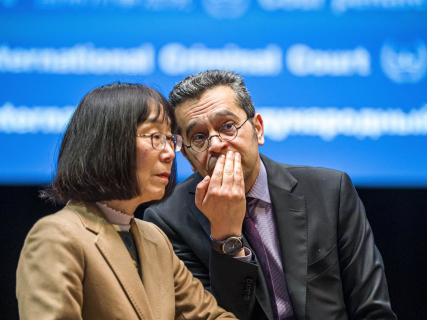

The Japanese authorities have described the sanctions imposed by the U.S. Department of the Treasury against the president of the International Criminal Court (ICC), Tomoko Akane, a Japanese jurist, as "very regrettable," while reiterating Tokyo's support for the court's work.
In a brief statement, the Japanese Ministry of Foreign Affairs indicates that it "takes note" of the sanctions announced by Washington against the Japanese judge, the current president of the ICC, and emphasizes that the country "has systematically supported the ICC in its efforts to prosecute and punish the most serious crimes that concern the international community and to defend the rule of law."
"From this point of view, the announced measures are very regrettable," criticized Japanese diplomacy, highlighting that Tokyo "will remain committed to strengthening the rule of law in the international community" and that it "will maintain communication with the involved countries."
Washington announced on Tuesday sanctions against Akane and a lawyer from the organization for their role in the investigation into Israel for war crimes committed in the Gaza Strip.
The Office of Foreign Assets Control (OFAC) has included the Japanese magistrate and the Senegalese Abdoulaye Seye, a senior litigation attorney, on its list, without providing further details in this regard.
Additionally, it has issued a license authorizing the settlement of transactions involving both ICC members until September 17.
Secretary of State Marco Rubio has justified the measure by accusing the last two affected of having "directly participated in the ICC's initiatives to investigate, detain, imprison, or prosecute officials" of governments that have not ratified the Rome Statute, which, he warned in a statement, "sets a dangerous precedent for all nations."
This step is part of the United States' crusade against the court based in The Hague, which it accuses of being a "corrupt supranational court" and "politicized" that abuses its authority.