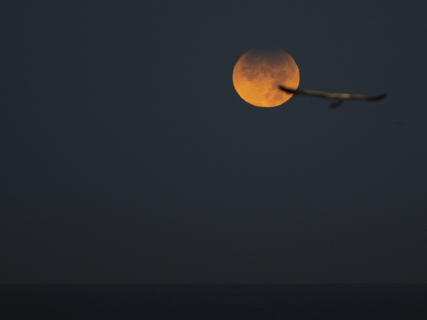

The partial lunar eclipse on Friday, August 28 will be visible from all of Spain, but not equally from all sides. The most striking phase will arrive shortly after six in the morning, when the Moon is already low and moving towards its setting.
The key recommendation is simple: you need to find a place with a clear view of the western horizon, preferably west-southwest. A hill, a building, a row of trees, or a nearby mountain can hide the Moon during the final moments, even if the sky is cloudless.
Featured story
Solar and lunar eclipse: what differences are there and how each one is observed
4 minutes
The National Geographic Institute confirms that the partial phase will be visible before the lunar sunset from all over the country. However, in the central and eastern peninsula, Balearic Islands, and Melilla, the Moon will set before that phase ends. In the west of the Peninsula, the Canary Islands, and Ceuta, it will be fully visible.
Look to the west before dawn
The eclipse will take place during the early morning of Thursday, August 27 to Friday, August 28. The full Moon will travel across the sky from west to east during the night, but as dawn approaches, it will already be descending towards the opposite horizon.
Therefore, it is not advisable to look for it directly overhead or facing east, where the Sun will begin to rise. From Spain, during the peak of the eclipse, the satellite will be low on the western horizon, with slight variations depending on the municipality.
The most comfortable spot is an open space with wide visibility: a beach facing west, a viewpoint, a permitted rooftop, or an elevated area without obstacles. There is no need to travel to a remote location if there is a clear view in that direction from the city.
The west of Spain will have more time to see the end
The geographical situation changes the time available to observe the phenomenon. The Moon sets later the further west the observer is, which gives more minutes to follow the eclipse.
The IGN indicates that in Galicia, Extremadura, the west of Castilla y León, a good part of western Andalusia, the Canary Islands, and Ceuta, the Moon will set after the end of the partial phase. This will allow for the complete evolution to be followed while the sky begins to lighten.
In Madrid, the Moon will hide just before that phase ends. Observing the peak will still be possible, but the final margin will be reduced. On the Mediterranean coast, Balearic Islands, and Melilla, the lunar sunset will come earlier, so the Moon will still disappear partially eclipsed.
The difference does not mean that the eclipse will be better only from the west. The maximum will be visible from all of Spain. What changes is the possibility of contemplating the last minutes, when the shadow of the Earth leaves the lunar disk.
What horizon is advisable to choose
The key is not just that the place is high. A viewpoint oriented towards the east or surrounded by reliefs can be worse than a low area with a clear view towards the west.
Before going out, it is advisable to check from the chosen place what can be seen in that direction. One must avoid points where the horizon is blocked by:
- Tall buildings, towers, or cranes.
- Nearby trees.
- Mountains or slopes.
- Cliffs, dikes, or constructions on the coast.
- Sea mist, common at dawn.
Astronomical applications or a mobile compass can help locate the west-southwest, but they do not replace a visual check. The Moon will be low enough that a small obstacle can hide it.
Light pollution matters less than in a meteor shower
A lunar eclipse can be seen from a city. The full Moon is a bright object and, although the shadow darkens it noticeably, light pollution does not prevent observing the phenomenon as it does with meteors or galaxies.
Moving away from urban centers improves the experience and makes it easier to appreciate reddish or coppery tones, especially if one wants to photograph it. But to see it with the naked eye, the decisive factor will be that there are no clouds and that the western horizon is open.
It is also advisable to move away from streetlights or direct lights that dazzle. A park, a terrace oriented to the west, or an open square can serve if they allow following the Moon without obstacles.