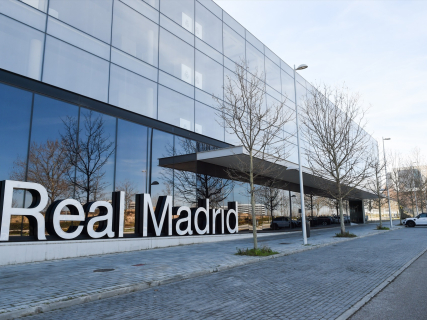

The Real Madrid Sports City in Valdebebas is preparing for a transformation that goes far beyond football. The urban modification driven to develop the Madrid Innovation District will allow the incorporation of offices, lodging establishments, commerce, health, educational, and cultural facilities into an area conceived as a large technological and innovation campus.
According to the urban documentation and the official information from the City Council of Madrid, the Governing Board initially approved on July 30 a specific modification of the General Urban Planning Plan (PGOUM) of 1997 regarding the DO-190 plot in Valdebebas, owned by Real Madrid. The file is currently in public information and will still have to undergo new procedures before reaching final approval.
The operation raises the buildability to 532,550 square meters, 172,550 more than in the current planning, and introduces uses different from sports. The change thus opens the door to a profound transformation of a part of the 120 hectares that Real Madrid owns in the area, of which approximately 35 are occupied by its Sports City and another 85 currently remain undeveloped.
What the reclassification of Real Madrid's land really means
The initial approval does not mean that Real Madrid can immediately start building hotels, offices, or a hospital. What the City Council modifies are the urban conditions of the land, currently classified as private sports facilities, to make new equipment and tertiary uses compatible with the future Madrid Innovation District.
The file must remain in public information until the end of September. Subsequently, the specific modification of the General Plan will have to be raised to the City Council Plenary for its provisional approval and then it will be up to the Community of Madrid to grant the final approval.
Therefore, talking now about a hospital or a university already decided would be going beyond what has been approved. The planning enables private health and educational uses, in addition to offices, lodging, commerce, and cultural activities, but specific projects will have to materialize later.
From 360,000 square meters of sports to 89,000
One of the most relevant changes appears when analyzing the distribution of buildability. The current planning recognizes approximately 360,000 square meters buildable for sports facility use, while the new arrangement reserves around 89,000 square meters for this use.
The rest of the 532,550 square meters planned is fundamentally distributed between 276,000 square meters of private facilities and 172,550 square meters of tertiary uses. The latter will fundamentally allow offices, in addition to lodging and proximity commerce, excluding large commercial surfaces.
The known documentation of the project contemplates approximately 100,000 square meters for offices within the tertiary. In the private facilities, around 110,000 square meters of health use and a similar area for educational use are proposed, while the remaining space may be allocated to cultural facilities and an auditorium. These are forecasts of the urban development, not definitively authorized individualized projects.
A private hospital, university, offices, and hotels: the uses allowed by the plan
The combination of uses explains why the project represents a substantial transformation regarding the current situation. The plot ceases to be conceived exclusively around sports activity to become a space where technology companies, research, training, offices, and complementary services can coexist.
In the health field, the documentation proposes the possibility of housing a private hospital, while for the educational space a private university is contemplated. The tertiary also admits lodging, which opens the door to the development of hotels or other formulas compatible with the planning.
The City Council justifies this mix of uses by the need to generate an innovation campus with sufficient size to concentrate companies, research, entrepreneurship, and knowledge transfer. Its proximity to Adolfo Suárez Madrid-Barajas Airport, IFEMA, Isabel Zendal Hospital, and the future City of Justice constitutes another of the arguments used to defend the location.
The land would reach a value of 360 million euros
The change of uses also has an important economic consequence. A feasibility report included in the file and prepared by Savills estimates the value of the resulting land at 360.1 million euros from the new planning.
The valuation distributes approximately 40.7 million among the sports land, 133.9 million for private facilities, and 185.5 million for tertiary use. This is an economic valuation included in the file, not an income that Real Madrid will automatically receive as a result of the urban modification.
The club could develop the assets directly, do so alongside other investors, or adopt other formulas compatible with the urban and legal framework. Therefore, the estimated value of the land cannot be equated with an immediate benefit for Real Madrid.
More than 200,000 square meters will be transferred free of charge to the City Council
The modification also incorporates land that will pass into public ownership. The City Council assures that it will obtain more than 200,000 square meters free of charge, equivalent to more than 20 hectares, for green areas and facilities.
Approximately 166,000 square meters will be allocated to green areas, allowing the continuation of the Metropolitan Forest and the creation of a linear park along the Arroyo de la Plata. Another 35,000 square meters will be reserved for a new public facility linked to innovation and technology.
The known file adds other transfers and urban obligations. The action must integrate the new development into the environment, generate pedestrian and landscape connections, and environmentally recover the surroundings of the Arroyo de la Plata, in addition to complying with the obligations arising from the urban development.
A project that still has years of processing and construction ahead
The official calendar confirms that the transformation of Valdebebas will not be immediate. Once the urban processing is completed, the City Council contemplates that the urbanization works will take place between 2028 and 2030.
The construction of the technological center and the rest of the buildings would be carried out progressively between 2029 and 2035. The City Council itself estimates that the investment needed to build the technological campus will exceed 2 billion euros, although this estimate should be understood as a projection associated with the complete planned development.
The City Council also maintains, based on the socioeconomic impact study incorporated into the project, that when the complex reaches its full capacity it could generate 1.213 million euros annually in contributions to the Madrid GDP and 23,800 jobs in knowledge-intensive sectors. These are economic estimates of the project and will depend on whether it is developed under the planned terms.
From the Sports City to the Madrid Innovation District
The project was publicly presented under the name Madrid Innovation District and is promoted by Real Madrid, the owner of the land, with the collaboration of the City Council and the Community of Madrid within their respective competencies.
The transformation is based on a circumstance that the City Council uses to justify the change in planning: of the approximately 120 hectares of the club in Valdebebas, 85 remain undeveloped, while the other 35 house the current Sports City. The declared objective is to take advantage of that area to create a technology campus connected with the rest of the neighborhood.
The significant difference compared to the current scenario lies, therefore, in the permitted uses. If the modification ultimately obtains final approval, an important part of the Real Madrid land could house offices, lodging, health and educational facilities, commerce, culture, and research, in addition to maintaining the existing sports uses. But there is still administrative processing ahead: as of today, what has been approved is the first urban planning step that makes that future development possible, not the final authorization to build it.