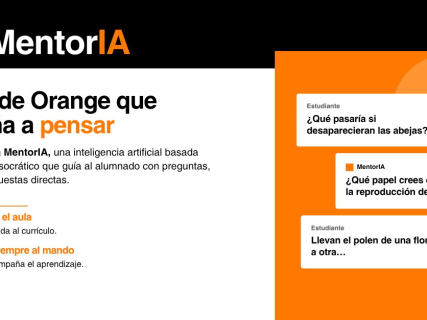

Orange has launched MentorIA, a tool of artificial intelligence designed to reinforce the learning and critical thinking of students without directly providing them the answers they seek. The platform uses the Socratic method to guide students through questions, hints, and cognitive challenges, with the aim of developing their own reasoning instead of delegating the learning process to technology.
Conceived by HUMANSDID and developed by BQ, the solution has been specifically created for the educational environment. It operates in a closed, safe space adapted to the school curriculum, complies with data protection regulations, and is designed for students aged between 14 and 18 years.
Currently, MentorIA is available for 4th year ESO students in subjects such as History and Biology. After a first pilot phase in three schools in the Community of Madrid, where it received a positive evaluation, Orange has begun to incorporate new educational centers to expand the tests and assess its pedagogical impact before extending the tool to more schools and subjects.
An educational AI that does not give direct answers
The approach of MentorIA is based on the risks associated with cognitive outsourcing, that is, the systematic delegation of thinking tasks to machines. The concern is that the dependence on immediate answers may weaken abilities such as critical thinking, creativity, and autonomous learning, especially during developmental stages.
In this context, the tool proposes a model of interaction different from that of artificial intelligence assistants that directly answer questions. Instead of offering a closed solution, it raises questions and hints that help the student advance in understanding the content and build their own conclusions.
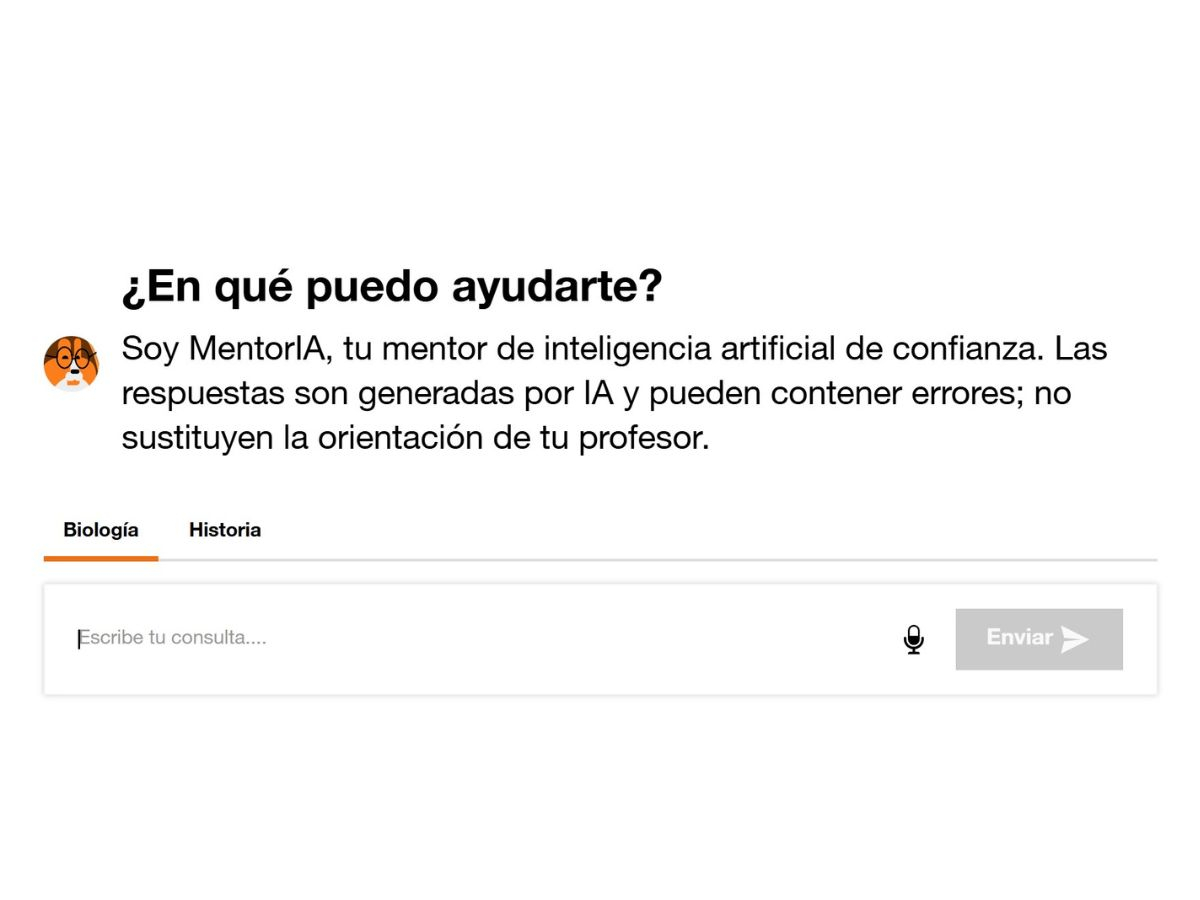
The platform incorporates a personalization engine that adapts the tone, difficulty, and pace of conversations to the age and behavior of the user. In addition, it records and organizes possible incidents according to criteria of when, where, what, and who, so that teachers can review each case and determine if intervention is required.
Human supervision is an essential part of the model. The teacher cannot intervene directly in the student's chat, but can review the interactions as part of the pedagogical follow-up. In this way, they can check how the student's reasoning evolves and whether the use of the tool aligns with the established academic objectives.
The teaching staff maintains control of learning
The implementation of MentorIA is articulated through educational centers and their teachers. Once participation is agreed upon, it is the teachers who introduce the tool in the classroom, contextualize its use within the academic programming, and validate its suitability for the pedagogical objectives.
The platform allows to create virtual classrooms, track student progress, and personalize content. Teachers can also review interactions, assess the quality of reasoning developed by the students, and supervise possible incidents.
The project is aimed at both public and private educational institutions and contemplates use by teachers and students inside and outside the classroom. When working with minors, the tool establishes supervision and teacher control as operating requirements, in accordance with the applicable safety standards for these technologies.
Orange frames the launch within its strategy to promote responsible use of technology and child protection in the digital environment. The company argues that innovation must be accompanied by resources that allow the development of critical skills and encourage conscious use of artificial intelligence among new generations.
Ana Torres, Director of Social Impact at Orange Spain, points out that MentorIA aims to contribute to analysis, reflection, and critical thinking through technology designed with pedagogical, ethical, and responsibility criteria.
For his part, José María Piera, CEO of HUMANSDID, argues that technology must serve people, especially when it comes to children. Alberto Valero, Director of BQ, emphasizes that the project's goal is to facilitate learning and provide teachers with tools to support students, rather than focusing the initiative on the technical capabilities of artificial intelligence.