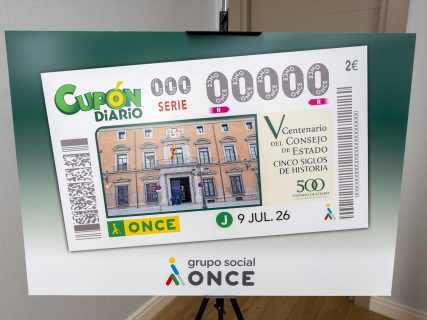
Daily ONCE coupon today: result of Monday, August 17 and winning number

Check the result of the Daily Coupon of the ONCE today, Monday, August 17, 2026, with the winning number, the winning series, and the refunds.

1 minute

EuropaPress 7651207 cupon once dedicado centenario consejo estado consejo general once julio

EuropaPress 7651207 cupon once dedicado centenario consejo estado consejo general once julio

Add DEMÓCRATA to Google

Ask FREN

Published

Last updated

1 minute

Most read

The Daily Coupon of the ONCE celebrates this Monday, August 17, 2026, a new draw with a first prize of 500,000 euros for the coupon that matches the five digits and the winning series.

JuegosONCE sets the draw for this Monday at 21:25 hours. The result will be added to the page after the celebration.

Result of today's Daily Coupon:

Winning number: pending draw

Series: pending

Reimbursement first digit: pending

Reimbursement last digit: pending

Result of the ONCE Daily Coupon today, Monday, August 17

The winning number and the winning series will be added to this page immediately after the ONCE publishes the result.

To win the maximum prize, both the five digits of the number and the series must match.

How much the Daily Coupon distributes

The Daily Coupon distributes a prize of 500,000 euros for the five digits and the series.

In addition, there are 49 prizes of 35,000 euros for those who get the five digits but have a different series. Prizes are also awarded for the first four, three, and two digits, as well as reimbursements for the first and last digit.

The prizes of the same coupon are not cumulative.

What time is the Daily Coupon today

JuegosONCE sets the draw for this Monday, August 17, at 21:25 hours.

From that moment, the winning number, the series, and the corresponding reimbursements will begin to be available.

Last result of the Daily Coupon

The last Daily Coupon prior to this Monday was held on Thursday, August 13.

The winning number was 80663 and the winning series, 041. The reimbursement for the first digit corresponded to 8 and the reimbursement for the last digit to 3.

How to check the Daily Coupon

The first thing to check is the five digits of the number.

Then, the series must be checked, as matching in this element also allows obtaining the maximum prize of 500,000 euros.

Even if the complete number does not match, the endings and the first digits must be checked because there are different categories of prizes.

The ONCE publishes the official results after each draw on JuegosONCE.

This information will be updated tonight with the number and series for Monday, August 17, 2026.

More key points, information and questions with FREN

AI-GENERATED CONTENT

What is the parliamentary process for modifying gambling regulations in Spain?

In Spain, the modification of gambling regulations is carried out, in legal terms, in the same way as the reform of any other ordinary state law. What matters is not the sector (gambling), but the type of regulatory instrument used. In practice, there are two main routes: approving a new law (or a reform law) specifically on gambling, or introducing changes to the sector through amendments to other laws under consideration (for example, budget laws or fiscal measures).

a) Reform through a specific or amending ordinary law

The basic regulation of gambling at the state level (online casinos, state betting, advertising, etc.) is generally modified through an ordinary law. The procedure follows the usual steps:

  • Initiative: it can take the form of:
    • Bill, presented by the Government. This is the most common route in technical matters such as gambling, because the Executive prepares the text with the support of the Administration (Directorate General or competent gambling body, Treasury, Consumer Affairs, etc.).
    • Private member's bill, presented by:
      • One or more parliamentary groups of the Congress or the Senate.
      • The regional legislative assemblies, through an initiative directed to the General Courts.
      • Popular legislative initiative, under constitutional and legal terms (with signature collection and admissibility control), although it is less common in such a technical sector.
  • Pre-legislative phase (if it is a government bill):
    • The competent ministry prepares a draft bill, including:
      • Regulatory impact assessment (economic, budgetary, gender, competition, etc.).
      • Reports from advisory bodies (for example, National Commission on Markets and Competition, Council of State, sectoral regulatory bodies) when appropriate.
      • Possible public consultations and hearings with interested parties.
    • The Council of Ministers approves it as a bill and sends it to the Congress.
  • Processing in the Congress of Deputies:
    • Consideration (if it is a private member's bill) or qualification by the Board (if it is a bill).
    • Amendments to the whole text (return or alternative text), which can block or replace the initial text.
    • Amendments to the articles, presented by the groups.
    • Work in Committee: drafting committee, committee report, and possible appearances by experts or the gambling regulator.
    • Debate and vote in Plenary, where the Congress approves the text.
  • Processing in the Senate:
    • The Senate can approve the text as is, introduce amendments, or propose a veto.
    • If there are amendments, the Congress decides whether to accept them. If there is a veto, the Congress can override it by absolute majority (or simple majority after a certain period).
  • Final approval:
    • Once the text is agreed upon by both Chambers, it is sent to the King for sanction and promulgation.
    • The law is published in the Official State Gazette (BOE) and comes into force on the date indicated or, by default, after 20 days.

If the procedure is not completed (due to dissolution of the Chambers, withdrawal of the bill by the Government, or rejection in a key vote), the reform lapses and a new procedure must be initiated in the next legislature.

b) Changes to gambling via amendments to other laws

Frequently, gambling regulation is adjusted by introducing amendments during the processing of broader laws, such as fiscal measures or budgetary accompaniment laws.

  • Who can introduce these amendments:
    • Parliamentary groups and, where applicable, deputies or senators under the rules of each Chamber.
    • The Government itself, through amendments if the initiative is parliamentary, or by modifying its initial text during the drafting phase.
  • Content of the amendments:
    • They can add new articles on gambling in the law being processed.
    • They can introduce final provisions stating: “The X Law on gambling regulation is modified as follows…”.
  • Admissibility control:
    • The Boards of the Congress or Senate can reject amendments considered not connected with the object of the law.
  • Process and outcome:
    • Amendments are debated in Committee and Plenary along with the rest of the articles.
    • If the general law is approved and the gambling amendments are part of the final text, the sector’s regulation is modified just as if it had been done through a specific law.
    • If the law is vetoed, rejected, or lapses, the gambling modifications it contained also lapse.

In both cases, the role of the Government is key: it can promote reforms, influence majorities, and, when it comes to private member's bills or amendments that increase spending or reduce revenues, it can oppose the so-called budget veto. In any case, any change in gambling regulation always culminates with the approval of a new law or the modification of an existing law, duly approved and published in the BOE.

Which specific laws currently regulate gambling and betting at the state and regional levels in Spain? What role do the autonomous communities have in the regulation and authorization of physical casinos, bingo halls, and gaming arcades? How could a gambling reform be designed to strengthen the protection of minors and people with gambling addiction?

What powers does ONCE have according to Spanish legislation and what is its institutional history?

The National Organization of Spanish Blind People (ONCE) is, according to recent Spanish legislation, a public law corporation of a social nature, with its own legal personality and full capacity for self-organization, subject to the State's protection. Its basic rules assign ONCE powers both in providing social services to people with severe visual disabilities and in operating certain state-wide lotteries, which finance these social purposes.

Legal framework and main powers

The core of ONCE's legal regime is Royal Decree 358/1991, of March 15, which reorganizes the organization. This royal decree, in the consolidated wording including its reforms of 1999, 2011, and 2015, and in Order SCB/1240/2019 that publishes the consolidated text of its Statutes, defines ONCE as a public law corporation of a social nature, with aims directed at personal autonomy, rehabilitation, and full social inclusion of blind or severely visually impaired persons, exercising delegated public functions throughout Spanish territory.

The powers derived from this framework and subsequent regulations can be summarized as follows:

  • Specialized social services for blind and severely visually impaired persons: educational inclusion, training and labor insertion, comprehensive rehabilitation, personal autonomy, accessibility, cultural and sports promotion, accessible bibliographic resources, etc., in accordance with Royal Decree 358/1991 itself and the Statutes published by the Order SCB/1240/2019.
  • Collaboration in public disability policies, acting complementarily with public administrations and able to enter into cooperation agreements with ministries and autonomous communities (for example, the agreement with the Ministry for the Ecological Transition recorded in the Resolution of May 22, 2025).
  • Operation of state-wide lotteries as a means of financing its social purposes. The first additional provision of Law 13/2011, on gambling regulation, designates ONCE as one of the two operators authorized to market state-wide lottery products, within a lottery reserve.
  • Management of specific gambling modalities: the traditional “coupon” and active gambling, as well as instant or pre-sorted lottery, specifically authorized by Royal Decree 1336/2005, which assigns ONCE the direction, organization, and operation of this modality and subjects its regulations and commercial parameters to verification by the Protection Council.
  • Status as an operator of “social, safe, and responsible lotteries”, subject to strict public control regarding responsible gambling, advertising, and consumer protection, in line with Law 13/2011 and periodic resolutions from the State Secretariat for Social Rights that publish regulations and calendars of ONCE lottery products (for example, Resolution of April 30, 2025 or Resolution of June 14, 2024 on extraordinary coupon draws).
  • Recognition as a singular social economy organization by Law 5/2011, on Social Economy, highlighting its specific role as a Third Sector actor combining gambling activity with protected employment and social services.

All this is structured under the State's protection, exercised through ONCE's Protection Council, a collegiate body whose composition and functions are established in article 8 of Royal Decree 358/1991. This council verifies that ONCE's proposals regarding gambling and its regulations comply with the law, controls issuance and sales volumes, collection, payment and expiration of prizes, and the destination of revenues.

Institutional history and ONCE Social Group

Official sources and institutional communications record that the historical origin dates back to 1938: the Community of Madrid, for example, recalls that “the ONCE Social Group was born in 1938 as the National Organization of the Blind” and that, through its programs, it offers equal opportunities to people with blindness and other disabilities, providing employment to tens of thousands of people ( note of June 7, 2025). Other cited journalistic sources indicate that the daily coupon began to be issued in 1939, establishing a tradition of solidarity financing that continues today.

Regarding the Franco era, the consulted databases do not provide a detailed historical development; however, they do show the continuity of the coupon model and the consolidation of ONCE as a welfare actor linked to the social protection policies of the time. The major normative leap occurs in democracy: Royal Decree 358/1991 establishes its current nature as a public law corporation, systematizes its social purposes, and organizes its tutelage relationship with the State.

From this basis, the current ONCE Social Group is configured, which includes:

  • ONCE itself, as a public law corporation and social gambling operator.
  • ONCE Foundation, created in 1988 by agreement of the General Council, dedicated to the social inclusion of people with disabilities through employment, training, and accessibility, recognized in multiple agreements published in the BOE (for example, the agreement with the Ministry of Justice on accessibility of public services, BOE-A-2025-22174).
  • The business group Ilunion, which groups special employment centers and social economy companies aimed at the labor insertion of people with disabilities, explicitly cited as the “socially responsible business group of the ONCE Social Group” in the 2025 environmental agreement.

Overall, Spanish legislation today positions ONCE as a hybrid actor: operator of state-wide lotteries subject to strict public control and, at the same time, a social action entity with delegated functions in social services and a central role in the social economy and inclusion of people with visual and other disabilities.

What are the legal requirements to claim lottery and gambling prizes in Spain?

In Spain, claiming lottery and gambling prizes is mainly regulated by the Law 13/2011, on gambling regulation, its regulatory development (especially Royal Decree 1613/2011) and various specific provisions for State Lotteries and Bets (SELAE) and for ONCE, as well as tax regulations (Law 16/2012, Law 11/2021 and the orders approving forms 230, 270, and 136, among others).

1. Identification of the winner

The general rule is that no prize can be claimed without prior identification of the participant:

  • The Resolution of July 12, 2012 of the Directorate General for Gambling Regulation (DGOJ) establishes that participant identification and verification that they are not subject to prohibitions "is an essential condition for claiming prizes obtained, regardless of their amount and nature".
  • For "online" games or other games subject to Law 13/2011, claiming requires having an active user registration per operator, with verified personal data (name, identity document, date of birth, etc.) and cross-checking with official records.
  • In in-person games (coupons, physical tickets), identification is required especially from certain amounts and always when the claim is made at credit institutions or central offices; the internal regulations of SELAE and ONCE specify which prizes can be paid at lottery offices, which at bank branches, etc.
2. Prohibition for minors and disqualified persons

Article 6 of Law 13/2011 sets the subjective prohibitions to participate and claim prizes in games subject to this law:

  • Minors.
  • Persons registered in the General Register of Gambling Access Prohibitions (RGIAJ), either by self-exclusion, or by administrative or judicial resolution.
  • Certain groups professionally linked to gambling in each case (operator staff, regulatory officials, etc.), as specified by Law 13/2011 and its development.

The Resolution of July 12, 2012 and Royal Decree 1613/2011 require operators to verify electronically:

  • Majority age through DNI/NIE data.
  • Non-inclusion of the player in the RGIAJ or other prohibition registers, before allowing play and mandatory before paying any prize.
3. Payment method and limits

The regulations of each product (e.g., Euromillions, Primitiva, Cuponazo, ONCE Active Game) determine:

  • Who can pay each type of prize: lottery offices, points of sale, SELAE offices, ONCE agents, or contracted financial entities.
  • Maximum amounts payable in cash at the point of sale and from which amount payment must be made by bank transfer or other electronic means, in line with anti-money laundering and cash payment regulations.
  • The possibility of automatic payment to the user's virtual account in online games, from which the player can transfer funds to their bank account, subject to additional verification controls.
4. Tax treatment of prizes

Since Law 16/2012 and subsequent regulations (including Law 11/2021), prizes from certain lotteries and bets (SELAE, ONCE, and similar) are subject to a special tax on lottery and betting prizes, managed through:

  • Withholding at source made by the operator or, where applicable, by the paying financial entity, which submits the tax via forms 230 and 136 and 270.
  • The tax applies to the portion of the prize exceeding an exempt threshold, which has changed over time; the withholding seen by the winner already includes the corresponding tax burden.
  • For non-residents, the same regulations apply this special tax through the Non-Resident Income Tax, also via forms 230 and 136.

In practice, the winner usually receives the net prize; the withheld amount is paid directly by the operator to the Tax Agency, without the taxpayer needing to file a specific tax return for the tax, except in particular cases.

5. Deadlines to claim (prescription/expiration)

The sectoral regulations of SELAE (Royal Decree 419/1991 and rules for each game) and ONCE regulations (such as the Coupon Regulations and recent resolutions) set expiration periods for the right to claim:

  • Each product establishes a maximum period from the date of the draw or event (usually a few months in practice).
  • After this period without presenting the winning ticket or requesting payment to the gaming account, the prize expires and the right to claim is extinguished.
6. Operators' obligations when paying prizes

Besides paying the prize according to each game's rules, Law 13/2011 and its development require operators to:

  • Maintain complete records and traceability of bets, operations, and payments (technical gaming system and internal control system provided in Royal Decree 1613/2011).
  • Ensure secure payment channels and monitor payment methods to prevent fraud and money laundering.
  • Provide the Tax Administration with information on prizes paid through informative declarations and corresponding tax returns.

In summary, to legally claim a prize in Spain it is essential that the participant is fully identified, not among the prohibited persons, respects the expiration deadlines, and accepts that the prize is subject to the special tax through withholding by the operator or paying entity.

Play

Test your knowledge with FREN!

How much do you know about this topic? Answer the following 3 questions.

What was the winning number and series in the ONCE Daily Coupon on Monday, August 17, 2026?

Question 1 of 3

How much money does one receive for matching the five digits and the series of the ONCE Daily Coupon?

Question 2 of 3

What is recommended to do to check a winning ONCE coupon?

Question 3 of 3

Hola, soy Fren. ¿Cómo te ayudo?