
After two years of recession and a growth of barely 0.2% in 2025, the German economy is beginning to show signs of recovery. The structural challenges facing its industry and the difficulties inherent in the current geopolitical situation persist. But, paradoxically in a context of greater tension for energy costs, the European giant is starting to emit signals of optimism.
The GDP advanced 0.4% during the first quarter of 2026 and another 0.3% in the second, according to the latest revision from the Federal Statistical Office of Germany (Destatis). Between April and June, the economy grew by 1% compared to the same period of the previous year.
Behind the recovery lies a profound change in German economic policy. Berlin has opened the door to increasing its levels of debt and neglecting the public deficit of historical fiscal rigor.
What has Germany done to get its head above water?
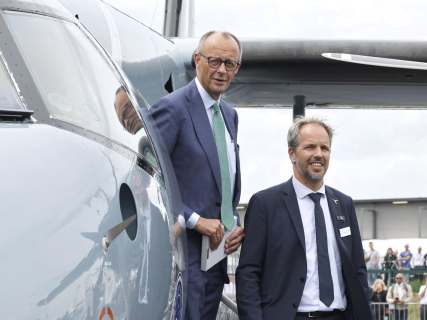
The response of the German economy is largely due to the fiscal stimuli approved by the government of Friedrich Merz, which has bet on financing large investments in infrastructure and increasing defense spending beyond ordinary limits.
The decline of the European giant was due, at least in part, to the neglect of this matter. "In recent years it had neglected investments in infrastructure, energy networks, technology... in the name of reducing debt and the public deficit," comments the director of Economic Situation of Funcas, Raymond Torres, for DEMÓCRATA.
Merz has launched an important investment plan, focused mainly on the defense sector, which has managed to mobilize the private sector. Since 2024, foreign investment has grown by 80% in the country.
The industry is the most benefited from this transfer of resources to the military sector. "It's not that car factories are being restructured, but they are taking advantage of those investment projects," Torres points out.
The budget of the Ministry of Defense has increased from 62.4 billion euros in 2025 to 82.7 billion in 2026. To that amount, 25.5 billion from the special fund of the Armed Forces is added.
The objective goes beyond that. The budget project for 2027 raises the budget of the Ministry of Defense to 109.7 billion and the government intends for the NATO computable spending to rise from 2.8% of GDP in 2026 to 3.5% in 2029.
Everything has a cost
Germany closed 2025 with a public debt equivalent to 63.5% of GDP and a deficit of 2.7%, according to data used by the European Commission. Brussels estimates that the deficit will increase to 3.7% of GDP in 2026 and 4.1% in 2027. The debt, meanwhile, would rise to 65.8% this year and 68% in 2027.
The Bundesbank anticipates an even greater deterioration in the medium term. Its June forecast suggests that the deficit could approach 5% of GDP in 2028 and the debt would then be around 70%.
In any case, Germany starts from a more favorable position than other major European economies and maintains the highest credit rating. Furthermore, regarding European rules, the country benefits from the European safeguard clause that allows for the absorption of increased military spending when controlling the deficit.
This change coincides with very different financial conditions than those of the previous decade. Germany, which reached negative financing rates, presents a yield on its ten-year bond in the vicinity of 3%, close to the highs recorded by that bond over the last twelve months.
In any case, Torres warns that trends in public debt go beyond Germany's specific situation. "What it is doing with its investment plans is also being done by other countries, which puts upward pressure on market resources," he explains.
This is happening in the United States, in Japan, and in other countries that have structural needs like France or Italy. Also Spain, he points out, although to a lesser extent.
Inflation returns to 2.9% due to energy
The provisional estimate from Destatis places the inflation rate for August at 2.9% year-on-year, compared to 2.8% in July and 2.3% in June. The main driver of the latest spike is energy. Its prices increased by 10.5% year-on-year in August, after 8.3% in July.
For Germany, energy has a dimension that exceeds the impact on households. The chemical, steel, and other energy-intensive industries have been bearing costs for years that affect their competitiveness against other production centers.
The blow from the Russian invasion of Ukraine, the end of cheap gas from Moscow, and the closure of nuclear plants has forced a rethinking of the German energy model in recent years, significantly boosting the renewable industry. Also the infrastructure for liquefied natural gas.
The China Threat
The Asian giant, which years ago was one of its major clients, now presents itself as the great industrial and technological competitor of Germany. The automobile is the best example. "Chinese cars are entering Europe at very competitive prices and adapting their electric motors, calling into question German leadership," explains Torres.
Few companies better reflect this transformation than Volkswagen. The group has just approved a new plan that includes another 50,000 job cuts, including management positions, while trying to regain competitiveness.
The adjustment also affects the product. Volkswagen aims to reduce its range by approximately half and cut around 75% of the complexity of its offering by 2035. The group seeks to concentrate production and increase economies of scale while adapting its strategy in China.
This is not an isolated case
Other firms like BASF, Thyssenkrupp, ZF, and Continental are also adjusting their workforces. BASF is undergoing its own restructuring in Ludwigshafen, one of the major European chemical complexes. Between January 2024 and June 2026, it reduced its global workforce by about 7,000 people. In May, it fell below 30,000 full-time equivalent jobs in Ludwigshafen for the first time since 1954.
The steel industry presents a similar situation. Thyssenkrupp Steel has agreed to a reorganization that includes cutting or outsourcing around 11,000 jobs.
The pressure extends to automotive suppliers. ZF Friedrichshafen expects to reduce between 11,000 and 14,000 positions in Germany by the end of 2028, as part of a reorganization aimed at adapting its capacity to weaker demand and the transformation towards electric vehicles.
At Continental, its ContiTech division has agreed to eliminate about 3,000 jobs worldwide, 1,600 of them in Germany, and move part of the activities to locations with more competitive cost structures.
They are not identical situations, but they converge on high costs, excess industrial capacity in certain sectors, international competition, and large investment needs to transform products and processes.
After spending comes the cuts
The expansive policy brings hangovers. And budget plans are beginning to incorporate subsequent consolidation. The Government has included in its planning consolidation needs that reach around 48 billion euros by 2030.
The pension system is in the spotlight. The Government plans to reduce the federal contribution to the pension system by 1 billion euros in 2027 and points out savings measures in health insurance from that same year.
Germany has already implemented reforms in the pension system, but it faces the same dynamics of population aging as other European economies. Without new measures, the Bundesbank estimates that the contribution rate to the pension system would have to rise from the current 18.6% to nearly 20% in 2028.
And, for now, it grows below Europe
Despite pulling Germany out of stagnation, the investment plan still does not resolve the underlying problems of the German economy. The European Commission forecasts a growth of just 0.6% in 2026 and 0.9% in 2027.
BBVA Research's forecasts are more optimistic. They believe that Germany can achieve an advance of 0.8% this year and 1.3% in 2027.
The results of that investment plan will dictate the future reforms that the country must undertake.
"The reasoning so far of the Merz Government is, first to reactivate the economy and then to adjust to avoid pronounced imbalances in public accounts," reasons Torres. "So far, they have been able to afford it because they started from very controlled levels of debt and deficit."