

It was 1995, the Felipe González era was giving its last gasps and the autonomous map was finishing fitting together. In March, Ceuta and Melilla simultaneously acquired the status of autonomous cities with the approval of their respective Statutes of Autonomy.
Spain thus concluded the territorial puzzle initiated during the Transition, which successive Governments from Adolfo Suárez to Felipe González had prioritized. But approving a Statute did not mean that all the competencies provided in it would automatically be exercised. It was necessary to develop the new framework and carry out the corresponding transfers of functions and services from the State.
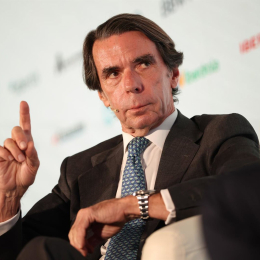
This is precisely the period that Juan Jesús Vivas has recovered three decades later. The Ceuta president took advantage of the visit of José María Aznar to Ceuta on August 27 to assert that his arrival at La Moncloa meant "a before and after in the course of our city over the last 30 years."
Featured story
Aznar returns to Ceuta 24 years after Perejil and in the midst of a crisis with Morocco
4 minutes
The former president of the Government traveled to the city to show his support after the massive entry of migrants on July 30 and 31, which has opened a political, migratory, and diplomatic crisis that still conditions life in Ceuta. Aznar's presidency had a dual dimension. His figure is inevitably associated with episodes such as the crisis of the islet of Perejil in 2002, key in the history of relations between Spain and Rabat, but also to the institutional development of Ceuta's autonomy.
Autonomy is exercised
One of the first milestones occurred in December 1996, just seven months after the arrival of the popular to La Moncloa. The Council of Ministers approved a series of royal decrees that made effective various transfers of functions and services from the State to the City.
Among them were competencies in nature conservation, environment, land planning and urbanism, roads, architectural heritage, and housing. The BOE published a good part of those transfers together in January 1997.
But it was not just a nominal change. In urbanism, for example, Ceuta began to assume functions of approval of plans, management, guardianship, and oversight within the limits established by state legislation. In roads, something similar happened: the City received functions and services that until then were directly exercised by the General State Administration.

The process continued throughout the entire legislature. In 1999, new transfers were approved in areas such as social assistance, culture and sports, health, and consumer and user protection. In social assistance, the transfer also included assets, personnel, and budget credits linked to the services assumed. And in health, the city assumed functions mainly related to public health, inspection, epidemiological surveillance, and sanitary control, although certain competencies remained in the hands of the State.
The Council of Fiscal and Financial Policy
The other major leap was financial and institutional. At the end of 1996, the Cortes approved the modification of the Organic Law on the Financing of Autonomous Communities to expressly integrate Ceuta and Melilla into the Council of Fiscal and Financial Policy.
The very exposition of motives of the Organic Law 3/1996 explained the reason: after becoming autonomous cities, it was necessary to "formalize the insertion of their respective financial regimes" within the general system of autonomous financing, preserving their fiscal peculiarities. The reform allowed Ceuta to be represented in the main body of financial coordination between the State and the autonomies.
In quotes
Although Juan Jesús Vivas wanted to acknowledge the former Prime Minister for his contribution to the institutional normalization of Ceuta, Jose María Aznar focused on the crisis that the region is going through.
During his visit, he placed the crisis in the realm of national sovereignty and argued that with the massive entry, the "territorial integrity" of Spain had been "violated." The former president demanded "firmness" in the State's response, warned that "weakness is and will always be provocative", and defended that "national sovereignty has no holidays." He also directly linked the future of the city with that of the entire country: "The future of Ceuta is the future of Spain".