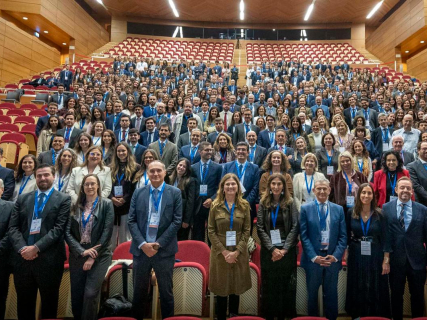

The State Tax Inspectors Association (IHE) considers that the Tax Agency is going through "the worst crisis in its history" and calls for a deep reform of its functioning to guarantee its independence from political power and strengthen the fight against fraud. Among its proposals are the creation of a specialized tax police force in economic crimes, a National Anti-Fraud Office and an AEAT management chosen by the Cortes Generales.
These have been some of the main conclusions of the XXXVI Congress of State Tax Inspectors, held this Thursday and Friday in Toledo, under the slogan A tax administration for citizens.
This diagnosis, included in the report presented during the sessions, to which DEMÓCRATA had access during the coverage of the congress, goes beyond staffing and funding needs. The association questions the political influence over the institution, the instability of its leaders and a system of objectives that, in its view, favors the accumulation of administrative actions over complex fraud investigations.
During the meeting, the president of IHE, Ana de la Herrán Piñar, underscored her concern about the functioning of public administrations. In her opening address she referred to the "abandonment and neglect" that, in her view, affect institutions and defended the need to strengthen their functioning and the responsibility of those who lead them. She also remembered Antonio Montero, a Tax Inspector who died in the Urda railway accident, and expressed her condolences to the victims and their relatives.
In addition, the inspectors warn of a "real risk" that the Agency will cease to exist as it is currently known, a concern they link, among other issues, to the commitments to transfer tax powers to Catalonia.
Fifteen general directors in almost 35 years
Institutional independence occupies a central place in IHE's demands. The association recalls that the Tax Agency has had fifteen general directors in almost 35 years, with an average tenure of just over two years. In one of those periods it came to have four heads in barely two years, a circumstance that caused more than 300 dismissals and appointments in positions of free appointment.
The inspectors also question that more than 50% of the positions occupied by members of this body are filled through free appointment.
To correct this situation, they propose that the Agency's director general be appointed by the Cortes Generales by qualified majority, with a five-year term, renewable once, and specified grounds for removal.
The model would include an annual appearance before Parliament to account for the results, the resources, and compliance with the strategic plans. It would also mean separating the Agency's leadership from the Secretary of State for Finance, who currently serves as its president.
The episodes of political use denounced by the inspectors
The report devotes a section to the episodes that, according to IHE, have damaged the reputation of the tax administration.
Among them, it mentions the 2012 tax amnesty, later annulled by the Constitutional Court; the dismissals and resignations recorded in the Central Delegation of Large Taxpayers in 2013; and various controversies related to the disclosure of reserved tax information.
It also includes the public statements made in 2024 by the then Minister of Finance about the tax situation of Isabel Díaz Ayuso's partner, which the association links to the duty of confidentiality established in article 95 of the General Tax Law.
IHE also questions the lack of technical explanations in certain matters. As an example, it recalls the appearance of a former director of the Agency before a Senate committee, where she attributed to an "inexplicable error" the absence of tax checks on a person under investigation from the circle of a former Prime Minister.
Nine out of ten citizens believe that there is a lot of tax fraud
The inspectors incorporate into their diagnosis the results of the surveys by the Center for Sociological Research on public opinion and tax policy.
According to the data corresponding to 2025 included in the report, 90.1% of citizens consider that there is a lot or quite a lot of tax fraud in Spain. However, only 43.7% believe that the Administration makes a lot or quite a lot of efforts to combat it.
The association points out that this perception has remained for years. Between 2006 and 2025, the percentage of citizens who considered fraud to be high never fell below 82%.
IHE also questions certain sanctioning practices of the AEAT. It maintains that for years sanctions have been imposed in a practically automatic manner, especially from the Management area, without sufficiently proving the taxpayer’s culpability, which has led to favorable rulings and judgments for those affected.
Featured story
Hacienda backs the inspectors amid the attacks over the growing rejection of taxes
2 minutes
More than half a million Management controls compared to 9,141 Inspection controls
One of the main criticisms in the document concerns the distribution of tax control actions.
In 2024, 524,239 control actions on economic activities were programmed: 515,098 corresponded to the Management area and 9,141 to Inspection.
IHE considers that this distribution reflects a model that has strengthened administrative checks while maintaining limitations on investigating more complex fraud.
The association questions that teams must meet quantitative objectives and internal deadlines which, it denounces, make it difficult to investigate large-scale schemes.
The report recalls that the degree of compliance with the objectives for tax and customs fraud control reached 136.91% in 2025, although it maintains that these indicators do not make it possible to know whether the actions are concentrated on the conduct of greatest tax risk.
To modify the model, it proposes creating a Tax and Customs Control Department that integrates the verification powers currently distributed among Management, Inspection and Customs.
A fiscal police force and new measures against corruption
IHE calls for the creation of a National Anti-Fraud Office, specialized in organized tax fraud, smuggling and money laundering, from which a fiscal police force constituted from the operational units of the Customs Surveillance Service would depend.
The association proposes giving it judicial police functions to investigate tax, smuggling and other economic crimes.
Among the legal reforms it proposes are investigative actions without prior identification, with safeguards, and a special and permanent inspection plan for representatives and political parties.
It also calls for facilitating access to certain asset declarations of public officials, strengthening the Anti-Corruption Prosecutor’s Office with specialized personnel and establishing a specific regime for certain defrauders.
This latter would include a special register and measures such as the revocation of the NIF and the registry closure of companies, a formula that the document calls "civil death".
Catalonia: Treasury denies that it wants to fragment the Tax Agency
The political agreement to move toward a singular financing model in Catalonia has been another of the central issues of the congress.
IHE considers that the transfer of powers and means of the AEAT to the Catalan tax administration would harm the investigation of fraud and the equality of taxpayers.
The association establishes three conditions that it considers non-negotiable: a single tax information system, a single treasury to manage withholdings and installment payments, and integrated control of economic activities.
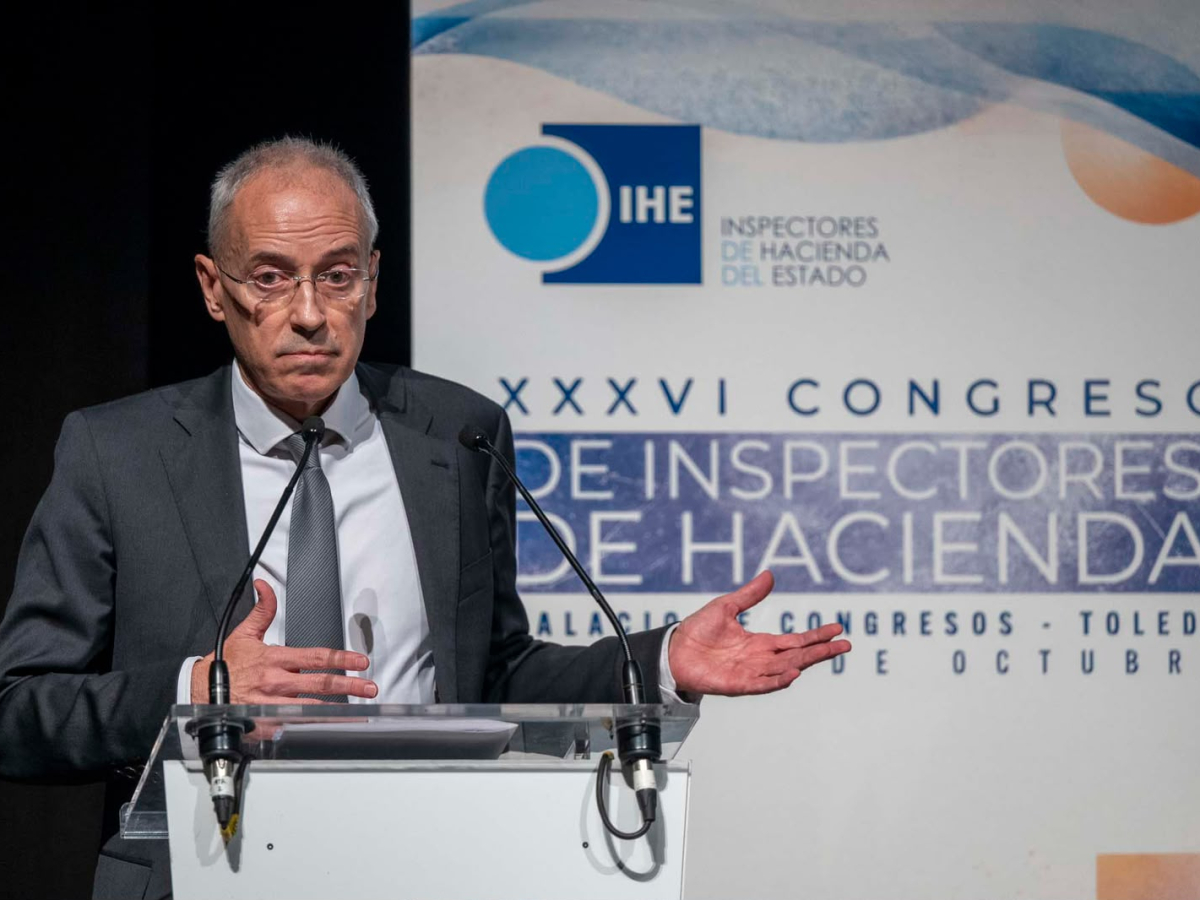
These warnings had a response during the opening of the meeting. The Secretary of State for Finance, Jesús Gascón, defended a strengthened Tax Agency and "never fragmented", in the face of the concerns expressed by the inspectors about the possible consequences of the tax transfers to Catalonia.
Gascón also conveyed his support to the civil servants in the face of the attacks directed against the corps and rejected that the modernization of the selection processes should translate into a reduction in training requirements.
The association, for its part, proposes as an alternative to fragmentation a Tax Agency Advisory Council in which the administrations that share the collected revenue participate.
Smaller staff than in 2009 and new artificial intelligence tools
The document finally addresses human resources and technological modernization.
The Agency had 27,226 employees in 2025, still below its 2009 staff. Its 2024-2027 Strategic Plan foresees reaching 29,376 employees at the end of that period, while IHE calls for progressively bringing the staffing level closer to the European average.
The association also defends stable, multi-year financing and a reorganization of the personnel to devote more resources to complex investigations.
In technological matters, it proposes incorporating artificial intelligence tools into the daily work of officials to analyze operations, detect accounting anomalies and reconstruct relations between companies, always with human supervision and verifiable results.
The proposals presented in Toledo are directed to the Government, the Parliament, the management of the Tax Agency and the State Secretariat for Finance. IHE calls for a new statute, an independent management, more resources and a control model that gives greater priority to the investigation of serious and organized fraud.