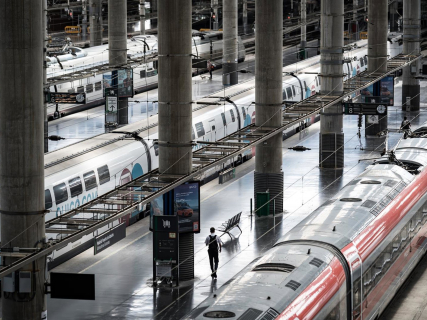

The volume of passengers of the high-speed train (AVE, Avlo, Ouigo, and Iryo) increased by 0.6% in August compared to the same month of the previous year, reaching 3.68 million users, against the drop of 4.6% recorded by the overall intercity rail transport, according to provisional data released this Friday by the National Institute of Statistics (INE).
Passengers of long-distance services other than high-speed decreased by 1.2% compared to August 2025, down to 763,000 users. In the case of medium-distance, the number of passengers fell by 6.8%, down to 2.99 million, while suburban users decreased by 5%, down to 34.86 million.
Overall, intercity rail transport in Spain recorded 42.29 million travelers in August, representing a year-on-year decline of 4.6%, according to the figures from the statistical agency.
PUBLIC TRANSPORT INCREASES
More than 371.6 million passengers used public transport in August, 3.3% more than in the same month of 2025, according to the INE.
Intercity transport accounted for more than 119.3 million travelers, 1.5% more on an annual basis. Within this category, bus transport recorded the largest increase, of 5.5%, while air transport grew by 2.7%. In contrast, maritime transport decreased by 1.4% and rail transport fell by 4.6%.
For its part, urban transport was used by more than 231.8 million travelers, 4.1% more than in August of last year. The number of metro users increased by 3.3% year-on-year, while urban buses recorded a rise of 4.6%.
By autonomous communities, urban bus transport recorded the largest year-on-year increases in Castilla y León, with 12.7%; the Region of Murcia, with 10.2%, and Extremadura, with 9.9%.
The Community of Madrid was the only region that recorded a decrease in the number of urban bus users, with a drop of 1.5% compared to August 2025.
DISCRETIONARY TRANSPORT INCREASES
More than 20.3 million passengers used special and discretionary transport in August, 4.2% more than in the same month of 2025.
Within this category, special transport decreased by 1.3%, exceeding 5.1 million users. School transport fell by 6.1% and labor transport by 1.2%.
On the contrary, discretionary transport, which includes services such as buses hired for excursions and organized trips, increased by 6.2% year-on-year, exceeding 15.2 million travelers.