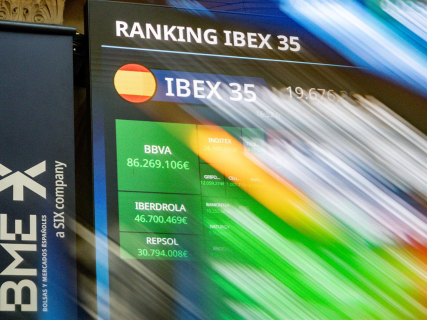

The Ibex 35 has closed the week with an advance of 1.54%, up to 19,326.30 points, driven by relief in the pressure on sovereign debt and the big tech companies, which had been suffering again due to doubts surrounding the financing of artificial intelligence.
The main Spanish index ended the session this Friday with a rise of 0.77%, after the chairman of the Federal Reserve of the United States (Fed), Kevin Warsh, cooled the option of applying a new interest rate hike in October.
"The Ibex advances with difficulties as the banking sector has been affected by the cold reception of the US results, while the companies benefiting from lower debt yields provide the counterbalance," explain the analysts from XTB.
Despite this, the Ibex 35 remains the most bullish stock index since the start of 2026, with an accumulated revaluation of 11.66%, surpassing Milan (+10.93%) and London (+9.57%).
In terms of US monetary policy, the chairman of the Fed has reiterated the central bank's commitment to price stability, emphasizing that approximately a month ago some stimulus measures were withdrawn.
In any case, the 'Guardian of the dollar' has reiterated that the entity will meet a couple more times in 2026, and that will be the key moment to analyze the situation. "I do not prejudge the meetings. I do not believe in predicting now what I will do in the meetings we have for the rest of the year," he added.
"Even so, the market continues to price in three Fed rate hikes in the next 12 months in light of the promise of price stability," stated the experts from Renta 4, who add that the figures for retail sales, weekly employment, and producer prices represent renewed upward pressure on inflation.
In parallel, geopolitical tensions continue. The president of the United States, Donald Trump, has stated that Washington is weighing the use of the GBU-43/B bomb -- colloquially known as MOAB, 'the mother of all bombs' -- against Iran and has reiterated that the war with Iran "is going to end very soon, one way or another," in a context of blockage in recent months of talks to end the conflict in the Middle East.
Despite this scenario, the United States claims that more than 40 commercial vessels managed to cross the Strait of Hormuz on the last day, despite the restrictions and attacks from Iran in the area, and has reported that the recent sinking of a Singapore-flagged ship was due to the impact of a missile launched by the Revolutionary Guard.
On the macroeconomic front, it has been published that the services sector increased its billing by 6% in August compared to the same month in 2025. For its part, the turnover of the industry advanced by 10.8% in year-on-year terms.
Likewise, it has been confirmed that the year-on-year inflation rates of the eurozone and the entire European Union (EU) reached their highest level in the last three years in September, after both stood at 3.8%, six tenths above the readings of August, according to Eurostat data.
In this scenario, the most notable upward values of the Ibex this Friday have been Acciona Energía (+3.18%), Acciona (+2.97%), Telefónica (+2.71%) and Merlin Properties (+2.46%). Only Redeia has concluded the day in negative, with a decrease of 0.20%.
The main European stock exchanges have also concluded the week positively: the British index FTSE 100 advanced by 0.38%, the French Cac 40 by 0.28%, the German Dax by 0.95%, the Italian FTSE MIB by 0.93% and the Euro Stoxx 50 by 0.58%.
On Wall Street, the indices were moving with mixed signs at the close of European markets: the Dow Jones was up 0.24%, while the S&P 500 was down 0.35% and the Nasdaq, with a strong technological component, was down 1.08%.
In the commodities market, the Brent barrel, a reference in Europe, fell by 0.18%, to 105.73 dollars, while the West Texas Intermediate (WTI), a reference in the United States, dropped by 0.12%, to 97.85 dollars.
In fixed income, the yield of the Spanish 10-year bond fell to 4.002%, from 4.025% at Thursday's close, which led the risk premium over the German bond to decrease slightly to 59.91 basis points.
In the foreign exchange market, the euro appreciated by 0.22% against the dollar, to an exchange rate of 1.1245 dollars per euro.
Regarding assets considered 'safe havens' in periods of high volatility, the price of an ounce of gold rose by 0.65%, to 4,197 dollars, while the main cryptocurrency, bitcoin, fell by 1.06%, to 81,576 dollars.