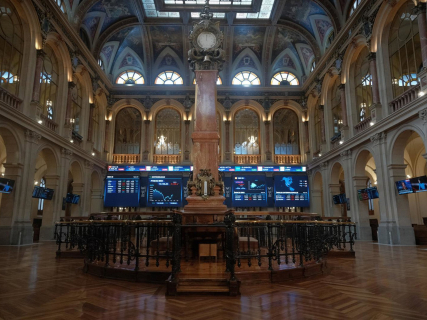

The Ibex 35 of the Madrid Stock Exchange recorded at midday this Friday, the last day of the week, an advance of 0.63%, trying to reconquer the 20,000 points it lost on Monday after having remained nine consecutive sessions above that psychological level.
At 12:00 hours, the Spanish selective was at 19,936.8 points on a day conditioned by the worsening of tensions in the Middle East and by the intention of the President of the United States (USA), Donald Trump, to initiate against Iran "the most devastating economic operation ever undertaken," which has pushed the price of crude oil up to 93 dollars.
In this line, the Secretary of the Treasury of the United States, Scott Bessent, has asked this Friday the allies of Washington to position themselves —"either you are with us or you are against us"— in the economic war against Iran announced by Trump, of which he has indicated he will offer more information next Monday at a press conference.
"We are going to crush the economy of this murderous regime, which will limit its ability to project power through its representatives," Bessent has assured, adding that "they will not be able to pay the Army."
He has also pointed out "a substantial inflation, both of food and general, in Iran," rejecting the pessimistic forecasts of some analysts about this strategy. Despite this, Bessent has defended that this tactic "does work." "We have a combination. It's a double blow. We have the blockade and we are going to impose the most severe sanctions in history," he has indicated, emphasizing that "this will work."
In his opinion, the oil markets "are misinterpreting the meaning of this economic pressure," since the United States has "control of the strait" of Hormuz and its forces can "continue extracting large amounts of energy" (hydrocarbons) from the enclave using "the southern lane."
The Iranian authorities have repeatedly denied that there is a safe route through the southern lane of the strait of Hormuz, off the coast of Oman, an area where explosions have occurred on cargo, merchant, and oil ships due to mines or projectile impacts.
Nevertheless, the Axios portal reported the day before that the Armed Forces of the United States have enabled a southern corridor through which between 15 and 20 tankers cross the strait every night in both directions, transporting around 10 million barrels daily —approximately half of the volume prior to the war— according to two U.S. officials.
"We have been controlling the southern lane of the Strait of Hormuz for two months now. The Islamic Revolutionary Guard can be a nuisance, but it does not control the strait. We do," said one of those officials, with direct knowledge of the operation, quoted by the U.S. media.
At the same time, the Israeli Army resumed airstrikes on Friday over the towns of Mayfadoun and Al Mansouri, in southern Lebanon, despite the truce agreed in June between the Israeli and Lebanese governments with the aim of moving towards a permanent ceasefire.
In this context, the Brent barrel —reference in Europe— fell 0.5% at midday of the European stock exchanges, to 93.3 dollars, while the West Texas Intermediate (WTI), reference in the United States, decreased by 0.43%, to 86.4 dollars per barrel.
The rise of bonds and inflation in Japan
In the macroeconomic sphere, investors are focusing today on the publication of various PMIs both in Europe and in the United States, in addition to the consumer confidence data in the eurozone for July.
Before the market opened, it was reported that Japan's core inflation, which excludes fresh food, accelerated in July to 1.8% year-on-year, two tenths higher than in June and its largest increase since January. This movement reinforces expectations of a new rate hike by the Bank of Japan at the meeting scheduled for September 17 and 18, after raising the official interest rate to 1% in June, its highest level in more than thirty years.
Markets are also closely following U.S. initiatives to address its large debt. The Treasury Secretary has indicated that the bond buyback program could exceed 4 billion dollars (3.456 billion euros), which would mean doubling the current limit, in a context of high rates on 10 and 30-year debt, whose yields have reached recent highs.
The next week will concentrate the attention of investors with the start of the annual meeting of central banks in Jackson Hole, which this year will take place from August 27 to 29.
In Spain, the National Institute of Statistics (INE) has released at 9:00 AM the data on hotel overnight stays for July, which increased by 0.3% compared to the same month of 2025 and by 1.5% in the first seven months of the year.
European stock markets remain positive and close to highs
In this scenario, at 12:00 PM this Friday, the largest increases within the Ibex 35 corresponded to Solaria (+2.27%), Arcelormittal (+1.9%), Banco Santander (+1.75%), Acciona Energia (+1.53%) and ACS (+1.33%). On the downside, the notable declines were Telefónica (-0.85%), Indra (-0.76%), Rovi (-0.75%), Grifols (-0.68%) and Amadeus (-0.28%).
On the other hand, the main European exchanges showed a mixed behavior in the mid-session, but without losing their historical highs. The Italian Mib advanced by 0.31% and the German DAX 30 added 0.26%, while the British FTSE 100 and the French CAC 40 moved practically flat, with slight declines of 0.02% and 0.01%, respectively.
In the foreign exchange market, the euro appreciated against the dollar to stand at 1.1701 "greenbacks," and in public debt, the yield of the Spanish ten-year bond moderated to 3.689%.