

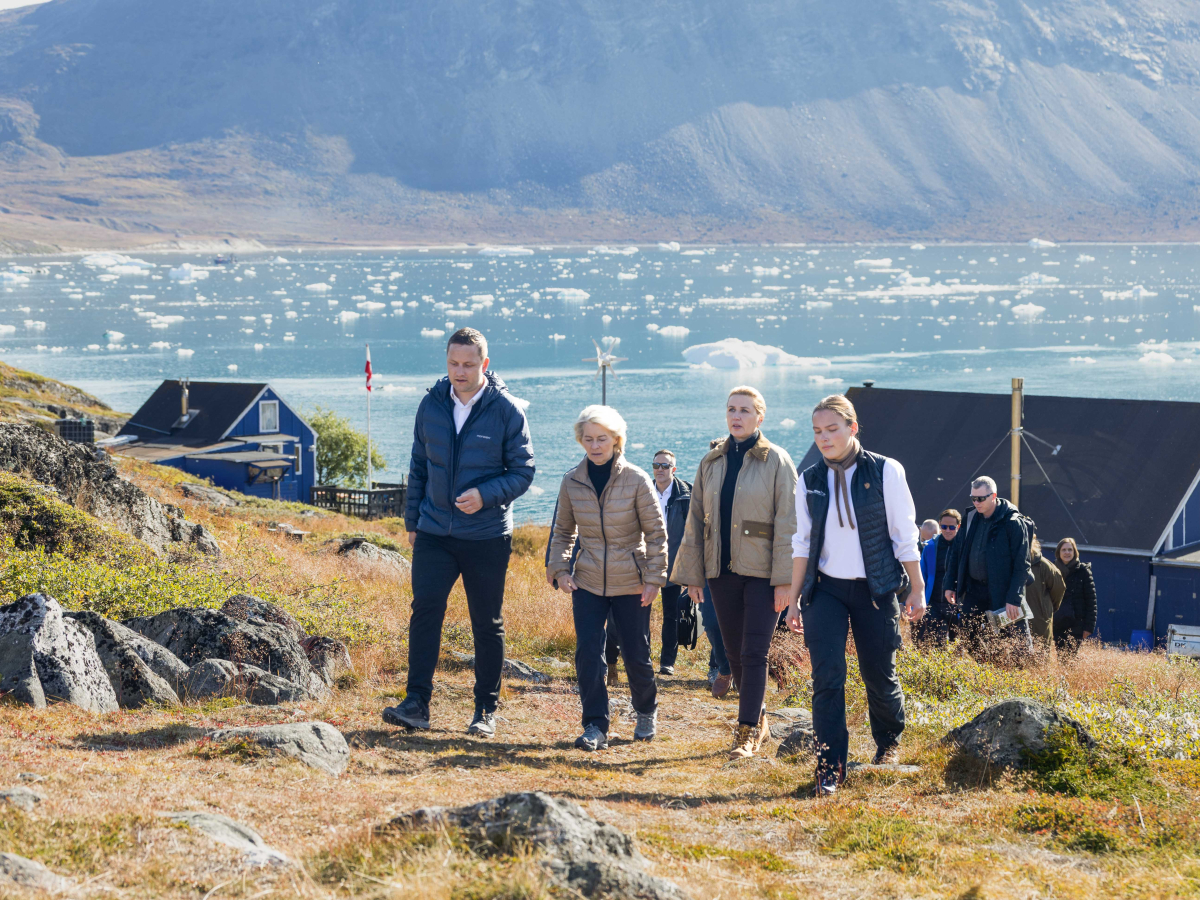
After the referendum in which Iceland decided to freeze expectations of an approach to the European Union, Brussels seeks to strengthen its position in the Arctic. This time, the move goes through Greenland, an autonomous territory of the Kingdom of Denmark and an increasingly relevant piece on the geopolitical, energy, and raw materials board. The President of the European Commission, Ursula von der Leyen, has traveled to Nuuk to announce the disbursement of 200 million euros intended to finance areas such as education and fishing, but also connectivity, hydroelectric energy, and access to raw materials.
The initiative occurs in a context marked by the increased geopolitical pressure on Greenland and by the threats from U.S. President Donald Trump regarding the territorial integrity of the island. Washington's political offensive forced the European Union to raise the profile of its strategy for the Arctic and to reinforce its discourse on sovereignty, security, and the strategic autonomy of its partners in the region.
Featured story
Brussels doubles down on its bet on the Arctic: "We have to seduce; not incentivize its rupture"
6 minutes
In fact, the President of the European Council, António Costa, even called the Twenty-Seven heads of state and government to an extraordinary summit last January to reaffirm the community commitment to Greenland, Denmark, and the entire Arctic. Now, the political statements that resonated then in the European capital are beginning to transform into economic allocations and concrete projects on the ground.
A partnership with strategic dimension
The community executive has committed to a new partnership package under Global Gateway, the European strategy for investment and external connectivity, worth 200 million euros, which will be deployed during this year and the next.
"Today I return to offer real results of our close cooperation," declared Von der Leyen from Nuuk this Monday. The President of the Commission is confident that the resources will allow "to create new opportunities" and consolidate "a strong and committed EU both in Greenland and in the Arctic." "Greenland is a strategic ally and a trusted friend," she stated. Greenland, Denmark, and the European Union have also signed a joint declaration that establishes the foundations to deepen their relationship and strengthen the common agenda for investment, political dialogue, and interpersonal exchanges. The document reaffirms a partnership based on "shared values and interests" and recognizes the growing strategic importance of the territory.
The intention of Brussels is to expand cooperation in areas considered priorities for European autonomy and resilience: education and training, infrastructure, sustainable raw materials, clean energy production, digital connectivity, sustainable tourism, housing, research and innovation, fishing, and climate action. The objective therefore transcends conventional economic cooperation. For the European Union, Greenland concentrates several of the elements that will determine its ability to compete and ensure its economic security over the coming decades: natural resources, energy, critical infrastructure, connectivity, and access to strategic supply chains.
Satellites, data, and artificial intelligence
The digital dimension also occupies a prominent space in the new relationship. The European Commission launched this Monday a connectivity project aimed at supporting the expansion of satellite capabilities in Greenland through European providers over the coming years. According to community sources, the initiative will improve the reliability and resilience of digital connections, especially in the most remote settlements of the island. Connectivity takes on additional importance in a territory characterized by its enormous geographical extent, low population density, and climatic conditions that hinder the deployment of conventional infrastructure.
Brussels is also studying extending its bet on data centers to Greenland, considered necessary infrastructures for the development of a European capacity in artificial intelligence. The Commission raises this possibility "as the necessary energy and digital infrastructures are developed," thus linking technological deployment to the availability of electricity and connectivity networks.
Signed! Our 🇪🇺🇬🇱🇩🇰 Joint Declaration.
— Ursula von der Leyen (@vonderleyen) September 7, 2026
It reflects a clear choice by Greenland to strengthen ties with the EU.
In order to protect its values, freedom and interests.
Europe is making a choice too.
To be more present and more engaged in Greenland and in the Arctic. pic.twitter.com/BGj0ngeWgq
The operation directly connects with one of the EU's strategic priorities: reducing its external dependencies on critical technologies and ensuring the material conditions to develop its own capacities in artificial intelligence, computing, and digital services.
Raw materials and energy
The new chapter of the relationship will also materialize in mining projects linked to the community industry, under sustainability criteria. The Twenty-Seven will provide support through technical analyses and mediation with potential investors, with the aim of contributing to creating stronger and more integrated value chains.
Access to strategic raw materials is one of the main European interests in Greenland. The island has relevant mineral resources for sectors linked to the energy and technological transition, at a time when Brussels is trying to reduce its dependence on third countries to ensure the supply of certain critical materials. Energy represents the other major axis of the strategy. Through hybrid systems based on renewable energies in towns and settlements, the EU aims to strengthen the viability and resilience of local energy supply.
In parallel, Brussels and Greenland are studying supporting the expansion of the Buksefjord hydroelectric power plant, the main hydroelectric facility in the territory, with the aim of responding to the increase in electricity demand in Nuuk.
With this package of measures, the European Union seeks to turn its political support for Greenland into a long-term economic, energy, and technological relationship. In an Arctic increasingly contested by the United States, Russia, and other powers, Brussels aims to consolidate its presence through investment, infrastructure, and access to strategic resources. The goal is no longer just to accompany Greenland, but to ensure a European role in one of the regions that will concentrate a good part of the geopolitical competition of the coming decades.