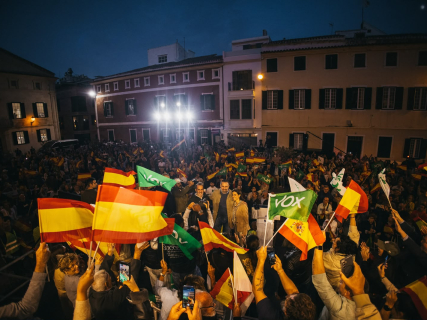
Abascal calls to change "ruin for prosperity" on 29N and accuses the unions of keeping silent in the face of the housing crisis.

The leader of Vox attacks Sánchez from Menorca, questions the actions of UGT and CCOO, and claims "national priority," tax cuts, and "remigration" as the axes of his electoral program.

WhatsApp Image 2026 10 23 at 20.26.51

WhatsApp Image 2026 10 23 at 20.26.51

Add DEMÓCRATA to Google

Ask FREN

Published

Last updated

5 minutes

Most read

Elecciones 29N · Encuestas

La media de las encuestas

Media a 23 de octubre de 2026 · 15 institutos

  • PP31,4 %
  • PSOE26,9 %
  • Vox18,8 %
  • Sumar6,4 %
  • Podemos3,1 %
  • ERC2,2 %
010203040ene 2024jul 2024ene 2025jul 2025ene 2026jul 2026

Media del último estudio de cada instituto en 30 días y su evolución semanal desde el 23J. Partidos con al menos un 2 %.

Todas las encuestas

Elecciones generales del 29 de noviembre · Demócrata

The president of Vox, Santiago Abascal, called this Friday from Mahón (Menorca) to mobilize in the general elections on November 29 to change "ruin for prosperity". In a rally focused on his criticisms of the Government of Pedro Sánchez, the leader of the party accused the Executive of being responsible for the housing crisis and reproached UGT and CCOO for remaining silent in recent years.

Abascal has called to take advantage of the electoral appointment to replace "the indignity of the invasion in Ceuta with national decency, oppression and censorship with freedom." The leader has appealed to national pride and rejected that Spain should continue under a Government presided over by Sánchez.

"The Spaniards are not condemned, as if it were a biblical curse, to suffer Pedro Sánchez and his corrupt mafia for four more years", he stated before the attendees. "A mafia of petty thieves like this cannot defeat us," he added.

Abascal attacks the unions over housing

The housing crisis has been one of the main issues of his speech. Abascal accused the Government of using it as a "smokescreen" to divert attention from other problems, despite considering it "directly responsible" for the difficulties Spaniards face in accessing a home.

The president of Vox has assured that, since Sánchez arrived at La Moncloa, the sale price of homes has increased by 74% and rents by 40%, figures he has used to question the housing policy of the Executive.

"And the only thing this Government has done for housing is remove the plaques that were in some municipalities from the former Ministry of Housing, but they have built absolutely nothing," he stated. Abascal also related the increase in population to the pressure on the real estate market and accused the Executive of not having sufficiently increased the residential supply.

His criticisms have extended to the unions UGT and CCOO, which he reproached for taking years to mobilize over this problem. "Eight years silent as the dead, not to say anything else. And suddenly they remember that there is no housing for Spaniards", he denounced.

In front of the Executive's policies, the president of Vox has defended that public aid to access housing, rental subsidies, and daycare spots should be granted primarily to Spanish families.

National priority, tax cuts, and remigration

Abascal has included these measures within his proposal of "national priority", one of the pillars of his program along with tax reduction, economic deregulation, and "remigration".

The leader of Vox has accused successive governments of favoring the foreign population over Spanish citizens. However, he has pointed out that the responsibility for this situation lies with the political leaders and not with those who receive the aid.

"If politicians give them benefits that they do not deserve, we cannot blame them, we have to blame the politicians who have betrayed us Spaniards," he has stated.

Abascal has insisted that housing aid, rental aid, and daycare spots must be primarily allocated to Spanish families, arguing that many have difficulties making ends meet, paying their mortgages, or accessing housing.

In economic matters, he has advocated for a tax cut and has denounced that citizens bear an excessive tax burden. "Today Spaniards are being absolutely robbed by the Government. Today more taxes are paid than ever and Spaniards receive less than ever", he has assured, before criticizing the state of the roads, railways, hospitals, and other infrastructures.

He has also defended a reduction of administrative obligations for self-employed individuals, farmers, and businesses. According to Abascal, an increasing part of their day is spent complying with procedures and regulations that hinder economic activity. In this regard, he has criticized regulations related to climate, equality, and the 2030 Agenda, which he has labeled as "fanatical legislations" and has accused of not contributing to economic growth.

On migration matters, he has defended the repatriation of those who have entered Spain irregularly and the expulsion of foreigners who commit crimes. He has also demanded that foreign individuals who have arrived in the country to receive social aid seek employment or return to their places of origin.

Criticism of Sánchez for his interview in "La Revuelta"

The president of Vox has also lashed out at Pedro Sánchez's appearance on the program "La Revuelta," from Televisión Española, where he was interviewed this Thursday by David Broncano.

"Yesterday we had him on television playing a lamentable role, acting friendly, as if he hadn't lied, betrayed, and his entire environment stolen from the Spaniards and corrupted in an absolutely disgusting way", he stated.

Abascal has questioned the tone of the interview, which he has described as a "massage interview," and reproached the president of the Government for participating in an entertainment space while, in his opinion, explanations about the corruption cases affecting his political environment are still pending.

"We are put on Televisión Española with a massage interview to make jokes about the situation. In short, I don't think jokes help because Spaniards have long been not in the mood for jokes," he added.

The jewels of Zapatero and the revolver gifted to Sánchez

Abascal has also taken advantage of the rally to question the explanations of the president of the Government regarding the gifts received by José Luis Rodríguez Zapatero during his time in La Moncloa.

The leader of Vox has stated that "the gifts received by a president are the property of the State" and has accused the former socialist president of keeping the received jewels in a safe at the PSOE headquarters.

He then referred to the revolver that Sánchez claimed to have received as a gift from the president of Turkey. "Did you also put it in the safe of the Socialist Party?", he asked him. "Stop deceiving people, stop scamming and make yourself available to the judiciary, which is what you should have done a long time ago," he added.

During his speech, Abascal also accused the Government of using other current issues to divert attention from the controversies related to Zapatero and the PSOE.

The controversy over the Grandchildren's Law

The president of Vox dedicated part of the rally to the controversy over the electoral roll and the known as Grandchildren's Law, after the judicial actions promoted by his party.

Abascal has claimed that it was Vox who brought the issue before the Supreme Court and has assured that 163,000 people remain registered in the electoral roll without having, according to his interpretation of the judicial resolutions, the right to vote in Spain. "It has been Vox that brought before the Supreme Court, in the silence of all the others, the fraud of the grandchildren," he stated.

The leader has also maintained that the high court has demanded action on those registrations and has warned of possible legal consequences if its resolutions are not complied with. These are statements made by Abascal during the rally, whose interpretation and scope must be distinguished from the specific content of the judicial decisions.

A call to mobilize beyond Vox

In the final part of the event, Abascal has warned his supporters against demobilization and has asked them not to consider the outcome of the elections as decided.

The president of Vox has called to distrust the polls that, he has claimed, convey that "everything is already done," and has demanded to remain "alert until the last day" of the campaign.

"May you all be like a nail on November 29 to bring the alternative to Spain," he has asked the attendees, whom he has encouraged to convince family and friends to come out to vote.

Abascal has extended his call to voters of the PP and also to those who supported the PSOE in previous elections, but now feel disappointed with Sánchez. "We absolutely call on everyone for a change in Spain", he concluded.

More key points, information and questions with FREN

AI-GENERATED CONTENT

What is the status of the parliamentary processing of the Grandchildren Law and what steps remain pending for its modification or repeal?

The so-called Grandchildren Law is not pending approval: it is the usual name for the eighth additional provision of Law 20/2022, on Democratic Memory, approved in 2022. As of October 23, 2026, no approved repeal of that regime is recorded; the pending parliamentary reforms were affected by the dissolution of the Cortes on October 6. To change it, a new legislative process will be necessary.

What remains in force and what has ended

It is advisable to separate three issues: the validity of the regulation, the deadline to apply for nationality, and controversies about its electoral effects. The nationality regulation is found in the Law of Democratic Memory; it does not constitute an independent law.

The ordinary deadline to submit applications ended on October 22, 2025, after the one-year extension agreed by the Government. That closure does not equate to repealing the provision nor automatically cancels the files submitted within the deadline, whose processing may continue according to applicable instructions. This is explained by the Ministry of Foreign Affairs.

What happened with the parliamentary reforms

  • Electoral reform through an amendment. On September 30, an amendment from Sumar was admitted for processing, presented in an educational project, to guarantee the vote of those who had obtained nationality through this route. The legal advisors questioned its lack of material connection with the project. Admission did not mean approval: examination in committee, commission, and subsequent votes remained. With the dissolution of the Cortes, that processing expired. (Demócrata, 09/30/2026).
  • Another modification of Democratic Memory. Royal Decree-Law 6/2026 modified aspects of the recognition of deceased or incapacitated persons due to their democratic activity, not the nationality regime of the eighth additional provision. Its subsequent processing as a bill also expired; that does not by itself eliminate the already effective modification of the decree-law. (BOE Text).
  • Parliamentary control. The motion approved in the Senate on September 30 demanded reviewing administrative application and providing data. A motion requests actions from the Government but does not modify or repeal a law. (Demócrata, 09/30/2026).

What steps would be necessary now

There is not simply a pending vote that can be resumed where it was interrupted. The ordinary parliamentary route requires a new initiative, with these milestones:

  • Presentation and admission. A government bill or parliamentary bill must specify which provision it modifies or repeals. The bill also needs to pass the consideration stage: the initial decision to process it.
  • Congress. Opening of amendments, committee report and debate; then approval in the Plenary when appropriate. For an ordinary reform, a simple majority generally applies: more favorable than opposing votes.
  • Senate. It can accept the text, introduce amendments, or veto it. If it changes it, Congress decides again; the veto can be lifted by absolute majority or, after two months, by simple majority in an ordinary law.
  • Publication. Sanction, promulgation, and publication in the BOE, with entry into force on the scheduled date. These phases are covered in the Congress Regulations.

Finally, the precautionary suspension of certain electoral effects does not equate to repealing the regulation nor automatically annulling the granted nationalities. The judicial procedure remains distinct from any parliamentary reform. (Demócrata, 10/21/2026).

What are the powers of the Prime Minister of Spain regarding migration policy and housing?

The Prime Minister does not have specific “sectoral” powers in immigration or housing like a ministry, but he does have very strong general powers that allow him to guide and condition almost all political action in these areas. His functions derive mainly from Article 97 of the Constitution, which assigns him the direction of the Government's action and the coordination of the other members of the Executive.

General framework of the Prime Minister's powers
  • Direct the Government's action: sets the major priorities, distributes portfolios, creates or abolishes ministries, and reshapes the Executive to adapt it to his objectives in migration or housing.
  • Set the general political orientation: defines the Government's line in the investiture program and in parliamentary appearances, including commitments on migration and housing.
  • Convene and preside over the Council of Ministers: decides the agenda and leads the approval of laws, royal decrees, and royal decree-laws affecting immigration and housing.
  • Promote the Government's legislative initiative: although technical proposals are prepared by ministries, the Prime Minister decides whether to bring them to the Council of Ministers for approval and submission to the Cortes.
  • Internal and external representation: embodies the Government's position before other States, the European Union, and international organizations when negotiating agreements, common policies, or funds relevant to migration and housing.
Powers in migration policy

The Constitution reserves exclusive State competence over “nationality, immigration, emigration, foreign affairs, and the right of asylum.” This competence is exercised through the Government as a whole, especially the competent ministries (Interior; Inclusion and Migration; Foreign Affairs, etc.), but the Prime Minister plays a key role:

  • Define the Government's migration strategy: decides, together with his ministers, the general orientation of migration policy (admission criteria, border control, integration, approach to irregular immigration, etc.).
  • Promote regulations: can order the preparation of bills or other norms (for example, reforms of the Foreigners Law or asylum) and bring them to the Council of Ministers for approval.
  • Crisis management and coordination: in situations of mass arrivals, humanitarian crises, or diplomatic conflicts linked to migration, coordinates the involved ministries and can activate extraordinary measures (also through royal decree-laws, which must later be ratified by Congress).
  • Negotiation in the European Union: sets and defends the Spanish position in the European Council on the Migration and Asylum Pact, responsibility sharing, external border protection, or related European funds.
  • External relations in migration matters: leads or endorses agreements with third countries on readmission, cooperation for flow control, or orderly labor migration channels.

Although the Prime Minister does not resolve individual files (visas, residence permits, asylum), he does order and condition the normative framework and general strategy with which those files are processed.

Powers in housing matters

In housing, there is a more complex distribution of powers. The Constitution allows autonomous communities to assume powers in land planning, urbanism, and housing, while the State retains faculties to set bases, basic equality conditions, and elements of economic and fiscal policy. Within this scheme, the Prime Minister exercises his general directing powers:

  • Define the State housing policy: decides, with the competent minister, the major lines of State action (rental aid, social housing, tax incentives, basic regulations affecting the entire territory).
  • Promote laws and reforms: orders the drafting of bills on housing and urbanism in the State part (for example, rules on public housing stock, urban lease regime as long as it remains State competence, or State housing funds).
  • Guide the General State Budgets: his leadership in budget preparation determines the volume and destination of resources for housing policies, rehabilitation, energy efficiency, and rental aid.
  • Coordination with autonomous communities and municipalities: presides over or supports multilateral cooperation bodies and bilateral agreements where funds are distributed and State housing programs executed by communities and local entities are agreed upon.
  • Use of extraordinary instruments: in housing emergency situations (for example, disasters or severe economic crises), can promote royal decree-laws with urgent measures on rent, mortgages, or aid, always within the constitutional framework.

In summary, the Prime Minister does not directly manage files nor promote a norm alone, but his powers of political direction, normative impulse, interministerial coordination, and EU representation give him a decisive role in defining and executing the Spanish strategy both in migration policy and housing, within the limits of the Constitution, laws, and the distribution of powers with autonomous communities.

Could you explain exactly how housing powers are divided between the State and the autonomous communities? What role does the European Union play in regulating the migration policy applied by the Spanish Government? How does the capacity of the Prime Minister differ from that of a specific minister when promoting a housing law?

What results did Vox obtain in the last general elections held in Spain?

In the last general elections held in Spain, on July 23, 2023, Vox obtained 33 deputies in the Congress, with 3,033,744 votes and 12.39% of the vote. It was the third national political force, although it lost 19 seats compared to the November 2019 elections. In the Senate, it did not obtain any senator directly elected at the polls.

The result in the Congress

The main data of Vox in those elections were as follows, according to the summary of electoral results:

  • Votes: 3,033,744 votes throughout Spain.
  • Percentage: 12.39% of the vote, a figure often rounded to 12.4%.
  • Deputies: 33 of the 350 seats in the Congress.
  • Position: third national force, behind the PP and PSOE.

In terms of representation, those 33 deputies approximately equaled 9.4% of the seats in the Chamber. It is important to distinguish this data from the percentage of votes: 12.39% measures electoral support, while 9.4% expresses what part of Congress was occupied by Vox's representatives. These are two different ways to describe the same result.

Comparison with previous elections

The reference to assess Vox's evolution is the November 2019 general elections. Then it obtained 52 deputies; in July 2023 it obtained 33. Therefore, it lost 19 representatives, which equals an approximate reduction of 36.5% of its previous representation. It also fell about 2.7 percentage points in votes, according to the same comparative balance.

The balance thus combines two facts: Vox maintained the third national position but entered Congress with fewer deputies than in the previous call. Maintaining that position did not mean maintaining its parliamentary size. The difference between 52 and 33 seats is the most direct data to appreciate the drop in its representation.

How it stood compared to other parties

The final distribution of the main candidacies was 137 deputies for the PP, 121 for the PSOE, 33 for Vox, and 31 for Sumar. Vox thus remained two seats above Sumar, according to the comparison published by Demócrata.

A relevant consequence of that distribution was that PP and Vox together summed 170 deputies. That figure was six seats below the 176 needed to reach an absolute majority in Congress. Therefore, their representatives combined were not enough to reach that threshold, as recalled by the Demócrata balance on 2023.

The result in the Senate

Vox did not obtain senators directly elected in those elections. This detail matters: the election result for the Senate must be distinguished from the presence a party may have through senators appointed by autonomous parliaments. The electoral data from July 2023 is, therefore, zero senators by direct election, according to the information on the electoral precedent.

In short, the essential figure to remember is 33 deputies and 12.39% of the vote: third national position, but with a loss of 19 seats compared to November 2019. These are results of held elections, not survey estimates or forecasts for a subsequent call.

Play

Test your knowledge with FREN!

How much do you know about this topic? Answer the following 3 questions.

What has Santiago Abascal requested from his supporters ahead of the general elections on November 29?

Question 1 of 3

Which unions has Abascal accused of remaining silent about the housing crisis?

Question 2 of 3

What measures has Abascal defended as part of his 'national priority' proposal?

Question 3 of 3