Sánchez accuses PP and Vox of "cutting back" the right to vote and promises to revalue pensions for another four years

The president of the Government attacks Feijóo and Abascal for the appeal regarding the 'grandchildren's law' and warns of possible social cuts if they govern. In a rally in Zaragoza alongside Pilar Alegría, he defends the public pension system and guarantees its update according to the CPI if he wins on November 29.

EuropaPress 7845434 secretario general psoe presidente gobierno pedro sanchez interviene acto

EuropaPress 7845434 secretario general psoe presidente gobierno pedro sanchez interviene acto

Add DEMÓCRATA to Google

Ask FREN

Published

Last updated

3 minutes

Most read

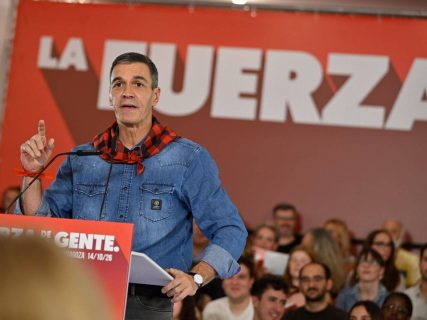
The president of the Government and socialist candidate for the general elections on November 29, Pedro Sánchez, accused PP and Vox this Wednesday of trying to "cut back" the right to vote of thousands of Spaniards and questioned what measures both parties would adopt if they reached the Executive. He did this during a campaign event in Zaragoza, accompanied by the general secretary of the PSOE of Aragón and former minister Pilar Alegría, where he also placed the defense of pensions and the welfare state among his main electoral messages.

Sánchez referred to the Supreme Court's decision to maintain the precautionary measures related to the so-called 'grandchildren's law', after the appeal presented by Vox and Iustitia Europa. The measure affects around 163,000 Spaniards residing abroad who obtained nationality through the Democratic Memory Law, whose electoral participation remains conditioned by the judicial resolution.

"If they are capable of doing this, cutting back the right to vote, curtailing a fundamental right such as the political participation of citizens, while in opposition, imagine what they can do if they reach the Government," the socialist leader stated.

The event, held under the slogan "The strength of the people", comes a day after the visit of the president of the PP, Alberto Núñez Feijóo, to Huesca. Both leaders have chosen Aragón to headline their respective campaign events during the same week.

Sánchez promises four more years of pensions linked to the CPI

The defense of the public pension system has occupied another of the main blocks of the speech. Sánchez has promised to maintain the revaluation of pensions according to the CPI for the next four years, if he manages to continue at the head of the Government after the 29N.

The socialist candidate has defended the sustainability of the system and the reform promoted during his mandate, which has been linked to the support of the European Commission and to the evaluations of the Independent Authority for Fiscal Responsibility (AIReF).

He has also highlighted that the Social Security Reserve Fund has gone, according to the figures presented in his intervention, from about 5 billion euros during the PP Government to around 20 billion currently.

Sánchez has used the open debate on pensions to question the positions of PP and Vox. While Feijóo has defended maintaining the update of benefits according to the CPI, the parliamentary spokesperson of the PP, Ester Muñoz, has warned of the risk of collapse of the system, and Vox proposes moving towards a mixed model that incorporates capitalization mechanisms.

The housing and the Maricarmen case enter the electoral discourse

Sánchez has also dedicated part of his speech to housing, one of the issues that have marked the end of the legislature after the parliamentary rejection of the Government's decrees.

The president has recalled Maricarmen Abascal, the 87-year-old woman who passed away after her eviction in Madrid, and has presented the fight against housing emergency as a priority for the next legislature.

"If the cause of our grandparents was democracy, and that of our parents was the Welfare State, yours will be the cause of housing in the next legislature," he stated.

The socialist leader has defended that the measures of his Executive favor small property owners and tenants, while he has held large investment funds responsible for part of the problems in the real estate market. Likewise, he has linked the possibility of approving new housing measures to the composition of the Parliament that comes out of the polls on November 29.

Pilar Alegría accompanies Sánchez in Zaragoza

The event has featured the participation of Pilar Alegría, general secretary of the PSOE of Aragón, who has spoken before the attendees to support the socialist candidacy and criticize the opposition.

The Aragonese leader has resorted to humor to refer to the candidates and has framed the electoral date as a choice between the PSOE project and the one represented by Feijóo and Abascal.

The rally in Zaragoza is part of Sánchez's pre-campaign agenda, which has intensified his public appearances after announcing the early election. The PSOE will hold an extraordinary Federal Committee in Fuenlabrada this Saturday to ratify its candidacies for Congress and the Senate.

More key points, information and questions with FREN

AI-GENERATED CONTENT

What is the current parliamentary status of the Democratic Memory Law and what procedures remain for its full implementation?

The Law 20/2022, of October 19, on Democratic Memory is fully approved, in force, and producing effects since its publication in the BOE on 10/20/2022 (official text). There are no pending parliamentary procedures regarding the original law. Reforms and extensive regulatory development have been approved, and some execution milestones and related legislative pieces remain to consider its deployment “closed.”

1. Parliamentary status and law reforms

According to our database, which collects official records, the situation as of 10/14/2026 is as follows:

  • Law 20/2022: definitively approved by the Cortes Generales and sanctioned on 10/19/2022; in force since the day after its publication (ninth final provision).
  • Error correction: published on 02/07/2023 (BOE-A-2023-3123), which adjusts several technical references.
  • Challenges before the Constitutional Court: at least two unconstitutionality appeals (No. 193-2023 and 349-2023) are recorded in the BOE in 2023, with no ruling annulling the law as a whole yet. Meanwhile, the norm remains fully in force.

Subsequently, the Government modified Law 20/2022 through Royal Decree-Law 6/2026, of March 3, which adds a new twentieth additional provision on the recognition and compensation of persons deceased or with disabling injuries due to their activity in defense and claim of democracy between 1968 and 1978 (BOE-A-2026-5060).

  • The Congress ratified Royal Decree-Law 6/2026 on 03/26/2026 (173 votes in favor, 170 against, and 7 abstentions) and agreed to process it as a bill by urgent procedure.
  • That processing as Bill “121/000090” was opened in Congress (amendment phase, Constitutional Commission, publication of total amendments), but finally the initiative expired on 10/06/2026. That is, the bill has lapsed and its processing ended without a new law approved.

The consequence is important: the reform introduced by RDL 6/2026 remains in force because it was ratified, but no subsequent law has been approved to reorder or modify it. From a parliamentary point of view, therefore, Law 20/2022 governs in its consolidated version (including the twentieth additional provision) and there is currently no bill in progress that changes it.

2. Regulatory development already approved

Law 20/2022 itself and its error correction contain numerous references to “regulatory” development or measures to be adopted “within the term of…”. Among the developments already approved are:

  • Royal Decree 265/2025, of April 8, which regulates the Democratic Memory Council and the State Registry of Democratic Memory Entities, in application of article 57 (consultative body) and article 59 (registry).
  • Royal Decree 1040/2025, of November 19, which establishes the procedure to prepare the Catalog of symbols and elements contrary to democratic memory and creates the corresponding technical commission, in execution of article 36.
  • Instructions and orders on acquisition of nationality through the eighth additional provision (Instruction of 10/25/2022 and its error correction, as well as a modifying instruction of 2024).
  • Various royal decrees on subsidies (2024, 2025, and 2026) for democratic memory activities and to finance exhumations, search, and identification of victims, consistent with articles 20 and 23 and the “duty of memory.”
  • Agreements and resolutions that create or activate instruments provided in the law: the Democratic Memory Council, the commission on human rights violations, the declaration of specific democratic memory sites, and public information procedures for new sites.

In parallel, Congress has approved non-legislative motions urging the Government to “guarantee the application of democratic memory policies in Spain,” politically reinforcing the demand for law execution.

3. Procedures remaining for full implementation

Although the “parliamentary cycle” of the base law is closed, Law 20/2022 itself and its subsequent development show that the following mainly remain pending:

  • Complete sectoral regulatory developments still foreseen in the law: for example, detailed regulation of some procedures (State DNA Bank, archives and documentary censuses, exhumation protocols, operation of the Democratic Memory Center, etc.), which the norm refers to “regulatory” development. Part is already approved, but not all references have been exhausted.
  • Fully deploy the created instruments:
    • Consolidate the Catalog of symbols and elements contrary to democratic memory (feed and update it annually, and complete the effective removal of included elements).
    • Complete and maintain the State Registry and Census of Victims, and the maps locating missing persons.
    • Develop and execute the Democratic Memory Plan and the multi-year plans for search, exhumation, and identification.
  • Reform of the Official Secrets Law: the sixth final provision of Law 20/2022 obliges the Government to present a classified information bill to guarantee access to archives. That bill was sent to Congress in 2025 but remains in processing with numerous extensions of the amendment deadline, so this pillar of access to historical documentation has not yet been completed.
  • Budget execution and territorial cooperation: the law largely relies on the action of autonomous communities and local entities (memory sites, removal of symbolism, support for exhumations). “Full application” requires maintaining and consolidating state budget allocations and agreements with territories and universities that have already been signed.

In summary, from a strictly parliamentary point of view, the Democratic Memory Law is approved and in force, and the 2026 reform via Royal Decree-Law as well. What remains is not so much a new state memory law but completing the regulations, plans, bodies, catalogs, archives, and resources that Law 20/2022 itself foresees so that all its rights and obligations are fully effective in practice.

Can you detail exactly which bodies Law 20/2022 creates (councils, commissions, centers, registries) and the status of each? What practical impact is Royal Decree-Law 6/2026 having on compensation to victims of repression, according to initial data on applications and granted compensations? How is the law being applied regarding the removal of Francoist symbols and declaration of democratic memory sites, with some concrete examples of recent decisions?

What are the main powers of Pedro Sánchez as President of the Government according to the Spanish Constitution?

The Spanish Constitution does not detail Pedro Sánchez's powers as an individual, but those of the President of the Government, whoever holds the office. His powers are concentrated in directing the Government's action, setting general policy, and articulating the relationship with the Cortes Generales and the King.

1. Political direction of the Government and the State

The core of presidential functions lies in articles 97 and 98.2:

  • The Government, presided over by him, directs domestic and foreign policy, the civil and military Administration, and the defense of the State, and exercises executive functions and regulatory power.
  • The President directs the Government's action and coordinates the functions of other members, without eliminating the competence and responsibility of each minister.

In practice, this means the President sets political priorities (government program, major reforms, economic and social orientation), decides the Cabinet structure, and coordinates the Executive's position on all major issues, both inside and outside Spain.

2. Appointment, dismissal, and configuration of the Government

Although the King formally appoints the President of the Government (art. 62 d)), the procedure is regulated in article 99:

  • After elections or in provided cases, the King proposes a candidate, who presents his program before Congress and must obtain the Chamber's confidence (investiture).
  • If he obtains that confidence (absolute majority or simple in second vote), the King appoints him President.

Once appointed, according to article 100, other Government members are appointed and dismissed by the King at the President's proposal. This grants the President effective control over:

  • Which ministries exist and how they are organized.
  • Who holds each portfolio and when they cease.

Article 101 adds that the Government ceases, among other cases, by resignation or death of the President or loss of parliamentary confidence, emphasizing the central role of the presidential figure.

3. Relationship with Congress: confidence, control, and dissolution

The President's powers vis-à-vis Parliament are articulated in several provisions:

  • Article 112: the President, after deliberation of the Council of Ministers, may raise the question of confidence on his program or a general policy declaration. If not passed, the Government must resign (art. 114.1).
  • Articles 113 and 114: Congress may approve a motion of censure implying the President's resignation and automatic investiture of the alternative candidate.
  • Article 115: the President, also after Council of Ministers deliberation and under his exclusive responsibility, may propose to the King the dissolution of Congress, Senate, or Cortes Generales and call elections, with certain limits (e.g., not while a motion of censure is pending).

Through these tools, the President can attempt to strengthen or renew his political legitimacy before the Cortes and the public, but is always subject to control and possible replacement by Congress.

4. Powers in exceptional situations

Article 116 regulates states of alarm, exception, and siege as constitutional crisis frameworks:

  • The state of alarm is declared by the Government via Council of Ministers decree, reporting to Congress.
  • The state of exception is declared by the Government but requires prior authorization from Congress.
  • The state of siege is declared by Congress by absolute majority, exclusively at the Government's proposal.

In all these cases, the President, as head of Government, plays a decisive role in deciding to activate these tools and in the political direction of their management, always within the limits and controls set by the Constitution.

5. Other relevant functions

Additionally, the Constitution links the President with other important powers:

  • The countersignature of the King's acts (art. 64), making the President or ministers politically responsible for the Crown's acts.
  • The proposal of consultative referendum to the King, with prior Congress authorization (art. 92).
  • The Government's central participation in international treaties (arts. 93 and 94) and in the preparation of the General State Budgets (art. 134).
  • A specific regime of criminal responsibility for the President and ministers (art. 102), with trial before the Criminal Chamber of the Supreme Court.

In summary, according to the Constitution, Pedro Sánchez, as President of the Government, concentrates the political direction of the Executive, leadership of governmental action, initiative before Congress at key moments (confidence, dissolution, exceptional states), and the capacity to configure and reshape the Government, always under the democratic control of the Cortes Generales.

What requirements must be met for a person to obtain Spanish nationality through the so-called 'grandchildren law'?

The so-called “grandchildren law” is not an independent law but the eighth additional provision of Law 20/2022, on Democratic Memory, developed by the Instruction of October 25, 2022 of the Directorate General of Legal Security and Public Faith (modified in 2024). It regulates a right of option for Spanish nationality of origin for certain descendants of Spaniards.

1. Who can benefit from the “grandchildren law”?

According to Law 20/2022 and the Instruction of 10-25-2022, the following three main groups may opt for Spanish nationality:

  • 1) Born outside Spain of a father/mother or grandfather/grandmother originally Spanish exiles
    Those who may opt are:
    • Born outside Spain.
    • Have a father or mother, or grandfather or grandmother, who originally were Spanish (i.e., Spaniards by origin).
    • That ascendant lost or renounced Spanish nationality as a consequence of exile for political, ideological, belief, or sexual orientation/identity reasons.
    The exile condition must be documented (exile pensions, refugee organization documents, certificates from exile-related entities, etc., along with passport entry stamps, consular registrations, consular civil registries, etc.).
  • 2) Children born abroad of Spanish women who lost nationality by marrying foreigners
    This refers to:
    • Children born outside Spain.
    • Of a Spanish mother who lost her nationality by marrying a foreigner before the Constitution came into force in 1978.
    The Instruction specifies that:
    • The mother's birth in Spain must be proven (literal Spanish birth certificate).
    • The marriage to a foreigner before 12-29-1978 must be proven, and in certain periods also the mother's acquisition of the husband's nationality, except in very old marriages where the Civil Code already presumed the wife followed the husband's nationality.
  • 3) Adult children of Spaniards who already obtained nationality of origin by option
    May opt:
    • Adult children of persons who were already recognized Spanish nationality of origin:
      • either under Law 20/2022 itself (eighth additional provision),
      • or under the seventh additional provision of Law 52/2007 (the previous “grandchildren law”).
    This corrects the limitation of the previous regulation, which excluded many adult children.
2. Formal requirements, age, and deadlines

Law 20/2022 establishes that:

  • It is a right of option: it requires an express declaration by the interested party before the competent Civil Registry (general or consular).
  • Deadline: the declaration must be formalized within two years from the entry into force of Law 20/2022; the law itself foresees that the Council of Ministers may extend it by one more year. It is essential to check in practice, at the consulate or on the Ministry of Justice website, whether the deadline is still open and if the extension has been agreed.
  • Age:
    • The right of option is not limited to minors: both adults and minors may exercise it in the contemplated cases.
    • In group 3, it is expressly required that the children be adults of those who obtained nationality of origin by Law 20/2022 or Law 52/2007.
  • General conditions of the Civil Code: except regarding the special deadline and that renouncing previous nationality is not required, the requirements of articles 20 and 23 of the Civil Code apply (declaration of option, oath or promise of loyalty to the King and obedience to the Constitution and laws, choice of civil neighborhood, etc.).
3. Usual basic documentation

The Instruction of 10-25-2022 details the documentation generally required along with the application-declaration:

  • Common documentation:
    • Applicant's identity document.
    • Applicant's literal birth certificate (from the local civil registry where registered).
  • Proof of nationality and condition of the ascendant:
    • Literal birth certificate of the father, mother, grandfather, or grandmother originally Spanish.
    • In the case of grandchildren: literal birth certificate of the father or mother linking to the Spanish grandfather/grandmother.
    • Where applicable, documents proving the ascendant's exile.
    • In the case of women who lost nationality by marriage: marriage certificate, proof of acquisition of the husband's foreign nationality, and in some cases, accreditation of the foreign legislation applicable at the marriage date.
    • For adult children of Spaniards by option: Spanish literal birth certificate of the father or mother already recognized as Spaniard by origin.
  • Submission and correction:
    • The application is made on official forms (annexes of the Instruction), available on the Ministry of Justice and Ministry of Foreign Affairs websites or at the registries themselves.
    • If documentation is missing, the Registry grants a period of 30 calendar days to complete the proof.
    • In consulates with high demand, the Instruction of 11-05-2024 allows that the request for an online appointment within the deadline serves to consolidate the right, even if the in-person appearance is later.

In summary, the “grandchildren law” allows certain descendants of Spaniards — especially exiles, women who lost nationality by marriage, and Spaniards by origin who already opted under previous laws — to acquire Spanish nationality of origin by option, provided they prove their family link, the ascendant's situation, and submit the complete application within the legal deadline.

How is the exile condition of the grandfather or grandmother practically proven for the purposes of the eighth additional provision of Law 20/2022? What differences exist between this “grandchildren law” and the previous regulation of the seventh additional provision of Law 52/2007? What concrete steps must I follow at a Spanish consulate to process nationality by option under Law 20/2022?

Play

Test your knowledge with FREN!

How much do you know about this topic? Answer the following 3 questions.

What has Pedro Sánchez promised regarding pensions if he remains in government after the elections?

Question 1 of 3

Which political party filed a challenge against the 'grandchildren's law' that led to precautionary measures by the Supreme Court?

Question 2 of 3

Who does Pedro Sánchez blame for the problems in the real estate market in his speech?

Question 3 of 3