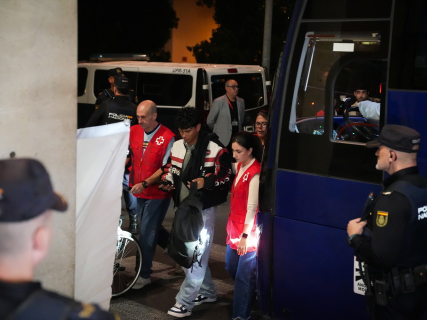
This was the night in Urda after the train accident: rescue and families waiting

The Urda sports center became a center of attention for relatives, some of whom still did not know the whereabouts of their loved ones by the end of Wednesday

noche accidente urda

noche accidente urda

Add DEMÓCRATA to Google

Ask FREN

Published

Last updated

4 minutes
Elecciones 29N · Encuestas

La media de las encuestas

Media a 27 de octubre de 2026 · 15 institutos

  • PP31,0 %
  • PSOE27,3 %
  • Vox18,9 %
  • Sumar6,3 %
  • Podemos2,9 %
  • ERC2,3 %
010203040ene 2024jul 2024ene 2025jul 2025ene 2026jul 2026

Media del último estudio de cada instituto en 30 días y su evolución semanal desde el 23J. Partidos con al menos un 2 %.

Todas las encuestas

Elecciones generales del 29 de noviembre · Demócrata

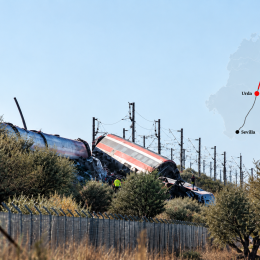
It has been a very long night in Urda. And the day will be as well. There are very hard weeks ahead for the injured and their families. The passage from Wednesday to Thursday was marked by the rescue work at the site of the train accident and the uncertainty of the families who are still searching for their loved ones. The emergency teams have continued working among the remains of the trains, illuminated by floodlights, while the authorities advanced in the recovery of the bodies and in the preparations to identify the victims.

The provisional toll remains at 68 dead, according to the information released by the Government of Castilla-La Mancha. At the close of Wednesday, the available data also counted dozens of people hospitalized and others who had been discharged. The authorities did not rule out that the number of fatalities would increase when access to the most damaged carriages could be obtained.

The intervention is taking place under judicial restrictions. The judge in charge of the case has prohibited access by people unrelated to the operation to a perimeter of two kilometers on both sides of the affected stretch. The ruling also prevents removing elements from the area and taking or disseminating images of the site, with the aim of preserving the evidence.

The Judicial Police must also gather information at the Atocha control center on rail traffic in the affected stretch, as well as documentation from Adif relating to the action protocols before, during and after the accident.

The Minister of Transport, Óscar Puente, had indicated during Wednesday that one of the hypotheses pointed to the authorization for the AVE to resume running while the Iryo train remained stopped on the same track. 

The identification of the victims, one of the priority tasks

The Institute of Legal Medicine of Toledo had received 52 bodies by the close of the day, and two others were at the Institute of Legal Medicine of Ciudad Real. The forensic experts had carried out eight autopsies and the expectation was to begin identifying the deceased this Thursday.

Identification requires comparing the available data and, when necessary, resorting to DNA samples from direct relatives. For this reason, the Civil Guard set up offices in Madrid, Toledo, Córdoba and Sevilla to collect information and facilitate the identification tasks of the people whose whereabouts had not been confirmed.

Until 20:30 on Wednesday, the command posts had registered 29 reports from family members and close contacts of disappearances related to the accident: 13 in Madrid, nine in Toledo and seven in Sevilla. 

Family members waiting for news about their loved ones

The Urda sports center became during Wednesday a point of attention for family members and affected people. Spaces were set up there to receive those seeking information, with water, food, health care and psychological support. Volunteers from Civil Protection and other teams collaborated in the care.

The wait was marked by the lack of information about some people who had been taken to hospitals without their relatives knowing where they were. The initial priority of the health teams was to attend to the injured, including those who had arrived unconscious and had still not been identified.
In the afternoon, a representative of Renfe informed the family members that the pavilion was going to close and that the assistance would be moved to the Civil Guard Command in Toledo. There, separate spaces would be organized for the affected by Renfe and by Iryo, with support staff. The family members would have to formalize the corresponding complaints and provide information that would allow their relatives to be identified.

The railway companies keep specific phone lines enabled for affected people and family members. Renfe has made available 900 10 10 20 and Iryo, 900 001 403. Attention points have also been established at the stations of Madrid-Puerta de Atocha, Sevilla-Santa Justa and Córdoba, as well as Málaga, with attention during the night.

Hospitals are attending to those injured in the accident

The injured were transferred to different health centers, mainly in Castilla-La Mancha. Among them are the University Hospital of Toledo, the Mancha Centro Hospital of Alcázar de San Juan, the General University Hospital of Ciudad Real and the University Hospital of Albacete.

The Emergency doctor at the Hospital of Toledo Miguel Ángel González explained to Cadena SER that the service had received a large number of patients during the morning and that the situation was beginning to normalize at night. The hospital organized teams and care spaces and applied a triage system to distribute the patients according to their severity.

The most serious cases arrived in some cases by medical helicopters. Other injured people were transported in mobile ICUs and required surgical interventions. The health personnel also had the collaboration of professionals who voluntarily joined the device during the emergency.

Three days of official mourning and a high-speed line interrupted

The President of the Government, Pedro Sánchez, announced three days of official mourning, from October 29 to 31. During that period, the national flag will fly at half-mast on public buildings and on Navy ships. Sánchez conveyed his condolences to the families and stated that the Executive's priority was to attend to the victims and their relatives.

High-speed traffic between Madrid, Ciudad Real and Andalusia continues interrupted by the accident. Adif is maintaining the incident on the affected section and is asking travelers to consult the information from the railway companies. Renfe has enabled special services by conventional rail between Madrid, Ciudad Real and Puertollano, with an approximate increase of one and a half hours in travel time.
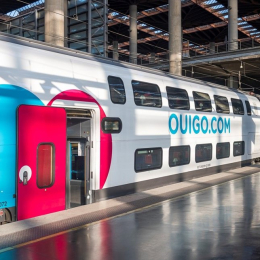
The company has also announced an alternative transport plan for travelers who need to travel between Madrid and Andalusia starting Friday, October 30, while the high-speed line remains closed. The schedules, routes and services available should be consulted on the official channels of Renfe and Adif.

This Thursday, the authorities face a new day of work in which they will have to advance the recovery work, identify the victims and provide information to the families. Meanwhile, the judicial investigation into the Urda train accident will try to reconstruct the circumstances that led to the collision of the two trains.

More key points, information and questions with FREN

AI-GENERATED CONTENT

What is the status of the judicial investigation into the Urda accident and what are the next steps planned for its clarification?

As of October 29, 2026, the judicial investigation of the Urda railway accident is in an initial instruction phase: evidence is being gathered and preserved to reconstruct what happened, with no causes or criminal responsibilities definitively established. It is led by the magistrate of the number 2 seat of the Civil and Instruction Section of the Orgaz Court of First Instance, who has decreed the summary secrecy. The next steps focus on analyzing the train recorders, obtaining circulation documentation from Adif, and cross-checking it with statements.

Actions agreed upon

According to the statement from the Superior Court of Justice reported by Demócrata, the judge adopted these measures on October 28:

  • Protect the scene: restrict access within a two-kilometer radius around the high-speed line, in both directions. Only security forces, rescue teams, medical personnel, and authorized judicial staff may remain. It is also prohibited to remove objects and to capture or disseminate images of the affected area, to preserve evidence.
  • Secure the black boxes: order their seizure and custody by the Toledo Judicial Police for subsequent technical study. The order does not mean that their analysis has concluded.
  • Investigate circulation control: send the Judicial Police to the Atocha center to collect data from the section during the hours of the accident and the report from Adif's investigation commission on those responsible for the control.
  • Obtain applied protocols: require Adif to provide information on actions before, during, and after the incident.

Additionally, the Civil Guard has already taken a statement from the Adif operator who authorized the resumption of the AVE's movement, according to published information. That statement alone does not allow assigning criminal responsibility.

What must now be clarified

The provisional reconstruction focuses attention on the 17 minutes between 8:36 and 8:53 a.m.: from the authorization for the AVE to continue until its collision with the stopped Iryo. The Demócrata timeline places earlier a failure of the LZB safety system that would have affected about 63 kilometers and stopped six trains. These data are an initial reconstruction, not judicial conclusions.

The following tasks derived from the announced proceedings are:

  • Expert examination of the recorders and cross-checking them with radio communications, computer data, signaling, and circulation orders.
  • Clarify what instructions the driver received, what the control center knew about the stopped Iryo, and why the authorization was not corrected during that interval.
  • Complete police, railway, and forensic statements and reports to verify whether technical failures, human errors, organizational deficiencies, or several factors concurred.
Deadlines and responsibilities

No public schedule is known to complete expert reports, hold new statements, or close the instruction. The secrecy limits knowledge of the proceedings, so what has already been ordered must be distinguished from foreseeable actions.

A complaint by Vox has also been filed for alleged negligent homicide and injuries, with requests to identify operators and shift managers. Its filing does not imply admission or a conclusion by the court.

In short, the priority is to turn the provisional sequence into a proven reconstruction. Only then can it be specified whether there are criminal responsibilities; attributing the accident exclusively to human error would be premature.

What are the competencies of the Minister of Transport in managing railway emergencies according to Spanish legislation?

The Minister of Transport has responsibilities for railway policy, prevention, and sectoral response, but does not automatically assume command of an emergency due to a train accident. Legislation distinguishes the technical management of the railway, civil protection, and accident investigation: each area has its own authorities and functions.

1. Railway prevention and planning

At the state level, the department directs railway policy and planning of the General Interest Railway Network. However, the obligations for safe operation and risk control fall directly on infrastructure managers —such as ADIF— and railway companies, each regarding their part of the system.

Royal Decree 929/2020, in its article 4, establishes this distribution. It also requires that safety management systems incorporate "action, alert, and information plans in case of emergency, agreed with the relevant public authorities." Therefore, these plans are not personal operational orders from the minister, but organizational obligations of the railway managers.

2. Coordination and provision of resources

Transport participates in civil protection actions within its competencies and according to applicable plans. Article 35 of Law 17/2015 states: "The Minister of the Interior will decide and the competent authority of the corresponding Department or body will order the intervention of these state resources."

Thus, the department can order the intervention of its resources through the legally provided channel and collaborate with regional, local, and state authorities. This does not make the Minister of Transport the general director of rescue, medical, or civil protection services.

3. Who directs a national interest emergency

The declaration of a national interest emergency corresponds to the Minister of the Interior, not the Minister of Transport. Articles 29 and 30 of Law 17/2015 also assign to Interior its direction, including ordering and coordinating actions and managing state, regional, and local resources in the affected territory.

The severity of a railway accident does not by itself transfer that command to Transport. Its intervention remains sectoral and is integrated into the corresponding civil protection leadership.

4. Service continuity and exceptional measures

Article 60 of Law 38/2015, of the railway sector, assigns the Ministry the adoption of necessary measures to guarantee proper service provision when a company ceases to provide passenger services subject to public service obligations, or provides them without guaranteeing people's safety.

This faculty must be distinguished from a more exceptional one: the temporary assumption by the State of certain services or infrastructures to guarantee public safety and national defense corresponds to the Government, not unilaterally to the minister.

5. Victim assistance and subsequent safety

Article 63 of Law 38/2015 requires operators and infrastructure managers to have plans for assistance to victims and families. Their approval corresponds to the competent management centers of the Ministry, after a mandatory report from Interior: not necessarily to the department head personally.

Technical supervision should also not be confused with ministerial command. The State Railway Safety Agency has functional autonomy, recognized in article 3.6 of Royal Decree 253/2024. Royal Decree 929/2020 allows adopting urgent preventive rules after accidents, respecting the corresponding competencies and procedures.

In short, Transport must promote prevention, provide resources, guarantee railway response, and protect users, without replacing Interior's competencies nor the autonomy of technical bodies.

What legal requirements must be met to officially identify victims of a railway accident in Spain?

The official identification of persons deceased in a railway accident requires documented medico-forensic and police action, under the direction of the competent judicial authority. It is not enough to find an identity document or for a relative to recognize personal belongings: there must be sufficiently accredited correspondence between the missing person and the examined body or remains. This explanation refers to deceased persons; the identification of injured persons follows different care and administrative circuits.

The current text of applicable provisions could not be verified here. Therefore, the following is a general orientation on the procedure, not an exhaustive list of legal requirements nor an opinion on a specific accident.

1. Judicial and medico-forensic intervention

When a death occurs under accidental circumstances requiring judicial investigation, identification is part of the death-related proceedings. The judicial authority, forensic doctors, and police specialists intervene. Railway safety investigation has a different purpose: to clarify technical circumstances and prevent new accidents, not to replace judicial identification of victims.

A distinction must be made between identifying the person and determining the cause of death. These are related issues, but a conclusion about how the death occurred does not by itself prove to whom the remains belong.

2. Recovery and traceability of remains

Recovery must allow maintaining the relationship between each body or fragment, the place where it was found, its belongings, and the samples obtained. Actions are documented and individualized references are used. The chain of custody must also be preserved: who collects, transports, receives, and analyzes each relevant element.

This traceability is especially important if remains are fragmented, burned, or mixed. The location of a belonging next to a body may guide the investigation, but does not automatically make its owner the deceased person.

3. Comparison of data before and after death

Identification is built by comparing data obtained from the body with known information about the missing person. Scientific methods used include fingerprints, dental comparison, and genetic analysis. Medical history, X-rays, prostheses, scars, or other individualizing characteristics may also be useful.

It should not be understood that all three methods are always mandatory nor that DNA is indispensable in all cases. The appropriate method depends on the state of the remains and available information. What matters is the solidity of the correspondence and its evaluation by specialists, not accumulating evidence unnecessarily.

4. Role of families and documentation

Families can provide disappearance data, medical and dental information, photographs, and elements to obtain comparison samples. Their cooperation should be channeled through those responsible for identification. Visual recognition may provide information but requires special caution when there are severe injuries or numerous deceased.

Analyses and conclusions must be documented in the corresponding reports. If relevant discrepancies exist, they must be investigated before closing identification.

5. Identification, delivery, and registration are not the same

The identification conclusion must be incorporated into the competent procedure. Delivery of the body to the family, death documentation, and registry inscription are related but distinct actions. A provisional communication, a passenger list, or a news report do not equate to that conclusion.

In summary: the core of the procedure is a reliable, documented identification unequivocally linked to the remains, with intervention of competent authorities. An initial hypothesis should not be confused with an officially established identity.

Play

Test your knowledge with FREN!

How much do you know about this topic? Answer the following 3 questions.

What is the provisional death toll according to the information released by the Government of Castilla-La Mancha?

Question 1 of 3

What measure has the investigating judge taken to preserve evidence in the accident area?

Question 2 of 3

What service has Renfe set up for travelers affected by the interruption of the high-speed line?

Question 3 of 3