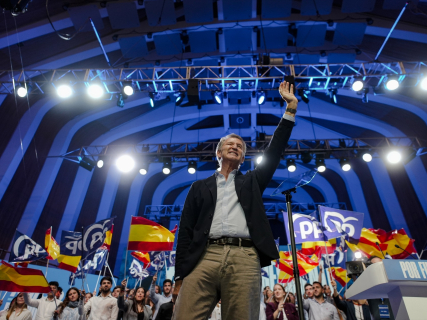
The PP uses a pizza to announce Feijóo's tax cut: "Don't let them eat your pizza"

The popular ones publish a video on social media with a pizza dedicated to the "workers" to promote the tax cuts promised by their leader, who proposes to reduce the income tax in 2027 if he reaches Moncloa.

EuropaPress 7864625 presidente partido popular alberto nunez feijoo acto precampana partido

EuropaPress 7864625 presidente partido popular alberto nunez feijoo acto precampana partido

Add DEMÓCRATA to Google

Ask FREN

Published

Last updated

3 minutes

Most read

Elecciones 29N · Encuestas

La media de las encuestas

Media a 24 de octubre de 2026 · 15 institutos

  • PP31,4 %
  • PSOE26,9 %
  • Vox18,8 %
  • Sumar6,3 %
  • Podemos3,1 %
  • ERC2,2 %
010203040ene 2024jul 2024ene 2025jul 2025ene 2026jul 2026

Media del último estudio de cada instituto en 30 días y su evolución semanal desde el 23J. Partidos con al menos un 2 %.

Todas las encuestas

Elecciones generales del 29 de noviembre · Demócrata

The Popular Party has resorted to a pizza to promote the tax cuts that its president, Alberto Núñez Feijóo, has promised to implement if he manages to govern after the general elections on November 29. The party published this Saturday, October 24, a video on its social media in which a pizza appears with the word "CURRANTES", accompanied by a message that seeks to convey its economic proposal to workers. "Don't let them eat your pizza. FINALLY 🇪🇸 LESS TAXES", states the publication disseminated from the official account of the party on X.

The audiovisual piece uses pizza as a metaphor for the money that workers receive for their effort and the part that they allocate to paying taxes. With this resource, the popular party transfers to the realm of social networks one of the main electoral commitments of Feijóo: reduce the tax burden to increase the disposable income of citizens. The campaign arrives just a day after the leader of the PP announced in Valencia a reduction of the Personal Income Tax (IRPF) for 2027, arguing that inflation and taxes are reducing the purchasing power of Spaniards.

Feijóo promises to lower the IRPF in 2027 if he reaches the Government

The president of the PP announced this Friday, during a rally held in Valencia, that he will approve a reduction of the IRPF in 2027 if he manages to reach the Moncloa. Feijóo defended that workers should keep a larger part of their income and accused the government of Pedro Sánchez of benefiting from the increase in revenue caused by rising prices. "In 2027, there will be a reduction of the IRPF so that inflation and taxes do not eat away at the salaries of Spaniards", assured the popular leader, who also criticized that the Executive collects more taxes when salaries increase to compensate for inflation.

Among his commitments is also to guarantee by law that workers receiving the minimum interprofessional wage (SMI) do not pay IRPF, through a mechanism that automatically updates the exemption threshold whenever the minimum wage increases. The proposal aims to prevent future increases in the SMI from generating new tax obligations for its recipients, although there are already deductions that neutralize the effective taxation of these workers. For the moment, the PP has not specified all the brackets and tax rates that it would modify with its reform nor the total cost that it would entail for public finances.

Less taxes on housing, the shopping basket, and energy

The promise to reduce the IRPF is part of a broader package of fiscal measures with which the Popular Party aims to tackle the rising cost of living. Among the proposals announced by the PP is the reduction of VAT to 0% for basic foods, as well as a reduction of the tax applied to energy from 21% to 10%. The party has also proposed to double the minimum per dependent in the IRPF, a measure with which it estimates that a family with two children could save up to 800 euros annually.

In terms of housing, Feijóo has promised a 60% reduction in VAT and the Property Transfer Tax for those under 40 who purchase their first residence, as well as public guarantees of up to 100% and new tax advantages to facilitate savings. These initiatives add to his commitment to build one million homes during the next legislature, one of the main pillars of the economic program that the PP is presenting during the electoral pre-campaign.

With the pizza video, the Popular Party seeks to give visibility to these proposals through a format different from traditional political speeches. The publication comes amid an intensification of electoral activity, while Feijóo continues to travel across Spain to present his Government program. The announced tax cuts remain electoral commitments, whose implementation would depend on the arrival of the PP to the Executive, its regulatory specification, and the approval of the corresponding legal changes.

More key points, information and questions with FREN

AI-GENERATED CONTENT

What is the status of the parliamentary processing of the PP's announced IRPF reduction proposal?

The IRPF reduction announced by the PP for 2027 is, as of October 24, 2026, an electoral commitment, not a reform with an identified open parliamentary process. It is not approved as law nor does it produce tax effects by itself. It is important to distinguish this announcement from previous initiatives on inflation and minimum wage, which have had different parliamentary paths.

The most recent announcement: pending legislative specification

The announcement made by Alberto Núñez Feijóo in Valencia on October 23 proposes approving an IRPF reduction in 2027 if he comes to government. According to information published by Demócrata, not all brackets, rates that would change, or the total cost of the reform have yet been specified. Therefore, it should not be described as a law pending amendments, committee review, or final vote. (Demócrata, October 24)

The commitment includes legally guaranteeing that those who receive the interprofessional minimum wage do not pay IRPF, through an automatic update of the threshold when the SMI increases. This promise also does not equate to the approval of that legal mechanism. (Demócrata, October 24)

What had been processed previously

The most directly related precedents allow specifying what has received parliamentary support and what did not become law:

  • IRPF adjustment to inflation. The Congress approved a non-legislative motion from the Popular Group, whose approved text was published on April 18, 2024. It was a political resolution, not a tax modification. (BOCG, April 2024)
  • New adjustment request. On June 12, 2025, another non-legislative motion from the PP to adapt the IRPF to inflation was approved. Its approval called for government action but did not directly modify the rate. (Approved text, June 2025)
  • General deflation. On April 22, 2026, points of a motion from the Popular Group urging to lower the IRPF to adapt it to price and wage increases were approved. Deflating means updating the tax limits to prevent inflation from increasing the tax burden without a real income improvement. This was also not a law. (Congress, April 2026)
  • Motion in the Senate. The popular initiative on bracket deflation was admitted on May 5, 2026. That procedure did not imply approving the reduction; moreover, it should not be presented as pending today: with the dissolution of the Cortes, pending ordinary parliamentary initiatives expire. (Senate Publication)
  • Exemption linked to the SMI. The PP's bill from the Senate to adjust the exempt limit to the minimum wage expired on October 6, 2026. Therefore, it does not continue its course in this legislature nor can it be confused with an approved reform. (Bill documentation)
What it means for the taxpayer

There is no applicable reduction derived from the announcement. Previous agreements called for changes but did not themselves set a new quota, rate, or withholding. To materialize the 2027 promise, the corresponding regulation must be specified and approved; it is not enough to recover an already approved motion.

In summary: the announcement remains in the electoral realm; previous parliamentary supports do not equate to an effective tax reform. The specific proposal on the SMI, moreover, ended by expiration.

What are the legal powers of the president of the Popular Party regarding fiscal policy in Spain?

The president of the Popular Party does not have, by virtue of that position, public powers to create taxes, approve budgets, or direct the tax administration. His capacity is internal leadership and political influence. The legal powers he might exercise as a deputy, senator, or president of the Government come from those positions, not from the party presidency.

1. Who legally decides on taxes and budgets

The constitutional distribution of powers does not grant fiscal powers to party presidents. It distinguishes between institutions that draft proposals, those that approve them, and those that execute them:

  • Taxes: Article 133.1 of the Constitution reserves to the State the original power to establish them by law. Autonomous communities and local corporations may establish and require taxes according to the Constitution and laws. The PP president does not replace any of these institutions.
  • General State Budgets: the Government is responsible for drafting the project and the Cortes Generales for examining, modifying, and approving it. The Constitutional Court confirms that only the Government can initiate the budget legislative procedure in STC 17/2019.
  • Budget execution: corresponds to the Executive, not to party leadership, as recalled by STC 34/2018.

Therefore, a declaration, electoral promise, or agreement signed by the PP president does not by itself modify tax obligations. To produce that effect, it must be translated into a decision by the competent body through the corresponding procedure.

2. What he can politically promote

His position allows promoting a fiscal orientation, defending reforms, and negotiating support. However, influencing a decision is not equivalent to having the legal power to adopt it.

In Congress, the formal channel is deputies and parliamentary groups. Article 126 of the Congress Rules allows a deputy with fourteen other signatures or a group with its spokesperson's signature to present bills. Being party president does not grant an additional personal legislative initiative.

He can also politically promote amendments, questions to the Government, or resolution proposals through those authorized. There are budget limits: amendments to the Budget project that reduce revenues require government consent; those that increase a credit must compensate with an equal decrease in the same section, according to Article 133 of the Rules.

3. Limits regarding parliamentarians

The party and parliamentary group are distinct legal entities, as recalled by STC 93/2023. The PP presidency does not automatically grant spokespersonship nor the powers reserved by the Rules to parliamentary representatives.

Moreover, voting is personal and non-delegable. Political discipline does not allow the party president to vote in place of deputies nor legally substitute their decision. STC 114/2024 relates this guarantee to the prohibition of imperative mandate.

4. What depends on the PP statutes

The concrete scope of his internal powers—directing strategy, representing the party, or intervening in program development—depends on the statutes and the distribution of functions among its bodies. It should not be presumed that all these decisions correspond exclusively to him.

Organizational autonomy is subject to the requirement of democratic functioning, according to STC 226/2016. In short, the statutes may grant him authority within the PP, but they cannot confer State fiscal powers.

What legal requirements must be met to modify the IRPF brackets and rates in Spain?

Modifying the IRPF brackets and rates generally requires a norm with the rank of law: an agreement of the Council of Ministers, a regulatory royal decree, or a ministerial order is not enough. The ordinary route is a law approved by the Cortes Generales, although there are other routes subject to limits. It is also necessary to distinguish between state regulation and autonomous competencies over the tax.

1. Legal reservation and material limits

Articles 31.3 and 133 of the Constitution underpin the tax law reservation: the essential elements of taxes must be regulated by law. The brackets and rates determine how much is paid and are part of those elements. Constitutional doctrine admits regulatory collaboration but not that the Government freely replaces the legislator when setting the tax burden (STC 233/1999).

Moreover, the reform must respect economic capacity, equality, system progressivity, and the prohibition of confiscatory scope in Article 31.1 of the Spanish Constitution. Therefore, complying with the legislative procedure does not allow approving any tax design.

2. Ordinary law and parliamentary procedure

To change the state scales, the IRPF Law 35/2006 can be modified by an ordinary law; an organic law is not required since it is a tax. The Government can present a bill, and entitled subjects can promote a bill.

The processing includes publication, submission of amendments, deliberation, and parliamentary approval, involving both Congress and Senate. Generally, a simple majority applies, without prejudice to special rules to override a Senate veto. Bills and amendments that reduce budget revenues may require government consent, according to Articles 111 and 126 of the Congress Rules.

3. Modification through Budgets

Article 134.7 of the Constitution establishes that the Budget Law cannot create taxes and can only modify them when a substantive tax law provides for it. Therefore, using the Budgets requires verifying that the specific modification is covered by that authorization; its law character does not eliminate this requirement.

Jurisprudence even admits substantial modifications when there is adequate legal provision. This authorization to the budget legislator should not be confused with authorization to the Government to change rates by regulation (STC 44/2015).

4. Royal decree-law: a limited route

The Government can approve norms with the force of law by royal decree-law if there is extraordinary and urgent need. However, it cannot sensibly alter the constitutional duty to contribute. The assessment considers the affected tax, the modified elements, and the nature and scope of the measure; urgency alone is not enough (STC 17/2023).

It must be submitted to Congress for validation or repeal within the constitutional period of thirty days from its promulgation. Its possible subsequent processing as a bill is an additional decision, not a requirement that replaces those material limits.

5. Territorial competence and application

Finally, it must be specified which scale is modified. The IRPF law distinguishes state and autonomous quotas and recognizes the exercise of autonomous competencies within the financing framework. A state modification does not automatically mean modifying all autonomous taxation. The norm must be published and determine its entry into force and temporal effects, identifying the fiscal year to which it applies.

Play

Test your knowledge with FREN!

How much do you know about this topic? Answer the following 3 questions.

What metaphor does the PP use in its campaign to explain its proposal for tax cuts?

Question 1 of 3

To which year has Feijóo promised to apply an IRPF reduction if he comes to government?

Question 2 of 3

What percentage reduction of VAT on energy does the PP propose?

Question 3 of 3