
Less than seven weeks before the general elections on November 29, 17.3% of Spaniards still do not know which party they will vote for, according to the October barometer of the Sociological Research Center (CIS). The percentage is approximately one in six interviewees and constitutes one of the main unknowns of the electoral campaign.
The study, conducted based on 5,025 interviews, allows identifying where these undecided voters come from through the recall of votes from the general elections of July 2023. The data shows differences between the electorates of the main parties, especially in the space to the left of the PSOE.
Indecision should not be confused with abstention. In addition to the 17.3% who respond that they still do not know who to vote for, 5.1% of respondents state that they would not go to the polls, 3.2% would vote blank, 1.9% would cast a null vote, and 2.6% do not answer.
Sumar concentrates the greatest indecision among the major parties
21.8% of those who recall having voted for Sumar in 2023 still have not decided their vote. It is the highest percentage among the electorates of the four main state parties from those elections. Only 30.3% assure that they would vote for Sumar again on November 29. The rest is divided among different options: 16.3% would vote for Podemos, 12.5% for the PSOE, and 4% for a possible left-wing coalition. Thus, former Sumar voters are one of the groups with the greatest indecision.
In the case of the PP, 15.6% of its 2023 voters remain undecided, while 62.7% declare that they would vote for the Popular Party again. 13.4% lean towards Vox, according to the direct responses collected in the survey.
Among those who voted for the PSOE, 14.5% still do not know who they will support on November 29. 63.6% maintain their intention to vote for the socialists, while 4.7% would opt for the PP and 3.2% for Sumar.
Vox presents a lower percentage of indecision, at 8.9% among its former voters. 73.2% would repeat their vote, 8% lean towards the PP, and 5.3% mention Se Acabó la Fiesta.
How many undecided voters are there in each electorate
The following table shows the percentage of people who answer "Still don't know" to the question about their voting intention, broken down by the party they recall voting for in the 2023 general elections.
| Vote in 2023 | Undecided in October 2026 |
|---|---|
| Sumar | 21.8% |
| PP | 15.6% |
| PSOE | 14.5% |
| ERC | 14.4% |
| Junts | 31.1% |
| EAJ-PNV | 10.9% |
| EH Bildu | 10.3% |
| Vox | 8.9% |
| BNG | 8.1% |
| Total of interviewees | 17.3% |
Junts registers a 31.1% of indecision among those who remember having voted for it in 2023, although this result should be interpreted with caution because the cross-section corresponds to a small group of 61 interviewees. The same caution applies to other territorial parties with small samples.
Not having a decided vote does not mean lacking preferences
The CIS introduces a second question for those who do not mention a candidacy in their direct intention to vote, including the undecided, those who would not vote, those who would opt for blank or null votes, and those who do not answer.
Among those who do not express a direct intention to vote, 40% of those who voted for the PSOE in 2023 still feel sympathy for the socialists, while 37.3% of former PP voters mention the popular party. In the case of Vox, the percentage stands at 10.3%, and among those who voted for Sumar, 20.6% express sympathy for this formation. These percentages are calculated solely on the former voters of each party who have not declared a candidacy in their intention to vote.
However, 44.3% of the total electorate does not feel sympathy for any party, while 5.7% do not know what to answer and 6.4% do not respond. These percentages correspond to the group of people without a declared candidacy in the first question, not exclusively to those considered undecided.
This distinction is important, as feeling sympathy for a party does not equate to having a decided vote. The CIS uses this information to construct the variable called "vote plus sympathy," which expands the direct responses but does not allow for the assurance that all those voters will end up voting for the mentioned party.
An unknown for the 29N campaign
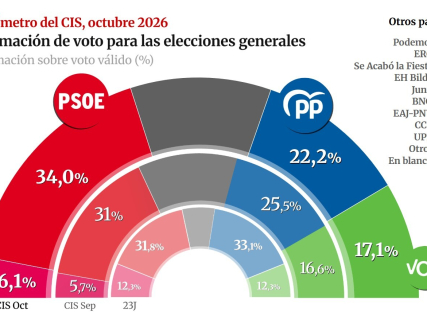
The October barometer places the PSOE at 34% of estimated vote, compared to 22.2% for the PP and 17.1% for Vox. Sumar reaches 6.1% and Podemos 3.1%, according to the calculation published by the agency.
These percentages are different from the direct intention expressed by the respondents, which includes the responses of those who have not yet chosen a party. The official estimate incorporates statistical adjustments and should not be interpreted as a proportional distribution of the undecided.