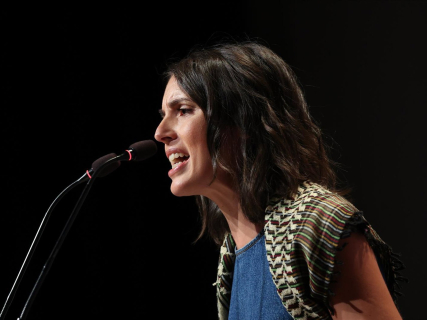
We can respond to the Frente Amplio with a proposal for territorial pacts that excludes Madrid and Catalonia.

The purple formation proposes to unlock the agreements between Podemos, IU, and Sumar in different communities and demands that the state leaderships respect the negotiations of their territorial organizations.

fotonoticia 20260929000112 1920

fotonoticia 20260929000112 1920

Add DEMÓCRATA to Google

Ask FREN

Published

Last updated

2 minutes

Most read

España vota · Congreso y Senado

Elecciones generales 29 de noviembre de 2026

Se eligen 350 diputados y los senadores de elección directa. Encuestas, calendario, candidaturas, programas y todo lo que necesitas saber para votar.

Faltan 43 días y 9 horas para que abran los colegios electorales.Hasta que abran los colegios, el domingo 29 a las 09:00 (hora peninsular).
Entra en el especial

Próximas fechas

  1. Presentación de candidaturas al Congreso y al Senado21–26 oct · Fecha prevista
  2. Voto desde el extranjero (CERA): envío de la documentación24–30 oct · Fecha prevista
  3. Publicación de las candidaturas presentadasFecha prevista
  4. Proclamación de candidaturasFecha prevista
Calendario completo

Podemos has responded to the latest offer from the Frente Amplio with a counterproposal focused on reaching territorial agreements, excluding Madrid and Catalonia, the two constituencies where the coalition of Ada Colau had offered the purple formation priority candidacies.

The response comes after the Frente Amplio sent this Friday, past 21:30 hours, a written proposal to incorporate Podemos into the coalition with full rights, guarantee representation on the lists of Madrid and Catalonia, and allow it to designate one of the spokespersons of the future parliamentary group.

However, Podemos insists on a formula of agreements by autonomous communities and asks to focus efforts on the territories where it considers that the conversations are more advanced.

"We propose to concentrate on agreeing on the territories that, like Extremadura, Euskadi, Cantabria, Galicia, or Murcia, already have agreements made or very advanced that are being blocked by the leadership of the Frente Amplio. It is essential to go together in those territories so that not a single leftist vote is lost," the purple formation states in its response.

To these five territories, it adds another six where it also considers it possible to reach an understanding: Andalusia, Castilla y León, Castilla-La Mancha, Asturias, Navarra, and La Rioja.

Podemos demands autonomy for territorial organizations

The counterproposal focuses on the negotiations that the autonomous structures of the parties maintain, especially Podemos and Izquierda Unida, although also Movimiento Sumar in some communities.

"Our proposal for all those territories is to allow the agreements that the territorial organizations, mainly Podemos and Izquierda Unida, and in some also Sumar, are already advancing, both in programmatic proposals, resources, and representativeness in the composition of the lists and spokespersons," the document states.

Podemos suggests that the state leaderships accompany these conversations to ensure a distribution that they consider balanced among the participating organizations, instead of subordinating the territorial agreements to a general negotiation.

The formation cites as an example the understandings reached in the Canary Islands and the Valencian Community, where Podemos has agreed to run alongside other leftist forces.

Madrid and Catalonia, out of the counterproposal

The response represents a substantial difference regarding the offer conveyed by the Frente Amplio. While the coalition had proposed the integration of Podemos in all the constituencies in which it runs, the purple formation limits its counterproposal to certain territorial agreements and does not include Madrid or Catalonia.

The negotiation thus enters its final hours with two different formulas on the table: a broader incorporation of Podemos into the Frente Amplio or a series of shared candidacies in those communities where the organizations consider understanding viable.

The exchange occurs just a few hours before the deadline to communicate the electoral coalitions for the general elections on November 29, so any agreement must be finalized before the closure of the planned calendar.

More key points, information and questions with FREN

AI-GENERATED CONTENT

What is the status of the processing of electoral coalitions between Podemos and the Frente Amplio in the Congress?

As of October 16, 2026, the information consulted does not report a finalized national agreement between Podemos and the Frente Amplio to run together in the November 29 Congress elections. There is a territorial agreement in the Canary Islands, while differences persist regarding the candidacies and the form of collaboration. It should be noted that this is an electoral negotiation, not a legislative initiative that must be approved by Congress.

The electoral deadline and formalization

The deadline to communicate electoral coalitions ends today, October 16. The published information distinguishes between negotiating a pact, announcing it, and formalizing it before the electoral administration: a political agreement alone does not prove that the coalition has been registered. Demócrata explains that coalitions can have different territorial scopes and must be communicated within ten days following the call (Demócrata, October 13).

Therefore, the status that can be described is that of partial territorial agreements and absence of an announced national pact, without prematurely concluding the deadline or confusing announcements with the accreditation of their registration.

What agreements exist by territories
  • Canary Islands: Podemos, Nueva Canarias, Izquierda Unida, and Movimiento Sumar announced on October 15 a joint candidacy under the brand Unidad del Pueblo Canario. This is a specific agreement between Podemos and organizations of the Frente Amplio, but it does not constitute a general pact for all of Spain (Demócrata, Canary agreement).
  • Catalonia: Podemos and ERC announced a collaboration that includes Podemos-linked candidates on the republican lists and cooperation during the campaign; this understanding does not automatically equate to forming an electoral coalition with common acronyms (Demócrata, collaboration with ERC). The Comuns maintain their candidacy within the Frente Amplio (Demócrata, Comuns position).
  • Aragon: the information from October 16 reports the Chunta Aragonesista-Frente Amplio Aragón alliance, composed of CHA, IU, Movimiento Sumar, Partido Verde, and Recortes Cero, without Podemos (Infobae, electoral follow-up).
  • Madrid and other territories: negotiations had not resulted in a shared national candidacy; information describes possible differentiated agreements by communities and greater difficulties in Madrid and Catalonia (Demócrata, territorial negotiation).
What prevents closing a general agreement

The main disagreement concerns the procedure for choosing representatives: Podemos advocates open primaries, while the Frente Amplio organizations have opted for an agreement among parties. On October 15, Ada Colau reiterated that she could renounce leading the candidacy if it facilitated a pact, but Ione Belarra maintained her demand for primaries (Demócrata, differences on candidacies).

There is also disagreement about who negotiates with whom. Podemos proposed territorial pacts with IU in ten communities, but Antonio Maíllo rejected negotiating outside the Frente Amplio, which he shares with Movimiento Sumar, Más Madrid, and Comuns (Demócrata, IU conditions).

In conclusion: there is no Podemos–Frente Amplio coalition pending parliamentary vote. There is a negotiation to present candidacies to Congress, with an announced agreement in the Canary Islands and different formulas in other territories. The consulted sources do not show accreditation of the registration of a joint national coalition.

What are Ada Colau's main competencies and what is her political trajectory?

Ada Colau is a Barcelona activist and politician, known for her defense of the right to housing and for having been mayor of Barcelona between 2015 and 2023, the first woman to hold that position. As of October 16, 2026, she does not hold an institutional position with executive powers. Therefore, it is important to distinguish her former municipal powers from her current political activity, linked to the Fundació Sentit Comú and the Frente Amplio candidacy proposal.

Main competencies and responsibilities

During her two terms, her main responsibility was to lead the municipal government and institutionally represent Barcelona. The powers of the position included:

  • Political leadership: coordinating municipal areas, supervising executive action, and distributing responsibilities among deputy mayors and delegated councilors.
  • Government and representation: representing the City Council and convening and presiding over its main bodies, including the plenary and the Governing Board.
  • Budget and regulation: promoting budget proposals and municipal ordinances, whose approval corresponded to the plenary.
  • Municipal services: directing government action in housing, urban planning, mobility, social services, environment, security, and public space, within the council's competencies.

These functions should be distinguished from her political priorities. Her government gave special prominence to public and social housing, response to evictions, regulation of tourist accommodations, and sustainable mobility. She also promoted superblocks and the recovery of space for pedestrians, along with social, equality, and climate action policies. The municipal biography also records her metropolitan and international responsibilities.

As president of the Metropolitan Area of Barcelona, she assumed political coordination responsibilities over supramunicipal services and policies, including transport, territorial planning, housing, and environment. These areas belonged to the metropolitan institution, not unlimited personal powers of its president.

Trajectory from activism to the mayoralty

Born in Barcelona in 1974, she developed her previous activity in social movements and at the Observatori DESC, specializing in social rights and housing. The Barcelona City Council itself highlights this background as a precursor to her arrival at the mayoralty.

  • 2009-2014: she was co-founder and spokesperson of the Platform of Mortgage Victims, known as PAH. Her activity focused on stopping evictions, defending solutions for mortgaged people, and demanding payment in kind.
  • 2014: she left the PAH spokesperson role to promote Guanyem Barcelona, the municipalist platform that later became Barcelona en Comú.
  • 2015-2023: she led Barcelona en Comú and governed the city for two terms, starting in 2015 and 2019. After the 2023 elections, she left the mayoralty.
  • 2017-2024: she held general coordination responsibilities in Catalunya en Comú until November 2024. These were political leadership and party organization functions, not administrative powers. (Profile in Demócrata).

Subsequent activity and current situation

After leaving the municipal frontline, she maintained public activity as president of the Fundació Sentit Comú, focused on reflection and political proposal development. She also participated in the Global Sumud Flotilla related to Gaza; she returned to Barcelona after being deported by Israel in October 2025. (Demócrata, October 5, 2025).

On October 12, 2026, Movimiento Sumar, Comuns, Más Madrid, and IU agreed to propose her as a candidate for the Presidency of the Government for the November 29 elections. This proposal represents a return to electoral prominence, but does not grant her governmental powers nor equate to holding a public office. (Demócrata, October 12, 2026).

What legal requirements must be met to register an electoral coalition for the general elections in Spain?

To run in general elections through an electoral coalition, the parties or federations that compose it must agree on its constitution and communicate it to the competent electoral board within the legal deadline. The central rule is in article 44.2 of the Organic Law of the General Electoral Regime (LOREG). It is important to distinguish this procedure from the subsequent presentation of candidacies: communicating the coalition does not replace the registration of its lists.

1. Who can constitute it

The coalition must be formed by parties or federations registered in the corresponding registry. It is not a new type of political party nor does it require, by itself, constituting a permanent organization. Its purpose is to present joint candidacies for the election in question.

A citizen platform without the status of party or federation cannot be part of a coalition by that condition alone. The grouping of electors constitutes another way of presenting candidacies, with different requirements, and should not be confused with a coalition.

2. Agreement and communication within the deadline

Article 44.2 requires communicating the coalition to the competent board within ten days following the call. This is a deadline linked to each electoral process: having run jointly in previous elections does not replace the communication corresponding to the new call.

The agreement must be adopted by those authorized to commit each formation according to their statutes and internal rules. The documentation must allow identifying the member entities and prove that the will to run jointly comes from their authorized representatives.

In general elections, the communication of coalition constitution is made before the Central Electoral Board. This action must be distinguished from the subsequent presentation of candidacies before the corresponding provincial electoral boards.

3. Mandatory content

LOREG requires that the communication expressly state:

  • The name of the coalition.
  • The rules governing it.
  • The persons holding its management or coordination bodies.

Additionally, the composition of the coalition must be unequivocally identified. It is important to specify its territorial scope and the elections for which it is constituted, avoiding ambiguity about where it will run and which organizations participate.

Internal rules may regulate decision-making, designation of representatives, candidacy preparation, and relations among formations. The legal requirement is that they exist and are communicated; publicly announcing a political pact is not enough.

4. Name and compatibility of candidacies

The name, acronyms, and symbol used to present candidacies cannot cause confusion with those belonging to or traditionally used by other legally constituted parties. Therefore, electoral identity must be reviewed before closing the documentation.

There is also a relevant limitation: parties or federations forming a coalition cannot present their own candidacies in a constituency where the coalition runs. The territorial design of the agreement thus has legal consequences and is not a mere organizational matter.

5. Subsequent procedures that remain necessary

Once the coalition is communicated, the requirements for electoral representation, administration, and candidacy presentation must be separately fulfilled. The lists must comply with applicable legal requirements on eligibility, documentation, balanced composition, and deadlines.

Also, for elections to the Congress and Senate, coalitions that did not obtain representation in either chamber in the previous call must provide the legally required signatures to present candidacies: 0.1% of the electors registered in the census of each constituency.

In short, the constitutive procedure requires a valid agreement and complete and timely communication; the effective possibility of competing also depends on the candidacies meeting all electoral requirements.

Play

Test your knowledge with FREN!

How much do you know about this topic? Answer the following 3 questions.

Which constituencies have been left out of Podemos' counterproposal for territorial pacts?

Question 1 of 3

What is the main difference between the Broad Front's offer and Podemos' counterproposal?

Question 2 of 3

What deadline is about to expire that conditions the negotiation between Podemos and the Broad Front?

Question 3 of 3