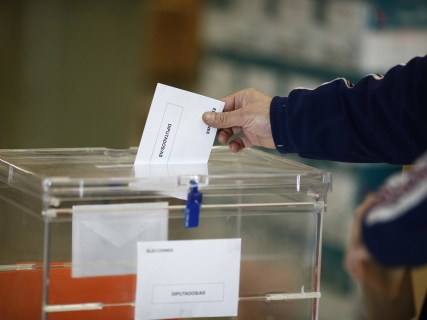
Work on November 29: how many free hours correspond to me to vote and if they are paid.

The legislation recognizes up to four hours of leave to exercise the right to vote, although its duration depends on the workday and the applicable provisions in each territory.

General election resources 2015, Congress, General Courts, Parliament, deputies, ballots, envelopes, ballot boxes, vote, vote EUROPA PRESS

General election resources 2015, Congress, General Courts, Parliament, deputies, ballots, envelopes, ballot boxes, vote, vote EUROPA PRESS

Add DEMÓCRATA to Google

Ask FREN

Published

2 minutes

Most read

España vota · Congreso y Senado

Elecciones generales 29 de noviembre de 2026

Se eligen 350 diputados y los senadores de elección directa. Encuestas, calendario, candidaturas, programas y todo lo que necesitas saber para votar.

Faltan 42 días y 10 horas para que abran los colegios electorales.Hasta que abran los colegios, el domingo 29 a las 09:00 (hora peninsular).
Entra en el especial

Próximas fechas

  1. Presentación de candidaturas al Congreso y al Senado21–26 oct · Fecha prevista
  2. Voto desde el extranjero (CERA): envío de la documentación24–30 oct · Fecha prevista
  3. Publicación de las candidaturas presentadasFecha prevista
  4. Proclamación de candidaturasFecha prevista
Calendario completo

The general elections on November 29, 2026 will be held on a Sunday, a working day for many workers in commerce, hospitality, healthcare, transportation, and other sectors. Those who have to go to their workplace that day have a specific right to be able to vote.

The Spanish regulations provide for a paid leave of up to four hours to exercise the right to vote, although its specific duration depends on the overlap between work hours and the opening hours of polling stations.

Up to four hours off to go vote

Article 13 of Royal Decree 605/1999 establishes that the competent administrations must take the necessary measures so that workers can have free time within their working hours to vote.

The general limit is four paid hours. However, this does not mean that all employees working on November 29 automatically have the right to be absent for a full four hours.

The provisions approved for the election day will specify the duration of the leave based on the hours of overlap between the working day and the voting hours.

The leave to vote does not mean losing salary

The time recognized to go to the polls is paid, so the worker should not lose the remuneration corresponding to the hours of leave.

When the working day is reduced, the regulations foresee a proportional decrease in the leave time.

The company can organize the distribution of absences to ensure the functioning of the service, always within the conditions established by the applicable regulation.

Workers who vote by mail

The legislation also provides measures for people who, due to providing services far from their usual residence or other work circumstances, have difficulties exercising their right to vote in person.

In these cases, permits may be established to carry out the necessary procedures to vote by mail, within the legal limits and conditions.

The justification of the electoral leave

Workers must consult their company's instructions and the labor provision corresponding to their autonomous community. They can also request a certificate of attendance at the polling station when it is necessary to prove the exercise of the right to vote.

It is advisable to differentiate this permission from that recognized for the members of the electoral tables, who have a specific regulation and an additional reduction of working hours the day after the voting.

More key points, information and questions with FREN

AI-GENERATED CONTENT

What are the pending parliamentary procedures to modify the paid leave for voting on election days?

No specific initiative has been identified in the consulted sources that allows listing the pending parliamentary procedures to modify the paid leave for voting. There is a draft reform of the electoral legislation that expired on October 6, 2026, but the available information does not prove that it included that modification. Therefore, it would not be correct to present its procedures as if they were those of a specific reform of the leave.

What electoral reform has been located

The main precedent is the Organic Bill modifying Organic Law 5/1985, of June 19, on the General Electoral Regime. Its documented progress includes these milestones:

  • The Council of Ministers examined the draft bill on April 15, 2025, according to the Council reference.
  • The Ministry of the Interior opened the public hearing and information period from June 13 to 26, 2025. This procedure allows submissions before parliamentary processing and is listed on its public participation page.
  • Subsequently, there is a government agreement related to the project, linked to the July 2025 reference.
  • Its parliamentary processing expired on October 6, 2026. Consequently, it should not be described as a project still awaiting amendments, report, or approval.

The practical consequence is important: an expired file does not retain pending procedures that can continue automatically. If the modification you are interested in was contained in that project, its approval would require promoting a new initiative. However, the consulted material does not contain the necessary articles to establish that relationship.

What Senate actions should not be confused with approval

An agreement of the Senate Plenary of June 10, 2026 has also been located to process directly and in a single reading a proposal to reform the Organic Law of the General Electoral Regime. Single reading is a processing modality; approving its use does not equate to approving the content of the law. This is defined by the published agreement.

The modification of the agenda to include that authorization has also been identified. Neither of these two acts alone proves a modification of the paid leave nor allows determining which substantive phases remain to be completed.

What it means for the electoral leave

The sources do contain provisions that apply leave for voting, but they are not proof of a general parliamentary reform. For example, the Skytanking agreement published on September 21, 2026 expressly refers to the electoral regulations applicable to each process to set the duration and paid nature of the leave (publication in the BOE).

In short, it is necessary to separate the application of the existing leave from its possible legislative modification. With the located documentation, it cannot be stated that only a vote, the Senate step, or publication in the BOE is missing. The supported conclusion is more specific: the identified electoral project expired and no specific initiative about this leave with pending progress can be detailed.

What powers does the Ministry of Labor have in regulating work leave during election days?

The Ministry of Labor intervenes in the labor framework of electoral leave, but does not have exclusive competence nor can it freely modify the rights established by law. The regulation combines legal guarantees, state regulatory development, and application measures by the competent autonomous communities. Therefore, it is necessary to distinguish between establishing the right to leave and specifying how it is enjoyed during each call.

1. The framework that Labor must respect

The main rights do not depend on a decision by the Ministry: they are recognized in the Organic Law of the General Electoral Regime and developed by Royal Decree 605/1999. This framework distinguishes three situations:

  • Working voters: must be able to have up to four paid hours within their working schedule to vote. If they work reduced hours, the leave is proportionally reduced. It does not mean four automatic hours for anyone: application measures specify its enjoyment.
  • Presidents, members, and tellers: have paid leave for the entire voting day if they must work that day, and a five-hour reduction on the immediately following day. For presidents and members, article 28.1 recognizes this reduction "in any case."
  • Proxy holders: have paid leave during the voting day if they must work. They are not granted the additional five-hour reduction provided for the previous group.
2. What regulatory margin does the Ministry have

Labor can intervene in preparing labor regulations and in state measures within its competence. However, a ministerial order cannot reduce or replace the leaves established by law. Changing those legal rights requires a law; developing their application requires respecting both the law and the state regulation.

Additionally, article 34.7 of the Workers' Statute allows the Government, at the proposal of the Minister of Labor and after consulting the most representative trade union and employer organizations, to establish special working hours and rest periods for sectors, jobs, and categories with peculiarities. This is a power of the Government at ministerial proposal, not authorization for the Ministry to unilaterally alter electoral guarantees.

3. What corresponds to the autonomous communities

The distribution is expressly stated in Royal Decree 605/1999: measures to facilitate voting correspond to "the State Administration or, where appropriate, the Autonomous Communities with labor competences," after agreement with the Government delegates.

Therefore, it should not be assumed that Labor issues a single instruction applicable to all Spanish companies in each election. The competent regional authorities can specify the conditions of enjoyment within the state framework. Regarding public personnel, the same royal decree assigns to public administrations the measures related to their own staff.

4. Other measures and practical limits

The regulation also contemplates up to four working hours to request census certification and send the vote by mail when working far from home or other circumstances hinder in-person voting. This provision also does not equate to a general and unconditional leave for any electoral procedure.

There is also the precedent of Order ESS/1169/2017, which established instructions for the Catalan elections of December 2017. Its scope was linked to that call: it should not be used as a general instruction in force for any election.

In summary, Labor participates in labor regulation but shares application with the competent territorial authorities. To determine the specific leave, the state guarantee, the applicable provision for the call, and the affected person's working hours must be combined.

What specific regulations govern paid leave for voting in other autonomous communities compared to the state?

Paid leave for voting has a common state basis, which is specified through provisions issued for each electoral call and territory. Therefore, the comparison is not between completely different rights: it is necessary to distinguish the right recognized by state legislation and the instructions that determine how it is enjoyed in each autonomous community.

1. The state reference regulation

The main rule for salaried workers is article 37.3.d of the Workers' Statute, approved by Royal Legislative Decree 2/2015, of October 23. It recognizes paid absence, with prior notice and justification:

"For the indispensable time, to fulfill an unavoidable public and personal duty, including the exercise of active suffrage."

Additionally, it establishes that when a legal norm or collective agreement determines a specific period, what it provides regarding duration and economic compensation will apply. That is, the Statute recognizes the right but refers to other provisions to specify it. You can consult the Workers' Statute.

The second reference is Royal Decree 605/1999, of April 16, on complementary regulation of electoral processes. It is part of the state framework that must be examined together with the territorial instructions of the call. It is published in the BOE.

2. What specific regulations should be sought in each community

To identify the specific leave, it is not enough to consult the autonomous electoral law: it is necessary to locate the order, resolution, or provision on the participation of workers corresponding to those elections. It is also important to check its personal and temporal scope: an instruction for a previous call should not be presented as permanent regulation applicable to subsequent ones.

The consulted sources allow identifying these examples, although they are state provisions related to elections held in autonomous territories, not rules approved by their governments:

  • Catalonia: Order ESS/1169/2017, of November 28, establishing the necessary instructions for the participation of workers in the Catalan Parliament elections of December 21, 2017. Its scope corresponds to that call: order published in BOE.
  • Andalusia: Order of March 31, 1982, issuing rules to facilitate the exercise of the right to vote of workers in the upcoming Andalusian Parliament elections. It is a historical reference, not an instruction for current elections: text published in BOE.
  • Galicia: Order of August 25, 1981, issuing rules related to the Galician Parliament elections. It is also linked to that call: text published in BOE.

No specific autonomous provisions necessary to offer a current comparison, community by community, have been located in the consulted sources. These examples prove the existence of territorial instructions but do not allow attributing current schedules or conditions to them.

3. Voting does not equate to being part of a polling station

The Organic Law of the General Electoral Regime regulates different leaves: its article 28 recognizes presidents and members of polling stations full paid working day leave, if it is a working day, and five hours reduction the following day. Article 78.4 extends those leaves to tellers; article 76.4 recognizes proxy holders paid leave during voting.

In conclusion, for the ordinary voter the initial reference is article 37.3.d; to specify its duration, the community and the call must be identified, without confusing their instructions with the special leaves of those performing electoral functions.

Play

Test your knowledge with FREN!

How much do you know about this topic? Answer the following 3 questions.

What is the maximum number of paid hours a worker can take to vote on November 29 if their schedule fully coincides with the voting hours?

Question 1 of 3

Does the permit to go vote imply a salary reduction for the worker?

Question 2 of 3

What should workers do if they need to justify their absence to vote?

Question 3 of 3