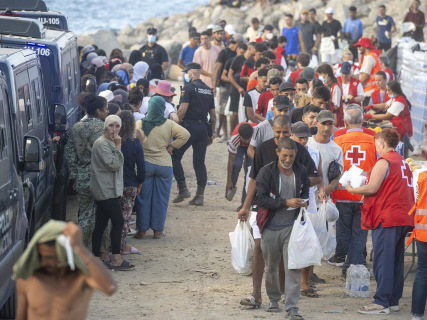

The Spanish Society of Public Health and Health Administration (SESPAS) has emphasized the urgency of strengthening health and public health resources in Ceuta. The entity demands improving accommodation conditions, with special attention to minors, and articulating an extraordinary coordination mechanism among all the involved administrations.
"The priority must be to solve problems, reduce risks, and recover normality through cooperation and verified information. The function of public health is to anticipate, identify risks, intervene on their determinants, and prevent those risks from turning into harm," it states in a statement.
SESPAS warns that the current crisis is causing "extraordinary pressure" on reception and protection devices, social services, the healthcare system, and public health resources of a small city, with about 84,500 inhabitants.
For the scientific society, the immediate challenge is twofold: on one hand, to safeguard health and ensure adequate sanitary conditions for all people remaining in Ceuta and, on the other, to facilitate that the Ceuta population gradually recovers its daily life.
"An exceptional situation of this magnitude temporarily requires also exceptional resources and a proportionate, coordinated response based on verified data," it adds.
Differentiate epidemiological risk and epidemic
The organization insists on the importance of not confusing concepts that have been used imprecisely in recent weeks. It recalls that high care pressure can overwhelm a healthcare system without necessarily having an epidemic, and that there can also be conditions of epidemiological risk that advise intervening preventively before an outbreak is declared. "Epidemiological risk does not mean epidemic," it indicates.
Likewise, SESPAS rejects automatically linking migration and disease. "Migrants do not represent a risk to public health by their condition. Risks fundamentally arise when any population group remains in conditions of concentration, precariousness, insufficient hygiene, or difficulty accessing healthcare and epidemiological monitoring," it details.
For this reason, the society emphasizes that the institutional response must avoid both fueling an unjustified alarm due to the available data and downplaying objective conditions that require preventive measures.
Temporary accommodations and environmental health
In this context, SESPAS positively values the start, on August 20, of the transfer of people who were in the beach of El Trampolín and in other precarious settlements to the temporary facilities set up in Loma Margarita and El Embolsamiento, with a combined capacity close to 1,800 places.
The scientific society considers it necessary for these accommodation alternatives to be consolidated, sufficient, and adjusted to the evolution of needs, especially after part of the transferred people have returned to the beach. "Having adequate accommodations facilitates hygiene and health, access to healthcare, continuity of treatments, and, when necessary, epidemiological monitoring," it points out.
In addition to accommodation, SESPAS demands to maintain and strengthen environmental health interventions, considering them a key preventive tool against the health risks associated with the current situation.
There is no evidence of a widespread epidemic
Regarding the epidemiological scenario, SESPAS indicates that, with the available information, the existence of a widespread epidemic linked to the arrival of people in Ceuta has not been confirmed, although the current circumstances make it necessary to maintain intensified surveillance.
Gastrointestinal cases, dermatological problems, scabies, and tuberculosis diagnoses have been reported, but the differences between the various sources lead the entity to call for caution until consolidated official epidemiological data is available. "In particular, the available information does not allow us to affirm that there is currently an outbreak of tuberculosis associated with the episode," it indicates.
The protection of minors is, for SESPAS, another of the central priorities. As of August 18, 2,168 minors had been officially identified since the beginning of the episode. The society considers it essential to ensure their safe accommodation, food, health assessment, mental health care, and protection against violence, exploitation, or trafficking.
SESPAS also draws attention to the impact on mental health, both of newly arrived individuals and of the entire Ceuta population and the professionals involved in the response. It reminds that the prolongation of an exceptional situation for weeks can generate uncertainty, fatigue, stress, and a sense of insecurity. "Periodic, understandable public information based on verified data, along with the gradual recovery of the usual spaces and services of the city, is also part of an adequate public health response," it highlights.
Proposal for an extraordinary coordination device
As a main measure, SESPAS proposes the temporary creation of an Extraordinary Coordination and Response Device. It would not be a new bureaucratic structure nor an organ that replaces competencies, but rather a technical and operational instrument of cooperation. "It should involve the Public Health authority of Ceuta, INGESA, and the Ministry of Health, along with the necessary organizations and entities depending on the actions to be developed," it points out.
According to the society, this device would allow for an updated view of the situation and the distribution of people, detect vulnerable groups, share healthcare, epidemiological, and environmental indicators, reduce risk factors, ensure an integrated health response, and provide citizens with common, verifiable, and understandable public information.
The entity sees it especially appropriate to periodically disseminate a joint technical report with a limited number of reliable indicators, in order to avoid the current disparity of figures and assessments, which can fuel both alarmism and the undervaluation of existing problems.