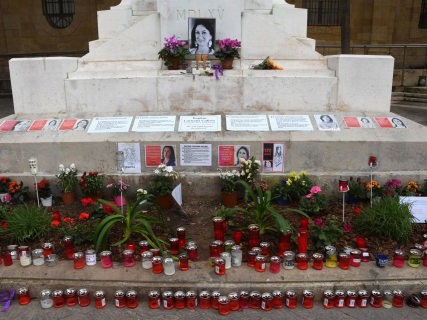

A Maltese court has declared media entrepreneur Yorgen Fenech not guilty of the two charges attributed to him for ordering the murder of journalist Daphne Caruana Galizia in 2017, when she was conducting investigations into corruption linked to the Government of Malta in the context of the Panama Papers.
The jury issued this Wednesday an acquittal verdict by eight votes to one on each of the charges of complicity and conspiracy, after about eight hours of deliberations, according to the newspaper 'Times of Malta'.
The Daphne Caruana Galizia Foundation has denounced Fenech's exoneration "nine years" after the reporter was murdered, "denying her the justice she deserves." "The institutional failures that allowed her murder remain unresolved and unreformed," it criticized in a public statement.
In the same vein, the NGO Repubblika has described the ruling as "disappointing" and has expressed its support for the journalist's family, who for nine years have had to endure "the revelation of the most intimate details" of her death, "years of criminal proceedings, continuous attacks, and defamation," in addition to an "intolerable burden" of being forced to "fight for the truths that the state itself was obliged to uncover."
"The verdict, however, does not require Malta to pretend that the evidence heard during this trial was never heard. It does not erase the findings of the public inquiry and does not answer the deep questions that remain about corruption, impunity, political interference, and state failures," the organization emphasized in its statement.
For its part, the NGO Occupy Justice has insisted that accountability will only be complete when "the full chain" of those who ordered the journalist's murder is clarified "and until the institutional failures exposed" after her death are corrected, at which point "the fight for justice" can be considered concluded.
"The work does not end here. Malta still needs the truth, accountability, protection for journalists, and institutions that act before corruption and impunity become irreversible," it added in another statement.
During the process, Fenech filed several legal actions in which he denounced the conditions under which he was arrested, the alleged illegality of his detention, the presumed failure of the Maltese State to safeguard his health, and the way in which the judicial proceedings were conducted, which, according to him, violated his right to a fair trial within a reasonable time.
The investigations pointed to the businessman allegedly having paid around 150,000 euros to the material authors of the crime to murder the journalist. Months before being murdered, Caruana Galizia had revealed the existence of an opaque company registered in the United Arab Emirates, called 17 Black, owned by Fenech and used to channel alleged illicit commissions to high-ranking officials of the Maltese Executive.
Two other people -- Robert Agius, known as 'Ta Maksar', and his partner Jamie Vella -- were found guilty in June 2025 of providing the explosive used in the attack that ended the reporter's life. In 2022, brothers George and Alfred Degiorgio accepted their responsibility in the placement and detonation of the bomb and were sentenced to 40 years in prison. A third implicated person, Vince Muscat, received a 15-year sentence after admitting his participation and providing detailed information about the crime.
Caruana Galizia, one of the most influential journalists in Malta, died on October 16, 2017, at the age of 53 when a bomb placed in her car exploded. At the time of her murder, she was investigating a case related to the Panama Papers and alleged bribes channeled from 17 Black to shell companies controlled in Panama by the chief of staff of former Prime Minister Joseph Muscat, Keith Schembri, and by the then Minister of Tourism, Konrad Mizzi.
A report published in 2021 concluded that the risk to the journalist's life increased significantly when she exposed the overseas businesses of prominent Maltese leaders linked to the leak of the Panama Papers in 2016.