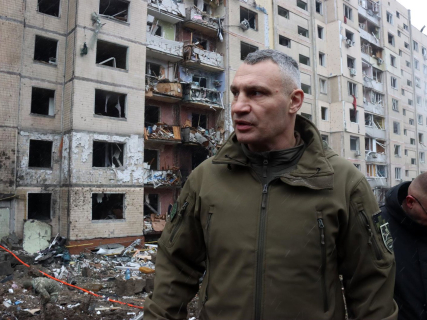

The Parliament of Ukraine has summoned this Wednesday the mayor of Kiev, Vitali Klitschko, to explain how the measures aimed at alleviating the energy crisis and preparing the capital for the imminent winter under Russian attacks have been implemented, after President Volodymyr Zelensky recently described the actions of the municipal authorities as a "total failure."
The proposal has been driven by deputy Mariana Bezugla, a member of Zelensky's party, Servant of the People, and has received the support of a good part of the parliamentary group, as she herself detailed on her social networks.
Among the central reasons for the summons to Klitschko are his management of the security of critical infrastructures —water supply, heating, and electrical grid— against the continuous Russian attacks, as well as the use of the budgets and resources of the City Council that were supposed to be allocated to the protection and repair of urban facilities.
This Tuesday, the head of the Ukrainian state hinted that the capital would not really be ready to face a winter that is anticipated to be much harsher than previous ones, and pointed out the alleged lack of preparation to safeguard infrastructures, shelters, educational centers, and transport hubs in Kiev.
"Unfortunately, there are many other problems. This includes the preparation of schools, the construction of defense facilities, the operation of transport, and the preparation of houses in Kiev for winter," he pointed out, as heard in a video disseminated on his social networks.
At the same time, Zelensky has contrasted the work of the Kiev City Council with that of other administrations, "which have done more, and some of them under much more difficult conditions," referring, for example, to those of Kharkiv or Zaporizhia.
The political rivalry between Klitschko and Zelensky predates the Russian invasion, but the management of the war has sharpened those discrepancies. The mayor of the capital has been a figure established since 2014, while the central government has tried to dilute the concentration of power that he accumulates.
Klitschko has publicly reproached Zelensky for using martial law to concentrate even more power and cut the autonomy of local governments and democratic institutions. In Kiev, the elected mayor's office coexists with the military administration of the City of Kiev, directly appointed by the president.
Unlike the regions close to the front, where management has been almost entirely assumed by these military administrations, in the interior provinces, elected authorities coexist with those appointed by the central Government, a duality that causes clashes in multiple areas.
For his part, Klitschko has turned to his social networks to denounce an alleged discrediting campaign aimed at "disturbing the heating season in order to divert resources linked to the central Government" and "destroying local autonomy, not only in Kiev, by dismissing community leaders for implausible reasons."
"The people elected me and I work tirelessly, doing everything possible under extremely difficult conditions to live up to the trust of the inhabitants of Kiev, so that the city can function amid the constant and devastating attacks from the enemy," he has written on Telegram.