Indefinite strike of teachers in Madrid from this Wednesday: schedules, demonstrations, and demands

The teachers of the Community of Madrid begin this October 14 a strike to demand salary improvements, fewer students per classroom, and a reduction of teaching hours. CCOO and UGT call for indefinite strikes, while CSIF proposes its own calendar of mobilizations.

3 minutes

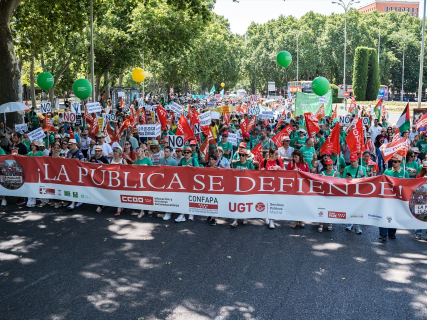
EuropaPress 7596112 numerosas personas sostienen pancarta lema publica defiende manifestacion

EuropaPress 7596112 numerosas personas sostienen pancarta lema publica defiende manifestacion

Add DEMÓCRATA to Google

Ask FREN

Published

Last updated

3 minutes

Most read

The indefinite strike of teachers in the Community of Madrid begins this Wednesday, October 14 in schools and institutes in the region. The unions demand improvements in the working conditions of teachers, a salary increase, and a reduction in the student-to-class ratios, while the Government of Isabel Díaz Ayuso considers their demands "impossible" to meet.

The mobilizations will take place through two parallel calls. On one hand, the strike committee, made up of CCOO and UGT and supported by organizations of families, students, and educational platforms, proposes to maintain the strikes throughout the school year. On the other hand, CSIF has called for three initial days of strike and a schedule of partial strikes that will extend, at least, until December.

The start of the protests will be accompanied by a demonstration this Wednesday at 6:00 PM from Atocha to Puerta del Sol, in addition to concentrations and other mobilizations planned for the coming days.

Schedules and route of the demonstrations

The unions have organized different activities during the first three days of the strike, from October 14 to 16.

Date Time Mobilization
Wednesday, October 14 During the morning Informative pickets and concentrations in neighborhoods and municipalities
Wednesday, October 14 12:00 Concentration at Puerta del Sol
Wednesday, October 14 12:00 CSIF concentration in front of the Ministry of Education
Wednesday, October 14 6:00 PM Demonstration from Atocha to Sol
Thursday, October 15 12:00 Human chain in front of the Ministry of Education
Friday, October 16 12:00 Open assembly in Retiro Park
Friday, October 16 6:00 PM Demonstration from Atocha to Sol

The strike committee maintains that the protests are the result of several years of mobilizations and accuses the Ministry of Education of a lack of negotiating will.

The organizers warn that they will maintain the mobilizations throughout the school year if a new negotiation pathway regarding their demands is not opened.

What the teachers of Madrid demand

Among the main demands of the strike committee is a salary increase of 600 euros per month, with which the teachers aim to reduce the pay differences compared to other autonomous communities.

They also demand to reduce the number of students per classroom and establish the following limits:

Educational stage Requested ratio
Early Childhood Education 13 students
Primary Education 15 students
Secondary Education 20 students
Baccalaureate 23 students
Vocational Training 15 students

The unions also ask to establish specific resources for students with special educational needs.

Another of their priorities is to reduce weekly teaching hours to 17 in Secondary and 22 in Primary. Currently, a process is underway to lower teaching hours to 18 in Secondary, while in Primary the 25 weekly hours are maintained.

These demands are joined by the improvement of staff, more resources for centers of special complexity, the elimination of the current bilingual model, and a climate control plan for schools and institutes.

CSIF calls for partial strikes until December

CSIF has opted for an independent call, with a strike on the days 14, 15, and 16 of October and subsequent partial strikes during the rest of the term.

The strikes are scheduled from 8:00 to 10:00 hours and from 16:00 to 18:00 hours on the following dates:

Month Strike days Schedule
October 20, 22, 26, and 30 08:00-10:00 and 16:00-18:00
November 3, 5, 11, 13, 16, 20, 24, 26, and 30 08:00-10:00 and 16:00-18:00
December 1, 10, 11, 16, and 18 08:00-10:00 and 16:00-18:00

The union explains that this model seeks to maintain pressure on the regional government without the prolongation of the strike causing ongoing economic harm to teachers.

Among its demands, the creation of a capital city supplement that compensates for the high cost of living in Madrid stands out, in addition to the reduction of ratios, salary improvement, and the decrease of bureaucratic burden.

CSIF also requests to recognize as teaching certain functions of tutoring, coordination, and leadership, to strengthen attention to diversity, and to improve educational infrastructures.

The Community of Madrid considers the demands "impossible"

The Minister of Education, Science, and Universities, Mercedes Zarzalejo, rejected this Tuesday the union demands considering them "totally unattainable" and "impossible."

The regional official has questioned the call and has reminded that some of the unions participating in the protests signed the educational framework agreement a year ago.

"This strike is absolutely incomprehensible if it is only related to the educational aspect," Zarzalejo declared, who maintains that the Ministry keeps the dialogue open with the union organizations through the sectoral table.

The autonomous Executive has also conveyed a message of reassurance to families and has assured that minimum services will be guaranteed in educational centers during the strike days.

"We respect the right to strike of all the calling unions and of all the teachers who join it, but we must also guarantee the right to education and also the right to work of all those who do not want to join the strike," the counselor has pointed out.

More key points, information and questions with FREN

AI-GENERATED CONTENT

What is the current status of the processing of union proposals in the Community of Madrid?

Recent information indicates that the union proposals in the Community of Madrid are in a very fragmented situation: there are areas where they have resulted in regulatory agreements or collective agreements, others where negotiations are still open, and some fronts clearly blocked. As of today (10/13/2026), there is no closed global package that unitarily collects the demands of CCOO, UGT, and the rest of the unions in health, education, transport, and public employment.

1. Regional public employment and social dialogue

At the general level of public employees of the Community of Madrid, the trade union organizations have used two levers:

  • The regional negotiation tables.
  • The state framework for salary increases and public employment, which sets the resource ceiling.

In the Madrid area, the regional government has approved a 2026 Public Employment Offer of 8,143 positions, of which 3,611 strengthen health and 2,484 education. The official note emphasizes that the OEP was presented at the General Negotiation Table of Public Employees and that it had the favorable vote of CCOO, UGT, and CSIF, which implies a closed union agreement at least in this matter of staff reinforcement.

In parallel, the Community has developed the consequences of the state remuneration agreement (an accumulated increase of 11 % between 2025 and 2028) through a budget of 887 million euros to finance the salary increases of Madrid public employees in 2025 and 2026. This regional deployment responds to a pact negotiated at the state level with the unions but has already materialized in decisions of the Madrid Government Council, so at this point the general salary demands are partially channeled and in execution.

2. Health: preliminary agreements and open conflicts

In health, the situation is more tense:

  • On one hand, the Madrid Health Service (Sermas) and the unions reached in February 2026 a pre-agreement on the Occupational Risk Prevention Plan in Primary Care, following a collective conflict demand. The text foresees phases of union participation to improve the plan and ends the conflict before a judicial sentence. This demand can be considered channeled, pending technical development.
  • In parallel, a deep conflict continues over remuneration conditions of medical specialists. In May 2026, the Health Department presented at the Sectoral Table a two-year plan to increase the on-call hour price until 2027, with relevant increases but qualified by AMYTS and other actors as "absolutely insufficient." The medical strike and mobilizations remain active, and the unions demand equalization above the national average and full recognition of on-call hours as overtime. Here the processing is under negotiation, with a high degree of political and union blockage.
  • Additionally, the Community has opened a specific negotiation with the Nursing College to improve overtime, stabilize staff, and create new professional figures. There are political commitments, but a comprehensive regulatory agreement has not yet been closed, so these proposals are in dialogue phase, without full translation into regulations or budgets.
3. Education: partial agreements and indefinite strike

In education, advances and conflict coexist:

  • In the subsidized education sector, the Community signed in April 2026 an agreement with employers and unions (UGT, CCOO, FSIE, FEUSO) to finance the partial retirement of teaching staff with replacement contracts starting in the 2026/27 school year. It will allow workday reductions with maintenance of contributions and entry of new teachers. Here the union demands have already been transformed into a formal agreement with economic and organizational content.
  • In non-university public education, however, CCOO and UGT have promoted an indefinite strike since September, demanding salary improvements, reduction of ratios, lower teaching load, and more resources. This call shows that union proposals in this segment are without agreement and at maximum pressure phase; there is no global pact with budgetary backing that has materialized them.
4. Transport: sectoral agreements

In transport and related sectors:

  • Metro de Madrid has been one of the cases with the greatest concretion. In 2025 a new collective agreement 2025‑2027 was signed between the company and all the trade union organizations (CCOO, UGT, and others). The text includes a 5 % average salary increase, annual workday reduction from 2026 (from 1,635 to 1,620 hours), and reconciliation measures. The Government Council authorized the necessary expenditure, so these demands are already approved and in force.
  • In other logistics and transport areas, the negotiation of collective agreements (mainly sectoral and state-level, although impacting Madrid) remains open, with unions denouncing insufficient salary proposals and threatening strikes. These tables are, therefore, under negotiation, without definitive closure.
5. General processing balance

In summary, the state of union proposals in the Community of Madrid is mixed:

  • Converted into regulatory or budgetary agreements: 2026 OEP with broad reinforcement of health and education; regional deployment of the state salary increase agreement for public employees; new Metro agreement; partial retirement agreement in subsidized education.
  • In advanced negotiation, but without closure: improvement of medical on-calls; package of measures for Nursing; various sectoral tables in health and logistics.
  • In conflict or blockage: large part of the demands of public education, and the core of the remuneration demands of Sermas medical specialists, where strikes and threats of new mobilizations persist.

The outlook is, therefore, that of an active social dialogue but very uneven by sectors, with some consolidated union achievements and other fronts clearly open for the coming months.

Can you detail only the health front, distinguishing what has already been approved and what remains on strike or negotiation? What practical implications does the partial retirement agreement signed in April 2026 have for subsidized teaching staff? To what extent does the 2026 Public Employment Offer respond to the demands of CCOO and UGT regarding staff reinforcement in health and education?

What are the competencies of the Ministry of Education, Science and Universities regarding collective bargaining?

The Ministry of Education, Science and Universities of the Community of Madrid plays a central role in the collective bargaining of personnel in the educational system, but always within the general framework of regional public service and state regulations on public employment and labor relations. It does not negotiate completely autonomously: its actions are coordinated with the Directorate General of Public Service and, when appropriate, with the General Negotiation Table and the Government Council itself.

1. General framework of its competencies

According to the Ministry's structure decree and the Community of Madrid's transparency documentation, Education, Science and Universities:

  • Is the sectoral department competent in matters of non-university teaching staff and much of the non-teaching staff of the educational network.
  • Participates in the Community's collective bargaining system, governed by the Basic Statute of Public Employees (EBEP), budgetary legislation, and, for labor personnel, by the Workers' Statute and applicable collective agreements.
  • Must respect the distribution of matters between the General Negotiation Table (for issues common to all regional public employment) and sectoral or specific tables (such as that of non-university teaching staff).

In summary, the Ministry is the specialized interlocutor in the educational field, but within an ordered negotiation scheme at the level of the entire regional administration.

2. Non-university teaching staff

Regarding teaching staff of public non-university centers (primary school teachers, secondary, vocational training, etc.), the Ministry exercises, among others, the following functions in collective bargaining:

  • Negotiation at the Education Sectoral Table of non-university teaching staff, representing the educational administration, regarding specific working conditions of teachers.
  • Promotion and drafting of sectoral agreement proposals (for example, on reduction of teaching hours, workday organization, tutoring, bureaucracy measures, etc.), which can later be submitted to the Government Council for formal approval when they have general or budgetary effects.
  • Application, interpretation, and development of agreements reached at the Sectoral Table: issuing instructions, creating and participating in monitoring commissions, adjusting staff and schedules, etc.
  • Management of certain personnel management instruments when regulated by negotiated agreements (e.g., lists of substitute teachers or criteria for filling certain positions), always within the general public service framework.

Numerous recent agreements on reducing teaching hours or improving teacher conditions have been signed between the Ministry and the trade unions present at the Sectoral Table, showing that it is the body leading sectoral negotiation in this field.

3. Non-teaching personnel in the educational field

Non-teaching personnel linked to education (administrative and service staff, technicians, educational support staff, etc.) mix civil servant and labor collectives. In this area, the Ministry's competencies are more shared:

  • Common matters (basic remuneration, general public employment offer, common workday regime, etc.) are negotiated at the General Negotiation Table of the Community of Madrid, where coordination falls to Public Service.
  • Specific conditions linked to the organization of educational centers and services (schedules of certain services, calendar organization in educational centers, etc.) can be negotiated with direct participation of the Ministry, as it is the competent department by subject matter.
  • In the case of labor personnel, the substantive regulation is given by the applicable collective agreement (for example, the single collective agreement for labor personnel of the Community or educational sectoral agreements), negotiated in bodies specific to that personnel, where the Ministry can intervene when they affect its scope.

Therefore, the Ministry cannot unilaterally alter a collective agreement nor "create" new working conditions for this personnel by itself; it can make proposals and participate in the corresponding tables, but agreements must fit the conventional framework and be formally assumed by competent bodies if applicable.

4. Negotiation tables and agreements

In practical terms, the Ministry's competencies in collective bargaining are concretized in:

  • Representing the regional government at the Education Sectoral Table of non-university teaching staff and, when appropriate, in other sector-specific tables or bodies.
  • Negotiating civil servant pacts and agreements related to teaching staff and educational issues of non-teaching personnel, which then require Government Council approval when they affect matters within its competence (expenditure, staff, etc.).
  • Participating in monitoring and interpretation commissions of agreements and collective agreements affecting the educational field, ensuring their compliance in centers and services.
  • Promoting specific sectoral agreements (career progression, partial retirement in subsidized education, professional recognition measures, etc.) in coordination with other departments when they affect personnel or expenditure matters.

In short, the Ministry of Education, Science and Universities acts as a specialized sectoral body that negotiates and manages working conditions of educational personnel in its scope, but its negotiating decisions are always integrated into the general labor relations system of the Community of Madrid and are subject to the limits and controls of public service and labor regulations.

Could you specify which matters can be negotiated at the Madrid Education Sectoral Table and which are reserved for the General Table? What recent examples of agreements signed by the Ministry with teaching unions have had the greatest impact on working conditions? How does the Ministry of Education coordinate in practice with Public Service and Finance when a teaching demand has a strong budgetary impact?

What legal requirements must be met for a teaching strike to be declared legally valid in Madrid?

According to the information found in the consulted knowledge base, there is no specific and detailed development regarding the concrete requirements that a teaching strike in the Community of Madrid must meet to be declared legally valid. The recovered sources focus on other aspects of the legal system (for example, on the figure of the decree-law or on the challenge of laws before the Constitutional Court), but do not provide a systematic list of formal and material conditions for the legality of a strike in the Madrid educational sector.

This means that, with the data available in the consulted sources, it is not possible to offer a closed and technically reliable list of:

  • Who is specifically legitimized to call a teaching strike in Madrid (types of organizations or worker representatives and their mode of action).
  • How the prior notice must be articulated (specific deadlines, precise recipients in the educational administration or in the entities owning subsidized or private centers, form of communication, etc.).
  • The minimum required content of the strike communication (identification of affected centers and collectives, expected duration, reasons, territorial scope, other formal aspects).
  • The detailed regulation of minimum services in the Madrid education field, beyond the general idea that they are set to balance the right to strike with other fundamental rights, such as the right to education.
  • The specific criteria that would allow qualifying a strike as illegal or abusive in the Madrid teaching field (for example, purely political strike, solidarity strike, rotating strike, slowdown strike, etc.), with the detail usually offered by Constitutional Court rulings and social jurisdiction.

From a methodological point of view, a rigorous answer to your question would require having a set of materials that, according to our database, which collects official records and technical-legal documentation, have not been usefully recovered for this specific case. It would be necessary to integrate, at least:

  • The constitutional framework on the right to strike.
  • The state regulations that generally regulate the exercise of the strike.
  • The specific regulations applicable to civil servant and labor teaching personnel dependent on the Madrid educational administration, as well as to teachers of subsidized and private centers located in the Community of Madrid.
  • Administrative practice and resolutions on minimum services in previous educational strikes in Madrid.
  • The relevant case law of courts on strikes in essential services and, in particular, in the education sector.

Since there is currently no sufficiently complete access, within the effectively consulted sources, to that normative and jurisprudential set applied specifically to the case of the teaching strike in Madrid, any attempt to detail concrete requirements (for example, exact prior notice deadlines, precise configuration of minimum services, or types of cases considered abusive or illegal) would risk being inaccurate or not conforming to current regulation and interpretation.

Therefore, the only thing that can be stated based on the information actually recovered is that there is no complete and reliable response in those sources to the specific legal requirements you ask about. To obtain a technically solid answer on the concrete legality of a teaching strike in Madrid, it would be necessary to directly consult the current regulations and specialized case law, or obtain a legal report prepared with full access to those sources.

Can you guide me on which specific regulations I should consult to analyze by myself the legality of a teaching strike in Madrid? What practical steps should a faculty or union follow before calling a teaching strike to minimize risks of illegality? What does a judge usually analyze when deciding if a strike in education is abusive or violates the right to education?

Play

Test your knowledge with FREN!

How much do you know about this topic? Answer the following 3 questions.

On what date does the indefinite teachers' strike begin in the Community of Madrid?

Question 1 of 3

What salary increase are the unions requesting for Madrid teachers?

Question 2 of 3

Which union has called for partial strikes until December in the Community of Madrid?

Question 3 of 3