
The Venezuelan opposition has reacted with extreme caution to the agreement announced early in the morning by the President of the United States, Donald Trump, through which Washington will gain control of one-fifth of the country's oil reserves in exchange for a broad international investment aimed at revitalizing the battered national oil industry.
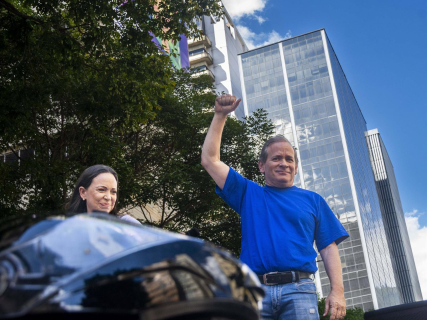
The former vice president of the opposition National Assembly, Juan Pablo Guanipa, has called for a "calm reading" of an understanding that, in his opinion, could prove decisive for the political and economic future of Venezuela.
Guanipa admits that it is necessary to "exploit and add value" to the vast oil reserves of the country and that, for this, the arrival of "a substantial foreign private investment" is "evidently" required. However, he warns that this effort will be futile if the population does not perceive "direct benefits" derived from it.
"If we see new jobs, more investment, more income, and a new economic upturn, this agreement will have support. But if we do not see it, little by little, there will be a popular repudiation," this prominent opposition figure has warned, still awaiting the stance of the two main references of the critical current against the Venezuelan government, María Corina Machado and Edmundo González.
The opposition leader has also reiterated his outright rejection of the current acting president, Delcy Rodríguez, whom he points to as a direct continuation of chavismo. "As long as we have the people who destroyed the country, a skyscraper is being built with mud pillars," he has stated in a message disseminated on social media.
In this vein, he has insisted that "the only way to truly reactivate the Venezuelan economy in the long term and make this agreement benefit both parties is with a free election that leads to a representative government, to clear rules of the game, to the rule of law, to institutions that allow us to manage our resources transparently and for the benefit of the nation."
Demand clarity on the terms of the agreement
Guanipa's party, Unión y Cambio, has taken a similar position in an official statement in which it urges the Executive to "explain to the entire country and before the National Assembly, the scope, terms, and conditions" of the pact, as it is a "contract of national interest" that, "consequently, must be seen and treated according to our Constitution."
The training underscores in any case the need to guarantee the "maintenance of oil ownership for Venezuelans" and emphasizes that "the exploitation of oil is the well-being of the Venezuelan people."
The former presidential candidate Henrique Capriles, also a member of Unión y Cambio, has insisted that "we desperately need investment, stable and well-paid employment, to recover the economy, stability, to end inflation, and an economic policy that allows Venezuelans a decent family income and to recover the ability to save."
In his opinion, "the reality of a impoverished country with a de facto Government is not a government elected by Venezuelans. We are an oil country and oil continues to be the great lever to drive everything and diversify and grow our economy," he has emphasized.
Capriles considers, however, that the announcement "leaves many questions unanswered" and criticizes the "opacity" of the Executive. "We must remember time and again that those who destroyed PDVSA are the same ones who remain in power and who will not rebuild anything," he has warned, demanding "new people and without vices" to take charge of the management.
The opposition leader sees it as "obvious" that the United States "seeks to defend the interests of its country and its fellow citizens" and emphasizes that it is "our oil." In this sense, he poses: "We must ask what is the scope of the oil agreement? What is its legal basis according to what our Constitution establishes? What are we going to receive as Venezuelans? What are we going to deliver as Venezuelans and under what conditions?".
Capriles points directly to Delcy Rodríguez, Jorge Rodríguez, and Diosdado Cabello, whom he accuses of being "disqualified to compromise the wealth and reserves of our nation solely with the idea of sustaining themselves in power."