
The president of Iraq, Nizar Amedi, assured this Saturday that Iran is granting "facilities" to the oil exports coming from the south of the country, a flow essential for the Iraqi economy, following the visit to Baghdad that began on Wednesday by the Iranian chief negotiator, Mohamed Baqer Qalifab.
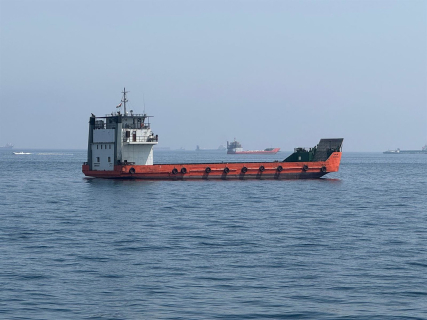
During his speech at the eighth Baghdad Dialogue Conference, the Iraqi leader confirmed what was announced hours earlier by the official Iranian agency IRNA: Tehran has authorized Iraq the passage of several of its tankers through the Strait of Hormuz. However, he did not provide details about the schedule or how many ships have already crossed or are expected to cross this strategic maritime route.
In April, the Iranian Foreign Minister, Abbas Araqchi, had already indicated that his country would do everything possible to facilitate the transit of freighters from states with which it maintains good relations, such as China, Pakistan, or Iraq itself, amid a practical blockade of the strait, controlled by Tehran and subjected to a perimeter closure by the United States.
Before the outbreak of the war triggered by the U.S.-Israeli attack on Iran at the end of February, Iraq was pumping around four million barrels daily and placing an average of 105 million barrels per month on the foreign market, mainly from the Basra region in the south, using the Strait of Hormuz, a key piece for global energy supply.
Since the start of the war in Iran in February, Baghdad has been forced to reorganize its exit routes to sustain the volume of sales, resorting to alternatives such as the Turkish port of Ceyhan, the Syrian port of Baniyas, or the Jordanian port of Aqaba, as explained this Friday by Prime Minister Ali al Zaidi.
Iraq, whose revenue from crude oil accounts for about 90 percent of its public income, aims to increase its oil exports to place them in a range of between 8 and 10 million barrels daily within a six-year horizon, according to the forecasts presented by Al Zaidi.
Qalifab, who has already concluded his stay in Iraq, has evaluated the trip very positively, "marked by fraternal cordiality" and, above all, by the determined start of "a new phase" of "economic cooperation operations" between both countries in the context of the war.