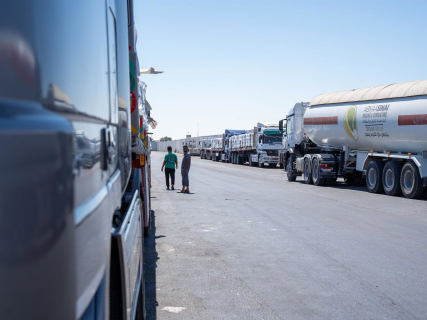

The Israeli coordinator for the occupied Palestinian territories confirmed this Thursday that the entry of private goods into the Gaza Strip remains paralyzed, after denouncing that Hamas has imposed an "extortion" fee on merchants. The Palestinian Islamist movement has flatly rejected this accusation and claims that it is a voluntary contribution aimed at reinforcing the liquidity of the economy of the enclave, already devastated by war.
In its official statement, the Israeli COGAT specifically points to Hamas for establishing a payment of 10,000 shekels, around 2,800 euros, "for each truck that transports goods to Gaza and demands that merchants sell approximately 30% of their goods in cash, in an effort to gain control of the profits."
Hamas replies that this amount corresponds to a "voluntary community initiative" in which "businessmen participate for a national fund whose resources are entirely allocated to support the most vulnerable groups, as well as housing, sanitation, and humanitarian aid projects."
Furthermore, the Islamist group argues that the provisions regarding cash operations, with a rate of 30%, were adopted "by mutual agreement with the Chamber of Commerce to alleviate the severe liquidity shortage and the deterioration of banknotes, and not as a unilateral decision or to control the funds, as the occupation claims."
After emphasizing that it has been "three years without imposing taxes or government fees on commercial trucks considering the exceptional circumstances," referring to the war in Gaza, Hamas accuses Israel of spreading "false narratives about the mechanisms to regulate trade and the entry of goods."
For its part, COGAT maintains that what Hamas is applying is a "forced tax imposition" accompanied by "threats against merchants who refuse to comply with its demands," and attributes precisely to these businesses the decision to "suspend the coordination of trucks transporting goods to the Gaza Strip until further notice, due to real fear for their lives and safety," a point that the Islamist movement categorically denies.
In any case, the issue has already been transferred to the international body responsible for overseeing the post-war scenario in the Gaza Strip, the Peace Board. Its executive director, Nikolai Mladenov, has aligned himself with the position of COGAT and has denounced the "unacceptable practices" of Hamas, which, he claims, must "end immediately."
For the Bulgarian diplomat, episodes like these "demonstrate the importance of launching the activities of the new Palestinian technocratic authority and the International Stabilization Force that must accompany its mandate to preserve its security in the Strip."