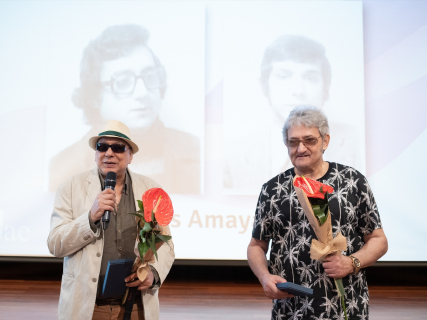
Delfín Amaya, member of Los Amaya and reference of the Catalan rumba, dies at 74 years old

The singer and guitarist has passed away in Barcelona, a city where he developed a good part of his life and his career. Together with his brother José, he turned Los Amaya into one of the great names of Catalan rumba with songs like "Caramelos," "Vete," or "¡Qué mala suerte la mía!"

4 minutes

EuropaPress 5187512 hermanos jose delfin amaya acto sociedad general autores editores sgae

EuropaPress 5187512 hermanos jose delfin amaya acto sociedad general autores editores sgae

Add DEMÓCRATA to Google

Ask FREN

Published

Last updated

4 minutes

Most read

Delfín Amaya, member of the historic duo Los Amaya, has died at the age of 74 in Barcelona. The musician, singer, and guitarist leaves behind a career of more than five decades closely linked to Catalan rumba.

Together with his brother José, he reached popularity in the early 70s and built a repertoire that ended up becoming part of Spanish popular music, in addition to starring in one of the great international showcases of the genre during the closing of the 1992 Barcelona Olympic Games.

Delfín Amaya dies at 74 in Barcelona

Delfín Amaya has passed away in Barcelona at the age of 74, according to information known this Wednesday, August 19. His death represents the loss of one of the two figures who shaped Los Amaya, the duo he created with his brother José and which gained special popularity during the 70s and 80s.

The first published information presents discrepancies about the exact moment of his death. Efe Eme places the death on August 18, while other information released this Wednesday indicates a different day. For that reason, it is more prudent to maintain as confirmed data that Delfín Amaya has died in Barcelona at the age of 74 without specifying the exact date of death until there is unequivocal confirmation.

There has also not yet been a publicly confirmed cause of death in the main information about the passing. The news known this Wednesday focuses on the loss of the artist and on a career that made his name and that of his brother part of the history of Catalan rumba.

Who was Delfín Amaya

Delfín Amaya was born in Oviedo in 1952 and later moved to Barcelona, a city where he developed his musical career. A singer and guitarist, he grew up in an environment closely related to music and belonged to a family linked to the famous dancer Carmen Amaya.

From a very young age, he shared his passion for music with his brother José. The two began to develop a proposal in which Catalan rumba coexisted with pop influences, a combination that would ultimately become one of the recognizable characteristics of Los Amaya.

Delfín assumed the roles of singer and guitarist within the duo for decades. His career spanned different stages of Spanish music, from the success of the early 70s to the revival of Catalan rumba before an international audience during Barcelona 92.

Who were Los Amaya

Los Amaya were formed by the brothers José and Delfín Amaya and began their recording career in the late 60s. They released their first album in 1969, with a repertoire of songs with a marked flamenco accent, before achieving the success that would definitively place them among the main representatives of Catalan rumba.

The big leap came in 1971 with "Caramelos". The song allowed Los Amaya to reach a much wider audience and opened a stage in which the duo developed a formula that combined the roots of rumba with melodies and arrangements from other styles. That same year they also released "Ya la pagarás".

Their career took another important step in the late 70s. In 1978 they began a phase with RCA and producer Tony Ronald, a period associated with some of their most well-known songs. During the following decades, José and Delfín kept the name of Los Amaya alive until it became one of the most recognizable in Catalan rumba.

Great hits of Los Amaya

The career of Los Amaya left songs that transcended the era in which they were published. "Caramelos" was the duo's first big hit, but later came songs like "Vete", "¡Qué mala suerte la mía!", "Mujer" and "Amor, amor", which consolidated their popularity during the 70s and 80s.

"Vete" ended up becoming one of the most representative songs of Los Amaya and is one of the songs that remain associated with the duo decades after its release. Along with "Caramelos", it summarizes a stage in which the brothers managed to expand the reach of Catalan rumba and bring it closer to different audiences.

Their repertoire also includes titles like "La inyección", in addition to the songs they accumulated over several decades of activity. The combination of rumba, flamenco elements, and sounds closer to pop was one of the keys to a musical proposal that accompanied the evolution of the genre.

Los Amaya took Catalan rumba to Barcelona 92

One of the great moments in Delfín Amaya's career came in 1992, when Los Amaya participated in the closing ceremony of the Barcelona Olympic Games. The duo shared the spotlight with Peret and Los Manolos in a celebration that made Catalan rumba one of the musical protagonists of the Games' farewell.

That performance brought the music with which Delfín and José had grown up and developed their career before an international audience. By then, more than two decades had passed since "Caramelos" and Los Amaya were already part of a fundamental generation to understand the expansion of Catalan rumba.

The Olympic participation also had discographic continuity. From that experience emerged "Rumbas de Clausura", linked to the performance of Barcelona 92 and to a stage in which the genre regained enormous visibility.

The last album of Los Amaya and the legacy of Delfín

Los Amaya continued to be linked to music long after their first successes. Their last discographic work was "Vuelven... Los Amaya!", published in 2013, more than four decades after "Caramelos" introduced them to the general public.

The album featured collaborations from artists such as Antonio Carmona and Muchachito Bombo Infierno, two names from later generations that reflect the continuity of rumba and its different fusions within Spanish music.

The death of Delfín Amaya at 74 years old now closes the life trajectory of one of the two halves of Los Amaya. From their discographic debut in 1969 to Barcelona 92 and their last album in 2013, the musician leaves a career marked by more than half a century of rumba and by songs like "Caramelos" and "Vete", which remain as the most recognizable titles of the duo.

More key points, information and questions with FREN

AI-GENERATED CONTENT

What are the legal procedures required to register a song as part of the cultural heritage in Spain?

In Spain, there is no simple form for an individual to “register” a song as cultural heritage, but rather an administrative procedure for declaring a protected asset handled by the historical heritage administrations. In practice, a song or musical expression is mainly protected as intangible cultural heritage through figures such as the Asset of Cultural Interest (BIC, intangible category) or equivalent regional figures (inventoried assets, cataloged assets, etc.).

1. Common legal figure

For a song, musical genre, or associated practice (ritual chants, work songs, ballads, etc.), the following are used depending on the autonomous community:

  • Asset of Cultural Interest (BIC) – intangible category: highest protection. Usually employed when the musical expression has exceptional relevance, deep roots, and a well-established identity value.
  • Intangible Asset of Cultural Interest / Intangible Asset of Cultural Interest (specific denomination according to regional law), with specific regulations for uses, safeguarding, and transmission.
  • Cataloged asset / general cataloged asset / inventoried asset: lower or intermediate levels of protection, included in regional inventories of cultural heritage or intangible heritage.
  • Additionally, some communities have specific intangible heritage lists or regional registers of intangible cultural heritage, where musical expressions are registered without necessarily reaching BIC status.
2. Competent administrations

Competence in cultural heritage is highly decentralized:

  • Autonomous communities: generally responsible for initiating, processing, and resolving the declaration of an asset (material or intangible) located in their territory. Through their cultural ministries, they manage catalogs, inventories, and BIC declarations.
  • State: intervenes mainly when the musical expression has national or international interest, when linked to the UNESCO representative list, or to coordinate a General Inventory of Intangible Cultural Heritage. It also approves basic regulations.
  • Municipalities: usually do not declare BIC, but can:
    • Promote the file before the autonomous community.
    • Approve municipal catalogs or local protection figures.
    • Issue reports and collaborate in documentation and safeguarding.
3. Basic phases of the procedure

The specific procedure is defined in the heritage law of each community but usually follows a common scheme:

  • 1) Initiative: the regional administration, a municipality, cultural entities, or even individuals can request or propose the declaration of the song or musical expression as a protected asset. The proposal is accompanied by a justificatory report, historical documentation, ethnographic data, recordings, etc.
  • 2) Initiation of the file: the competent body of the autonomous community issues an initiation resolution. From that moment, the song usually enjoys provisional protection, similar to the definitive one, while the file is processed.
  • 3) Instruction and documentation: technical information is gathered (musicological, ethnographic, sociological studies) and a report or memorandum is prepared defining the intangible asset: context, bearer community, transmission forms, risks, safeguarding measures, etc.
  • 4) Public information and hearing: the initiation and, if applicable, a summary of the proposal are published in the regional official bulletin (and sometimes in the BOE if it affects the State), opening a period for any interested party to submit allegations. Persons or entities directly affected are given a hearing.
  • 5) Mandatory reports: advisory bodies (heritage council, culture commission, etc.) issue technical and legal reports on the appropriateness of the declaration and the specific figure to apply (BIC, cataloged asset, inclusion in inventory, etc.).
  • 6) Resolution: the competent authority (usually the Councilor of Culture or the regional government) issues the declaration resolution or, if applicable, agrees to archive the file.
  • 7) Publication and registration: the resolution is published in the official bulletin of the autonomous community (and, when appropriate, in the BOE) and registered in the official registry or inventory of cultural assets, with the exact definition of the asset and protection or safeguarding measures.
4. Legal effects of the declaration

The declaration as intangible cultural heritage produces effects on the protection and management of the song, not on the ownership of copyright:

  • Safeguarding obligation: the administration must promote the conservation, documentation, and transmission of the musical expression (support for performers, educational programs, sound archives, etc.).
  • Limitations on interventions that harm it: institutional uses can be restricted or conditioned if they seriously distort the cultural meaning of the song (for example, prohibiting its use in official acts contrary to its ritual or identity character).
  • Official recognition and priority in aid: the declaration usually facilitates access to grants, support and dissemination programs, as well as greater institutional visibility.
  • Registration in national or international inventories: regional protection is often a preliminary step for proposals to the UNESCO intangible heritage list or other national registers.
  • Compatibility with copyright: the status of cultural heritage does not eliminate or replace the intellectual property rights of authors or heirs; these are distinct legal planes that coexist.

In summary, the path is not so much to “register” the song directly as to promote before the autonomous community a file for the declaration of intangible cultural heritage, which follows a formal administrative procedure with phases of initiation, instruction, public participation, reports, and resolution published in the official bulletin.

What powers does a City Council have to organize official tributes to local musicians?

A Spanish City Council has sufficient legal basis to organize official tributes to local musicians (public events, recognitions, use of spaces and symbols), provided it acts within its own competences and respects general regulations (contracting, grants, equality, coexistence, etc.). These competences are mainly set out in the Law 7/1985, of Local Regime Bases (text in the BOE) and are complemented by regional laws and municipal regulations.

1. Cultural competence of the municipality

The key lies in the municipality's own competence of promotion of culture. Article 25.2 of the Basic Law establishes that the municipality shall exercise as its own competence, among others:

  • “Promotion of culture and cultural facilities” (art. 25.2.m LBRL).

Under this umbrella generally fall:

  • Organizing events, festivals, concerts, or days in tribute to local artists.
  • Granting public recognitions (presentation of plaques, mentions in institutional acts, participation in local festivals, etc.).
  • Promoting educational or outreach programs about the musician's figure in music schools, cultural centers, or municipal libraries.

2. Use of public spaces and municipal facilities

The same Basic Law assigns municipalities competences over infrastructures, facilities, and services of municipal ownership (article 25.2.d and the minimum service regime of article 26). This allows:

  • Using squares, theaters, auditoriums, cultural centers, or municipal civic centers for the tribute.
  • Declaring certain spaces linked to the artist (for example, naming an auditorium or a room after them, following local procedure).
  • Regulating the use of public roads (stages, traffic closures) according to circulation and coexistence ordinances.

All this must respect municipal ordinances (noise, schedules, safety, cleanliness) and, when public spending is involved, the applicable contracting and grants regulations.

3. Honors, distinctions, and municipal symbols

The Basic Law assigns the Plenary, in general regime or open council, competences over:

  • Approval of the organic regulation and ordinances (art. 22.2.d).
  • Adoption or modification of the municipal flag, emblem, or coat of arms (art. 22.2.b, in Open Council regime, and their equivalents in the ordinary regime), that is, over local symbols.

From there, the usual practice is that:

  • The City Council approves a Regulation of Honors and Distinctions, regulating titles such as “Favorite Son”, “Adoptive Son”, city medals, or honorary mentions to artists.
  • The Plenary, following that Regulation, formally agrees to grant an honor to the local musician (for example, honorary title or municipal medal).
  • At the tribute event, a reinforced use of municipal symbols (flag, coat of arms, anthem) can be made, always in accordance with state, regional legislation, and the ordinances themselves.

4. Limits and conditions

Although the scope of action is broad, the City Council must respect several limits:

  • Legality and neutrality: tributes cannot violate fundamental rights or discriminate against others; they must comply with principles of objectivity and equality in the use of public resources.
  • Regional competences: Autonomous Communities may have local regime laws, cultural heritage laws, or symbols laws that specify or condition how honors are granted and how flags and coats of arms are officially used.
  • Budgetary regime: any expense associated with the tribute (fees, production, dissemination) must be foreseen in the budget and comply with contracting and grants regulations.
  • Public order and coexistence: use of public roads, schedules, and capacities are subject to municipal ordinances, safety rules, and, if applicable, coordination with other administrations (civil protection, traffic, etc.).

In summary, a City Council has sufficient competence to organize official tributes to local musicians as part of its function of promotion of culture, being able to use municipal spaces and symbols and grant honors, provided it does so through formal agreements (usually by the Plenary) and respects general regulations and its own ordinances.

What has been the electoral representation of parties linked to culture in the Spanish Parliament in recent legislatures?

In the sources consulted, there is no case of a party explicitly defined as “of culture,” “of music,” “of cinema,” “of books,” or “of language” that has obtained its own representation in the Congress of Deputies or the Senate in recent democratic legislatures. Political and parliamentary press analyzes in detail the composition of the Cortes, subsidies to parties with seats, and the distribution of groups (PP, PSOE, Vox, Sumar and their territorial allies, nationalists, etc.), but it does not record that there have been cultural sector formations that have surpassed the electoral threshold to enter the General Courts.

1. Absence of “cultural” parties with their own seats

Specific searches for terms like “Culture Party,” “music party,” “cinema party,” “book party,” “language party,” or equivalents, combined with terms like “seat,” “Congress,” “Senate,” or “legislature,” do not return results related to candidacies that have obtained national parliamentary representation. There are also no references to parties like the “Pirate Party” or other cultural-digital projects having won a seat in the Cortes.

In contrast, journalistic coverage focuses on the usual actors of the Spanish party system (PP, PSOE, Vox, Sumar, ERC, Junts, PNV, EH Bildu, BNG, Canary Coalition, UPN, etc.), who occupy all seats and form parliamentary groups. Articles on public funding of parties with representation in Congress exclusively mention these general forces, with no trace of sectoral organizations focused on culture.

2. Parties with a strong cultural agenda, but not strictly “cultural”

Although there are no “culture” parties with their own presence, there are formations whose political identity includes a very marked cultural component:

  • Nationalist and territorial parties (ERC, Junts, BNG, PNV, etc.) that articulate part of their project around language, cultural identity, and cultural policies of their territory. However, their main definition is nationalist or sovereigntist, not “cultural sector.”
  • Left-wing parties with a strong emphasis on cultural rights and democratic memory (Sumar, Podemos, IU, Más País, etc.), which promote initiatives on linguistic diversity, access to culture, cultural taxation, or copyright, but remain broad-spectrum parties.

This cultural dimension clearly appears in recent debates: proposals on music quotas in co-official languages on radio playlists, reforms of the Cinema and Audiovisual Culture Law, creation of an Copyright Office, protection or review of the cultural status of bullfighting, recognition of intangible heritage, etc. All these initiatives, however, are promoted by generalist or nationalist parties, not by labels born as “culture parties.”

3. How cultural representation is channeled without own parties

The absence of strictly cultural parties with seats does not mean the sector lacks political presence. The sources show an indirect representation model:

  • Through Culture parliamentary commissions in Congress and Senate, where groups appoint spokespersons and debate laws, non-legislative proposals, and hearings on cultural industry, languages, copyright, RTVE, heritage, etc.
  • Through structured interaction between the cultural sector and existing parties: sessions in Congress or Senate, forums organized by parliamentary groups to listen to filmmakers, publishers, musicians, or management entities, and public hearing processes on cultural regulations.
  • Through civil society organizations (creators’ associations, cultural foundations, entities like Òmnium Cultural in Catalonia, anti-piracy platforms, etc.) that influence the legislative agenda but do not run as parties in general elections.

In this scheme, the interests of the cultural world are inserted into broad programmatic lines (social-democratic, conservative, nationalist, eco-socialist…) and negotiated in terms of cultural public policies, rather than through the direct presence of a “culture party” with its own parliamentary group.

4. General balance in recent legislatures

With the available information, the electoral representation of parties explicitly linked to culture in the General Courts during recent legislatures can be summarized as follows:

  • No cultural sector parties with their own seats in Congress or Senate are identified.
  • All representation is concentrated in generalist or territorial parties, which include culture as part of their agenda but not as the sole axis.
  • Culture has a strong legislative (laws, non-legislative proposals, debates, forums) and budgetary presence, but channeled by these broad parties and organized civil society, not by independent cultural labels with seats in the Chambers.

In other words: in the Spanish Parliament, there is a lot of cultural policy, but to date, there are no “culture parties” with their own electoral representation in the General Courts.

Can you detail which recent legislative initiatives on culture, cinema, or copyright have been processed in the last two legislatures? Which parties and parliamentary groups usually lead proposals related to co-official languages and cultural diversity in Congress and Senate? How are the Culture Commissions of Congress and Senate organized and what powers do they have in processing cultural laws?

Play

Test your knowledge with FREN!

How much do you know about this topic? Answer the following 3 questions.

In what year did Los Amaya participate in the closing ceremony of the Barcelona Olympic Games?

Question 1 of 3

What was Los Amaya's first big hit?

Question 2 of 3

In which city did Delfín Amaya develop most of his musical career?

Question 3 of 3

Hola, soy Fren. ¿Cómo te ayudo?