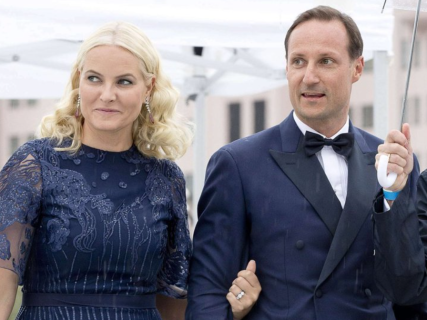
For years, Mette-Marit was the woman who should not fit into a monarchy. Now she is the queen of Norway.
The death of Harald V and the arrival of Haakon to the throne also transform the role of his wife, who leaves behind the title of crown princess to become queen consort. It is the last chapter of a story that began long before her name was associated with the Royal House: in Kristiansand, in southern Norway, where she was born on August 19, 1973, and grew up as the youngest of four siblings.
The official biography of the Norwegian Royal House describes a conventional childhood in the Vågsbygd neighborhood and a much broader educational trajectory than her later public image might suggest. Mette-Marit finished her secondary studies in 1994, spent a year as an exchange student in Australia, and later took courses at the University of Agder, the University of Oslo, and the School of Oriental and African Studies in London. Years later, she would also complete a master's in management at the Norwegian School of Management.
But before all that, there was another life.
The young woman who was outside the protocol
Mette-Marit did not come from an aristocratic family or a European dynasty. She was a Norwegian citizen who, as she would later recall, had led a youth far removed from the behaviors that were then expected of a future princess.
She was the mother of Marius Borg Høiby before meeting Haakon, and during those years, she was linked to a youthful environment and the music scene of her country that would later become ammunition for those who questioned her arrival in the royal family.
When her relationship with the crown prince began to become public, the problem was not only that Mette-Marit was a commoner. It was that she had a past that clashed with the traditional image of a future queen.
Haakon met her in 1999. According to the reconstruction published by Reuters on the occasion of his accession to the throne, they both met in the atmosphere of the Quart festival in Kristiansand, and their relationship later solidified. By then, Mette-Marit was already the mother of a child.
The relationship soon transcended the private sphere. And the reaction was immediate.
The scandal that turned her past into a state matter
The Norwegian Royal House knew that the marriage was going to provoke controversy. Haakon himself decided to defend the relationship, and Mette-Marit ended up appearing publicly before the wedding to talk about her past.
It was a decisive moment. The future crown princess then recognized that she had led a life that did not meet the ideals expected of someone who was going to enter a royal family. That intervention, far from erasing the criticisms, contributed to changing the tone of the debate.
Haakon and his father, Harald V, ended up supporting the relationship. The engagement was announced on December 1, 2000, and on August 25, 2001, the couple married at Oslo Cathedral.
The wedding had something of a historical break. Mette-Marit arrived at the Royal House not only without blue blood but with a child from a previous relationship. And yet, the institution decided to embrace that reality instead of hiding it.
The Norwegian Royal House points out that Marius became part of the family and that, subsequently, the two children of Haakon and Mette-Marit arrived: Princess Ingrid Alexandra, born in 2004, and Prince Sverre Magnus, born in 2005.
The one who had been presented for months as a threat to the reputation of the monarchy ended up becoming one of its most recognizable images.
From controversy to building a role of her own
Mette-Marit needed time to find her place. She did not have the training of a princess by birth nor a family tradition that had taught her since childhood how to navigate a court. Her education had to continue already within the institution.
The Royal House itself highlights her evolution towards very specific areas: literature, youth, social inclusion, mental health, the environment, and international cooperation.
Literature became especially her territory. For years she has participated in projects aimed at promoting reading and has traveled across Norway on the so-called Literature Train. In 2017, she also took on the role of ambassador for Norwegian literature abroad, participating in international events such as the book fairs in Frankfurt and Cairo.
Her relationship with culture is not only institutional. Mette-Marit has publicly explained her passion for reading and has made books one of the main hallmarks of her work as a member of the Crown.
She has also developed an intense activity related to HIV and AIDS. For years she served as a special representative of UNAIDS and participated in international programs, including trips to Africa focused on health and development.
This social profile allowed that woman whose private life had been the subject of scrutiny to end up building a public identity much more associated with social causes than with strict ceremonial representation.
The illness that changed her agenda
The arrival of Mette-Marit to the Crown occurs, however, at a particularly delicate moment from a personal point of view.
In 2018 she was diagnosed with chronic pulmonary fibrosis, an illness that has progressively limited her ability to maintain the usual pace of official activities. The Royal House has been communicating over the last few years various periods of leave and modifications to her agenda due to her health condition.
In June 2026, the situation reached a decisive point. The Crown Princess underwent a lung transplant, which was reported as satisfactory by the Royal House. Reuters then reported that the intervention took place after the deterioration of her chronic lung disease and a period of evaluation to determine if she could undergo the transplant.
Now Mette-Marit faces her arrival to the throne after that intervention and while she continues to recover.
The circumstance adds an unexpected dimension to her coronation. It is not just about assuming a new title: the new queen will have to play an institutional role of enormous exposure while managing a medical recovery that had already forced her to reduce her public agenda.
The family that arrives at the Crown
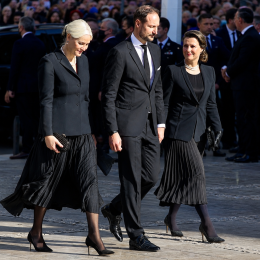
Mette-Marit does not arrive alone either. With Haakon she has built a family that represents a good part of the evolution of the Norwegian monarchy.
Marius Borg Høiby, her eldest son, was born before the relationship with the prince and was incorporated into the royal family from the beginning, although without being part of the line of succession. Ingrid Alexandra, on the other hand, now occupies a completely different position: with Haakon's arrival to the throne she becomes Crown Princess and will be the future queen of Norway.
The Royal House has presented the three children for years as part of a modern family, but the reality of recent years has complicated that image. Marius has been the protagonist of a judicial process of enormous repercussions in Norway and his situation has inevitably projected onto the institution.
The controversy adds to another that has directly hit Mette-Marit.
The past that came back to haunt her
In 2026, years after that first controversy seemed definitively overcome, the past knocked on the door of the future queen again.
The publication of emails and documents related to Jeffrey Epstein revealed that Mette-Marit had maintained contact with the American financier between 2011 and 2014. The matter provoked a new wave of criticism and forced the crown princess to offer public explanations.
Reuters points out that Mette-Marit expressed regret for that relationship and claimed that she had been manipulated. The controversy has taken on a particularly sensitive dimension because it occurs at the same time as the legal case involving her son.
The situation places the new queen in front of a paradox. The same institution that 25 years ago decided to bet on transparency regarding its past now finds itself facing a question related to her personal relationships.
The difference is that back then Mette-Marit was a young woman trying to enter the royal family.
Now she is the queen.
A different Crown
Her personal story largely explains the transformation of the Norwegian monarchy over the last few decades.
Mette-Marit did not arrive at the palace as a princess trained since childhood to represent a dynasty. She came from outside. She had to explain her past, publicly acknowledge her mistakes, learn the rules of an institution she did not know, and gradually build her own space.
Haakon also had to defend that decision against those who believed that the marriage could jeopardize the future of the Crown. Harald and Sonja ended up supporting their son and his future daughter-in-law, consolidating a tradition that they themselves had inaugurated in 1968, when the then Prince Harald married a commoner, Sonja Haraldsen.
The story seems to repeat itself, although with a fundamental difference.
Sonja had to prove that a woman without royal blood could become queen.
Mette-Marit has had to prove that a woman with a biography far from the court could represent the institution.
Featured story
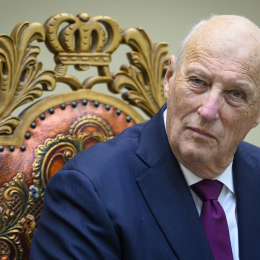
Harald V dies, the king who changed the Norwegian Crown and challenged his own dynasty for love
5 minutes
From uncomfortable princess to queen
For 25 years, Mette-Marit has gone from being one of the most questioned figures in the Norwegian royal family to becoming one of the central figures of the institution.
Her story contains almost all the elements that have transformed European monarchies: the abandonment of strictly dynastic marriages, the incorporation of people from outside the aristocracy, the permanent exposure of private life, the need to be accountable to a more demanding society, and the growing importance of social causes over ceremony.
But her arrival to the throne does not occur at an easy moment.
Norway debuts a king after the death of Harald V, an extraordinarily popular figure with a long history of institutional stability. Haakon will now have to build his own reign and Mette-Marit will have to accompany him from a much more visible position than the one she held as crown princess.
She will do so after going through two of the most difficult moments of her life: a serious illness that ultimately required a lung transplant and a controversy related to her past that has once again put her personal decisions in the spotlight.
Mette-Marit thus arrives at the Crown with a biography very far from fairy tales.
She was not born to be queen. She was not educated to be queen. Before meeting Haakon, she was a young woman from Kristiansand, she studied, traveled, had a child, and lived a life that she herself acknowledged did not fit the traditional model of a future sovereign.
Precisely for that reason, her story is so representative of the Norwegian monarchy that is now beginning a new stage.
The woman who one day had to ask to be judged for who she was and not just for who she had been finally reaches the highest place of the Crown.