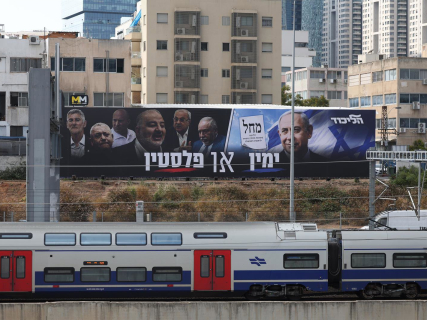

The next October 27, Israel will return to the polls in a general election that is, in practice, posed as a plebiscite on the management of Prime Minister Benjamin Netanyahu in the last four years and on his response to the Hamas attacks of October 7, 2023, considered the worst attack suffered by the country since its founding.
Below are detailed in five keys the main elements that are being decided in this election and the possible outcome scenarios:
The goal of 61 seats
The Israeli Parliament, the Knesset, has 120 seats, the same number as the ancient Great Assembly of wise men and Jewish religious leaders from the 5th century BC, so any government that aspires to a stable majority needs to reach the known figure of 61 seats.
In Israel, as is the case in Spain, citizens do not directly elect the Prime Minister, but vote for closed lists of parties or coalitions. The distribution of seats is carried out through a proportional system that treats the entire country as a single constituency and divides the total valid votes —once excluding the lists that do not achieve the minimum required support— among the 120 seats, thus setting the number of ballots needed to obtain representation.
The polls depict a very tight landscape between the two major blocks in contention. On one side, the one led by Netanyahu along with his current government partners, including the ultranationalist formations of Bezalel Smotrich and Itamar Ben Gvir; on the other, the anti-Netanyahu front, whose main reference is former Chief of Staff Gadi Eisenkot at the head of his newly created party Yashar.
3.25% threshold and pressure for useful voting
One of the constants of Israeli politics has been the strong parliamentary fragmentation, with an average of more than ten parties represented —there are ten in the current Knesset and in some legislatures it reached fifteen—. To try to reduce this atomization and facilitate the formation of coalitions, the electoral threshold has been hardened over time.
Initially it was set at 1%, it rose to 1.5% before the 1992 elections, was raised again to 2% in 2004, and was fixed in 2014 at the current 3.25%. In practice, the lists that do not reach that percentage of votes are excluded from Parliament.
In such tight elections, the choice of ballot takes on special relevance, as the votes that go to parties that do not exceed 3.25% are subtracted from the total on which the final distribution of seats is calculated. Hence, calls for useful voting have intensified in the final stretch, especially from Netanyahu's environment, concerned that support for small far-right formations, such as the People of Israel led by reserve general Ofer Winter, ends up wasted given the small distance between both blocks.
Participation, a decisive factor
This debate connects with another key element: the level of participation. Traditionally, turnout at the polls in Israel has exceeded 60%, remaining at high figures despite the growing detachment from politics and the decline in voters observed in many democracies.
Not even between 2019 and 2022, when Israelis were called to the polls five times due to the instability of coalitions, was there a collapse. In the November 2022 elections, from which the current government emerged, participation reached 70.6%.
Forecasts point to a similar figure this time, although the mobilization capacity of each block will be decisive. Polls detect a greater intention to vote in the opposition camp led by Eisenkot, while among the ultra-Orthodox parties, participation is also usually very high. The involvement of the Arab-Israeli electorate, usually lower — in 2022 it stood at 53% — will be especially relevant and all indications are that it could increase.
Results schedule and government formation
The polling stations will open from 7:00 AM to 10:00 PM on October 27 for the more than 7.3 million citizens eligible to vote in Israel, a figure clearly higher than the 6.78 million registered in the last call.
The first provisional results will be known during the early morning, and the count will be practically closed by noon on October 28, pending the votes of diplomats abroad — who already voted on October 16 and 17 —, of the military — who can also vote in advance — and of healthcare personnel. These groups use the double envelope system: they place the ballot in one envelope, which in turn is placed in another with their identifying data to allow verification.
With the scrutiny completed, the president of Israel, Isaac Herzog, will open a round of consultations lasting up to 7 days with all parties that have won seats, to whom he will ask to propose their candidate for prime minister. After these meetings, Herzog must entrust the formation of government to whoever he deems has the best chances of gathering the 61 necessary supports, without it having to be the leader of the most voted list.
The designated person will have 28 calendar days to finalize a coalition and a government program, with the option of a 14-day extension if the president grants it. Once the agreement is sealed, the new prime minister and their cabinet must undergo a confidence vote in the Knesset, where a simple majority will suffice: more votes in favor than against.
Possible scenarios after the count
The simplest scenario would be for one of the two blocks to immediately reach the desired barrier of 61 seats, which would allow for relatively comfortable governance. However, polling studies consider this outcome unlikely, unless the polls are very wrong.
Another option is for Eisenkot to prevail over Netanyahu — most polls place Yashar ahead of Likud — and manage to articulate a sufficient majority to govern. However, most analysts agree that, for this, he would need the support, at least external, of the Arab-Israeli parties, an uncomfortable hypothesis in post-7-O Israel. It could also happen that one of the two blocks manages to attract deputies from the opposing camp to surpass the confidence vote.
The possibility that generates the most concern is the blockage: that neither of the two sides manages to impose itself and the country is forced into a new electoral repetition. This scenario could materialize if both leaders fail in the confidence vote — both could attempt it if the first to receive the mandate does not succeed — or if the deadlines expire without a coalition agreement. In such a case, Israel would have to call elections again within a maximum of 90 days, during which Netanyahu would continue in office as acting prime minister.