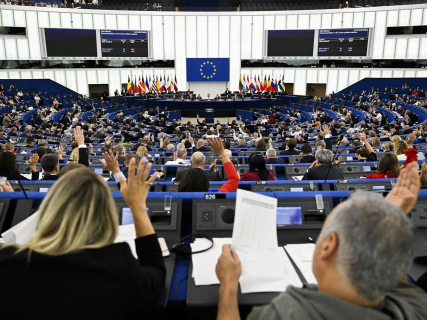

The plenary of the European Parliament has urged the European Commission this Thursday to ensure that its next anti-corruption strategy includes more stringent common rules on conflicts of interest, political financing, and revolving doors. At the same time, it emphasizes the urgency of strengthening the protection of independent bodies, journalists, judges, and whistleblowers who contribute to uncovering cases of corruption.
In a resolution approved by a show of hands in Strasbourg (France), the Eurochamber "notes that special attention must be paid" to measures affecting the enforcement of sanctions in cases of corruption, "such as pardons, amnesties, commutation of sentences, early or conditional release," in order to avoid reducing the "effectiveness" of punishments, weakening their deterrent capacity, or "eroding public trust" in the application of the law.
In this regard, the text, whose rapporteur has been the PP MEP Javier Zarzalejos, "recommends that when these measures are applied, they be subject to clear, objective, and transparent criteria and to duly motivated decisions that are made available to the public."
The European Union has an anti-corruption law that came into force in May of this 2026, but the MEPs are calling on the Commission to use the new strategy to specifically address the "evolution" of risks, with particular attention to the rise of organized crime and the impact of new technologies. At the same time, they warn that the perception of impunity can be as damaging to democracy as corruption itself, which not only harms the economy but also undermines the rule of law and strengthens crime and hostile actors.
Consequently, the MEPs propose to develop a risk map of corruption based on reliable data, strengthen training, and tighten rules on public procurement, subsidies, and transparency. They also demand greater harmonization regarding conflicts of interest, gifts, sponsored trips, asset declarations, and revolving doors, as well as more precise rules for the activity of lobbying groups.
Likewise, they advocate for establishing common criteria on political financing and transparency regarding political foundations and intermediaries, and emphasize that the institutions of the Union themselves must adhere to the highest levels of integrity in the fight against corruption.
The position of the Eurocámara aims to strengthen cooperation and the exchange of information between national authorities and Union bodies, such as Europol, the European Prosecutor's Office, or the Anti-Corruption Office (OLAF), for which it demands adequate resources and full guarantees of independence.
In addition, the resolution requests more effective instruments to trace, seize, confiscate, and recover assets and goods resulting from corruption, which feed organized crime and money laundering. It also draws attention to new risk areas, such as cryptocurrencies, and demands the gradual elimination of so-called "golden passports," through which some member states grant residence permits to citizens of third countries in exchange for large investments in their territory.