
The Government of the United States highlighted this Tuesday the "notable achievements" and "real" advances made a year after the Peace Summit held in the Egyptian town of Sharm el Sheikh, which brought together about twenty international leaders to endorse the plan promoted by President Donald Trump regarding the future of the Gaza Strip, two years after the attacks by Hamas and the subsequent Israeli military offensive.
"We are making real progress towards a demilitarized Gaza, where Palestinians can live without the dominance of Hamas and Israel can enjoy genuine and lasting security," said the spokesperson for the State Department, Tommy Pigott, on the first anniversary of the agreement signed by Trump and the leaders of Qatar, Egypt, and Turkey.
The Foreign spokesperson has repeatedly praised the occupant of the White House, whose leadership "ended a war that seemed to have no end in sight." Until the meeting in Sharm el Sheikh, the bombings and operations by Israel on the Gaza Strip had caused nearly 67,900 deaths and more than 170,000 injuries, according to the authorities of the Palestinian enclave.
"Since that historic advance, a series of notable achievements have laid the foundations for a new Gaza: a lasting ceasefire, the return of all hostages, both alive and deceased, the creation of the Peace Board and a Palestinian technocratic administration to govern Gaza, and a recovery plan with a complete budget," Pigott stated.
The spokesperson also indicated that the flow of humanitarian aid "has also increased" and that its "diversion by Hamas has been reduced," although he acknowledged that the reconstruction of the Palestinian enclave "will be a arduous process that will extend over several years, and (that) its implementation will be difficult."
Last Saturday marked one year since the ceasefire came into effect, without its second phase being activated yet. Since then, nearly 1,500 Palestinians have died and more than 5,100 have been injured in Israeli attacks, according to data from the Gaza Health Ministry, controlled by the Palestinian Islamist group, which accuses Israel of blocking the arrival of aid and basic materials, another of the commitments included in the pact.
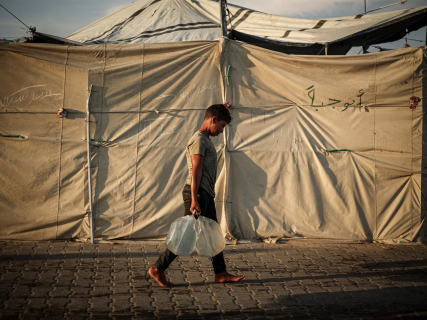
In this period, Israeli forces have also expanded the so-called 'yellow line', to which they withdrew after the agreement, and which has gone from covering around 51% of the Strip to exceeding 60%. According to Israeli Prime Minister Benjamin Netanyahu, this situation will remain until the disarmament of Hamas, which increases the overcrowding of a population practically displaced in its entirety by the devastating Israeli offensive.
In contrast, other elements of the agreement, such as the release of the kidnapped and the delivery of the bodies of hostages after the attacks of October 7, as well as the work for the creation and deployment of an International Stabilization Force, have indeed materialized or have made progress. However, these advances have not translated into a broad process that allows for the consolidation of the main political, humanitarian, and stabilization objectives planned.