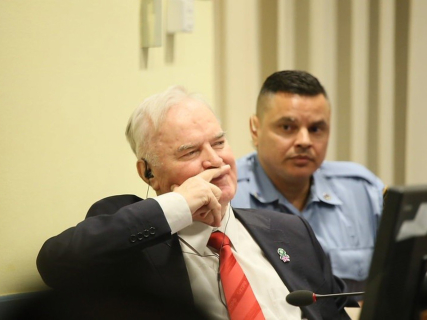

The president of Serbia, Aleksandar Vucic, has lashed out this Friday against the International Criminal Tribunal for the former Yugoslavia (ICTY), which he blames for wanting General Ratko Mladic, convicted of genocide for his involvement in the Srebrenica massacre, "to die in prison." He has recalled that Belgrade repeatedly sent requests for the former military officer to serve the rest of his sentence in Serbia due to his fragile health, requests that were denied.
"Now we have seen that The Hague wanted Mladic to die in prison; they did not want the general to die in Serbia, where he wanted," Vucic stated during a visit to an agricultural fair in the town of Osecina. In this context, he has directed harsh criticism at the court based in the Netherlands, which he has accused of "uncivilized, unprecedented, and unjustified" behavior.
During his statements, the head of the Serbian state has avoided taking a position on the proposal of his Minister of Justice, Nenad Vujic, who on Thursday suggested the possibility of granting state honors at Mladic's burial. Vucic has emphasized that the Executive is still waiting for the ICTY to send the necessary data to organize the repatriation of the remains.
"For now, I cannot say anything more because we have not received any information from The Hague," the president pointed out, insisting that the final decision corresponds to the relatives of the ex-general. "If they want Mladic to be buried in Serbian territory, Serbia will help to do it in a dignified and appropriate manner," he assured.
In the same appearance, Vucic reiterated his complaint that "the West wants to make Serbia the only guilty party" in the four conflicts in which it was involved during the wars of the disintegration of Yugoslavia: Slovenia, Croatia, Bosnia — where the Srebrenica massacre took place — and Kosovo.
"Serbian blood doesn't even matter," the president concluded in statements broadcast by the public radio and television RTS, in which he insisted that, in his opinion, the international community applies a double standard when evaluating the victims of the different sides.