
The internationally recognized Government of Yemen claimed this Tuesday before the international community to assume as a "shared responsibility" the protection of the Bab el Mandeb strait and to prevent this strategic enclave for global trade from becoming a "blackmail card of a terrorist group," in direct reference to the Houthi rebels.
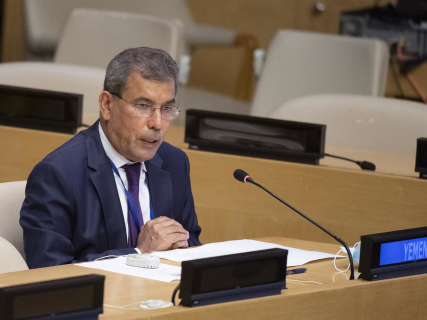
The Yemeni ambassador to the United Nations, Abdulá Alí Fadhel al Saadi, delivered this message during an emergency session of the Security Council, convened after the recent takeover by the Houthi insurgency of the Yemeni coast of the Red Sea, resulting from an offensive that began in early September.
Al Saadi emphasized that Bab el Mandeb "is territory and waters of Yemen, but the interests it protects transcend its borders and affect all countries on the planet." He added that "every ship that crosses this strait, every shipment --including energy ones-- and every supply chain that depends on it makes its security part of the economic security of countries located thousands of kilometers from Yemen."
The Yemeni representative stressed that the forces currently fighting the Houthis not only fulfill their "national duty," but are also "on the front line of defense of an international corridor on which the interests of the whole world depend."
In his speech, he warned the Security Council of the consequences of leaving Yemen alone in the protection of Bab el Mandeb. He raised "the question" of whether the international community "will recognize that protecting this interest is a shared responsibility or if it will leave the Yemenis alone to bear the cost of protecting a corridor that everyone needs (...) If it will accept that one of the most important passageways in the world for trade and energy becomes a tool of blackmail in the hands of a transnational terrorist group."
Al Saadi called on the Council for "more than a simple condemnation" of the Houthi offensive, which has already left more than half a thousand dead and 100,000 displaced, according to figures released this Tuesday by the United Nations High Commissioner for Refugees (UNHCR). Instead, he proposed "to build a deterrent system that prevents militias from turning Yemeni territory into an open platform of threats that endangers the region and the world."
The diplomat detailed that this approach must be articulated "through the effective application of the arms embargo, ending financing and smuggling networks, preventing the flow of military personnel, technology, and specialized knowledge, and strengthening the capabilities of the Yemeni state and its partners to protect the coasts, ports, territorial waters, and maritime corridors."
On the ground, the Houthis have launched an offensive in areas of the provinces of Taiz and Hodeida and, since then, have made significant advances, including the capture of the city of Mocha and areas near the Bab el Mandeb strait. This turn represents a severe setback for the internationally recognized Yemeni authorities, supported by Saudi Arabia.
These advances have expanded the rebels' capacity to influence maritime traffic through Bab el Mandeb --something they have already promised not to do-- a corridor whose relevance has increased following disruptions to transit in the Strait of Hormuz due to the offensive launched on February 28 by the United States and Israel against Iran.
The deterioration of the situation on the ground threatens to blow up the truce agreed upon in 2022, after years of conflict and despite the mediation efforts of the United Nations to reach a peace agreement that ends the war that began in 2014, which has plunged the country into one of the most severe crises on an international scale.