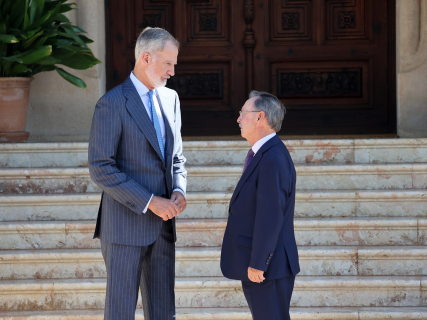

The possibility that Felipe VI travels to Ceuta is back in the debate. No one doubts that this trip will take place, although the exact moment is not clear at all. In the midst of a migration crisis, the monarch committed to the president of the autonomous city, Juan Jesús Vivas, to travel there, but the Government did not consider it appropriate at that time. Now, when there is still a long way to go before normality returns, Vivas, according to La Razón, would be pressuring for the visit to take place on September 2, coinciding with Ceuta Day. The Government has not referred to the matter again, although, as El País has published, the Executive, however, did probe through a minister the option for the king to make a call to Mohamed VI, although that contact ultimately did not take place.
The last known official position of the Government regarding the trip was expressed by Minister Óscar López on August 7. Asked after the meeting between Felipe VI and Vivas, he assured that the king will visit Ceuta "when it is appropriate" and that there will be "absolute coordination" with the Government. The message confirmed the perspective of a future visit, but avoided committing to a date and placed its organization within the framework of institutional coordination between the Royal House and the Executive.
The Constitution
The article 56.3 of the Spanish Constitution establishes that the acts of the monarch will always be endorsed in the manner provided by article 64 and that, except for constitutional exceptions, they lack validity without that endorsement. Article 64.1 provides, in turn, that the acts of the king will be endorsed by the president of the Government and, when appropriate, by the competent ministers. The endorsement also implies, according to the second paragraph, that those who carry it out assume responsibility for those acts.
In a visit of the political and diplomatic relevance that a trip to Ceuta would have in the midst of a crisis with Morocco, coordination with the Executive thus acquires a particularly relevant dimension.
The precedent of 2007 and Morocco's sensitivity
The possibility that Felipe VI travels to Ceuta has also reopened the memory of the visit of Juan Carlos I and Queen Sofía in November 2007. That trip provoked a strong diplomatic reaction from Morocco, which expressed its rejection and called its ambassador in Madrid for consultations.
This precedent helps to explain why the current visit is also analyzed in terms of bilateral relations. The eventual presence of the head of State in Ceuta would have an evident institutional significance, but it would also arrive at a particularly sensitive moment after the border crisis of the last few weeks.
The very information from El País about the survey for a call to Mohamed VI places in that same context the caution with which any direct initiative from Felipe VI related to Morocco is being handled.