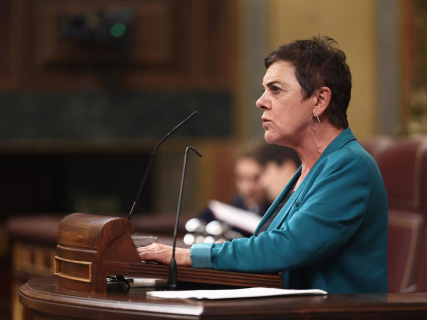

The spokespeople of Bildu and the BNG in Congress have questioned this Thursday the management of the Government of Pedro Sánchez in the crisis triggered in Ceuta by the massive entry of migrants on July 30 and 31, and have cast doubt on the version of the Executive that shifts responsibility to Morocco.
Mertxe Aizpurua, from Bildu, has admitted that the Government "has not been up to the task" in this crisis because, a month after the massive arrival of people, "the humanitarian crisis continues, the social situation in Ceuta remains complicated, and the political and international implications of this triple crisis remain unclear and unexplained."
"With an unresolved humanitarian crisis and a latent social crisis, the political, diplomatic, and international crisis cannot be overlooked. And your Government has not yet provided a sincere and credible response to it," emphasized the abertzale parliamentarian.
No one is so naive as not to see Morocco
In her view, "no one is so naive as to believe that a massive entry like the one that occurred in Ceuta was generated spontaneously through social networks." As she has emphasized, "no one is so naive to think that Morocco, none of its governmental or state structures had anything to do with what happened, and that they didn't even know what was happening to be able to convey the information to a supposed 'European partner'."
Aizpurua claims to understand "the risks of pointing to Morocco and confronting a regime that could repeat a similar action," but argues that "what is not acceptable" is to absolve it of blame and present it as a "reliable partner." In this context, she has suggested to the Executive that "perhaps it is time to recalibrate its position towards Morocco and rectify its mistake with the Sahara."
In her analysis, there are only two scenarios: either the Police and the CNI did not inform the Government of the possible implication of Morocco, or the Executive was aware and chose to hide it, exonerating Rabat. "Both options would be of extreme gravity in democratic terms and deserve responses commensurate with that gravity --she pointed out--. That is why we expect them to act with transparency and clearly explain what happened, what they know, what they do not, and make the appropriate decisions to clarify the necessary responsibilities."
Furthermore, he has taken advantage of his intervention to reproach Alberto Núñez Feijóo for the PP's refusal to welcome the migrants arriving in Ceuta in their communities and the climate of tension that, in his opinion, is being fueled throughout the State. "They are feeding a very dangerous monster --he has warned--. And you are so irresponsible and incapable that by the time you want to stop it, it will have completely swallowed you."
"It could hardly have been done worse"
On the other hand, the BNG deputy, Néstor Rego, has reproached the president that it is "evident" that the Government's action in this crisis "could hardly be worse," by combining, he said, a lack of foresight and reaction, a lack of effective responses, and a permanent feeling of "lack of control" and "discoordination."
Rego has also referred to the existence of police reports that would not have reached the Executive, referring to the one prepared by the National Center for Immigration and Borders (CENIF), whose content would go against the version defended by Sánchez regarding Morocco's role in the massive entry of migrants into Ceuta.
Moreover, the Galician nationalist deputy has detailed that, in his opinion, it is evident that the main beneficiary of this destabilization operation is Morocco, interested in reinforcing its control over the Strait, as well as the United States and Israel, in response to the Spanish Government's foreign policy.
"They have arrived late and poorly"
In the same critical line, the Compromís deputy integrated into the Mixed Group, Águeda Micó, has censured Sánchez for continuing to defend Morocco, which she has defined as a "submissive" ally of Israel and the United States, when, in her view, this massive entry into Ceuta aims to make it seem like an "invasion" to "change a leftist government for a right-wing one."
Micó has also accused the president of having acted "late and poorly" in the Ceuta crisis and of not having done "everything in his power" to offer an adequate solution. At the same time, she has directed her reproaches at the PP for "inflaming the atmosphere" and going to the affected areas to "provoke more pain."