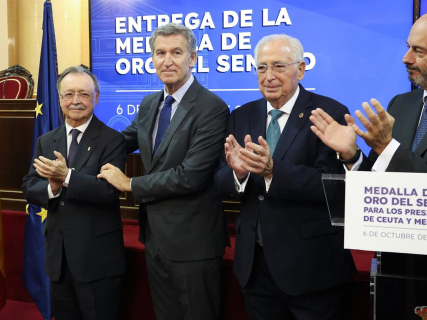

The Senate has granted this Tuesday its Gold Medal to the presidents of Ceuta and Melilla, Juan Jesús Vivas and Juan José Imbroda, as recognition of their political careers and as a gesture of institutional support to the two autonomous cities after the migratory crisis recorded last July.
During the ceremony, both leaders emphasized the Spanish identity of Ceuta and Melilla and the importance of reinforcing their protection and the presence of the State. "Ceuta is not for sale, Ceuta is defended, Ceuta is Spain," Vivas emphasized.
In the same vein, the president of the Senate, Pedro Rollán, highlighted that the distinction not only rewards the work of Vivas and Imbroda but also extends to the inhabitants of the two cities.
"Ceuta and Melilla are the place where Spain begins, where the heart of Spain beats stronger," Rollán stated, who described both as "bastions of sovereignty, of Europeanism, and of coexistence" and demanded the "permanent and unconditional commitment" of the State to them.
The migratory crisis of July focuses the recognition of Ceuta
A good part of the event revolved around the situation that Ceuta is experiencing after the events of July 30 and 31, when, according to Vivas, "around 100,000 people were used to breach the borders and, therefore, to breach territorial integrity," leaving a "dramatic and painful mark" and causing the city to remain "absolutely far from normality" two months later.
The Ceuta president has demanded the return to Morocco of all the people who entered massively and irregularly during those dates and has estimated that around 15,000 still remain in the city.
"Ceuta has changed. Ceuta is not the same as it was on July 29," Vivas pointed out, who denounced a decrease in "freedom," "tranquility," and "justice," as well as the deterioration of public services, security, and the local economy.
In this context, Rollán has called for accountability and to identify those who incurred in "neglect of duties" during the crisis, while valuing the work of the State Security Forces and Corps and of Vivas himself.
"He was where he needed to be, on the front line, protecting the city and his own, putting the general interest before any other personal circumstance," the president of the Senate emphasized.
Criticism of the Government and demand for more presence from the State and the EU
Vivas has attributed to the Executive the responsibility for not having prevented what happened and has defended that the state authorities should have heeded the previous warnings, acted after the precedent of May 2021, and put "all the means and capabilities of the State" so that Ceuta could regain normality.
In his view, what happened "could have been avoided" and the fact that it was not constitutes a "tremendous injustice." For this reason, he has demanded that the people of Ceuta be able to "know the truth" of what happened and that the foundations be laid for there to be "a before and an after."
Among his demands, he has called for greater involvement from the European Union (EU) and the State in areas such as defense, security, justice, health, and education, in addition to a border "securely fortified."
He has also requested a mechanism that allows for a response that is "agile" and effective in crises like that of July and has insisted that Spain's sovereign decisions regarding Ceuta and Melilla "must not be conditioned by Morocco."
"We want good relations with Morocco, but good relations that are based on respect. Without respect, there can be no good relations," he has emphasized.
Unity of Ceuta and Melilla in the defense of their Spanishness
Imbroda, for his part, has also attacked the Government's actions in border management and has accused the Executive of "inability, lack of foresight, frivolity" and "irresponsibility" during the events of July.
The president of Melilla has cited as examples of support for Ceuta and Melilla the social mobilization in Spain, the upcoming visit of the Kings, and a resolution from the European Parliament that, in his opinion, implies that "Europe supports the future of both cities," providing "certainty," "confidence," and "stability."
In addition, he has claimed the Spanishness of Ceuta and Melilla and has rejected the arguments that, according to him, question their belonging to Spain. "Melilla is Spain without any kind of ambiguity and without any kind of complex," he has proclaimed.
Imbroda has also linked the future of Melilla to the elections on November 29 and has expressed his desire for the leader of the PP, Alberto Núñez Feijóo, to be the next president of the Government, considering that he has demonstrated his "commitment" and "loyalty" to the two cities.
In this same line, Rollán closed the event asking for a Government of the Nation "that is up to the circumstances" and defended that the recognition serves so that the situation of Ceuta and Melilla "does not fall into oblivion".
Controversy over the absence of the PSOE at the event
No representative of the PSOE attended the tribute held in the Upper House, an absence that has been harshly questioned by the PP.
The general secretary of the popular party, Miguel Tellado, criticized the PSOE's decision, which he described as "another disdain" for Ceuta and Melilla.
"Another disdain for Ceuta and Melilla and for the compatriots who live there. There are 54 days left until we have a government that promotes unity and concord and banishes the confrontation that Sánchez fuels," Tellado wrote on his account on the social network 'X'.
The members of the PSOE in the Senate Table had already voted against granting the Gold Medals to Juan Jesús Vivas and Juan José Imbroda.
According to socialist sources, their rejection is due to the fact that, in their opinion, it is "a partisan use of the Upper House again" and "there are no precedents to justify it." "Previously it was given to those who were presidents of the Senate and on the 25th anniversary of democracy, to those who had been regional presidents. There is nothing more," they argued.